Showing posts with label best-books. Show all posts

Sunday, December 31, 2023

Best Books I Read: 2023

Picking up the old habit of writing actual detailed book reviews has been tough for me, both in finding the time and also in thinking of things to say. I read a lot of business, history, and economics books this year, and while they have been very useful and educational, with books like those I have the problem of either wanting to write a million words or just jotting down 2 sentences. I know that actually putting in effort and recording my thoughts will be of tremendous help to future me, but the lure of laziness is eternal. I have decided to compromise by linking to other reviews I found useful when getting my own opinions in order; I used to consider this cheating but as I've gotten older I've realized the benefit of bouncing my own thoughts against everyone else's out there.

Below are my top 5 for each category, in alphabetical order by author as always. For fiction, my top pick this year is Lonesome Dove, the Great Texas Novel. For non-fiction, I really can't decide between Barbarians at the Gate (the best Wall Street book ever), Mexico: Biography of Power (a truly unique history), and Thunder Below! (a superb war memoir), with Barbarians at the Gate probably taking the crown. Reading too many good books is better than reading too few!

As always, my Goodreads, which has the full versions of these reviews, is here.

Fiction:

Dashiell Hammett - Red Harvest. The original hard boiled detective novel. I had previously read The Maltese Falcon back in 2012, but this slightly earlier novel, Hammett's first, is actually quite different in fundamental ways: darker, less psychological, more action-focused, although there are not quite as many shootouts as you might think. It's inspired many films - the Coen Brothers' Blood Simple, Kurosawa's Yojimbo, Rian Johnson's Brick, etc - but none of those movies really capture what makes the novel distinct: the unadorned prose, the incredibly rapid pacing, and the single-mindedness of the unnamed protagonist as he runs around the city getting into gunfights and unraveling corruption schemes. There's a common trope about horror movies that modern cell phones make most of them too implausible; this novel is basically 100 years old, and while there are maybe a few too many large-scale shootouts for this adventure to escape front page notice today, the bones of the story are strong enough that there are surprisingly few aspects (the Prohibition setting, the endemic labor violence, a town being controlled by a mining corporation) that you couldn't cleanly update to a contemporary time period, which is why it's still so influential today.

Larry McMurtry - Lonesome Dove. Lonesome Dove is unquestionably the Great Texas Novel - even though half the novel takes place outside our borders, the implicit moral is that leaving here to chase after an unknown paradise is a bad idea - and more than that, it's one of the finest character-focused novels I've read. Rarely do you read such a plainspoken epic whose power comes so overwhelmingly from the simple interactions of the people in it; while most novels come off as overtly written in some way, with visible signs of the author's hand guiding the narrative or putting words in everyone's mouth, somehow Lonesome Dove seems to emerge organically from the landscape and the characters. When I bought my paperback copy in a used bookstore several years ago the proprietor stopped to tell me that I was in for a real treat and he was right; it's rare these days that I read a novel with such a truly affecting story.

Álvaro Mutis - The Adventures and Misadventures of Maqroll. An extremely long, almost overwhelming chronicle of solitude, friendship, and the voyages in between. It's composed of 7 interconnected novellas told from a variety of perspectives, all revolving around the singular character of Maqroll the Gaviero (a pun meaning both "the Lookout" and "the Seagull"), perhaps the most melancholy sea adventurer in literature, as well as his friends Abdul Bashar and Ilona Grabowska, set in various Latin American and European locales at undefined moments in the immediate postwar era. Maqroll is less a citizen of the world than a visitor to it ("a hostage of the void", in his phrase), and the novel is filled with his wanderings: long journeys through fantastic landscapes, ludicrous illicit schemes hatched with unreliable partners in the shadow of hostile authorities, improbable cocktails consumed in dire living conditions, doomed love affairs accompanied by recondite literature, and, most of all, long meditations and appreciations for the power of the eternal ties that bind certain people to one another across oceans and continents, in any circumstance, despite any obstacle. Mutis is one of those one-and-done authors who earned his way into the pantheon of world literature on the strength of a single great work; he has crafted such a rich world for Maqroll and his companions here that despite this novel's great length, you finish it feeling like you've only gotten a glimpse of a nearly infinite tapestry of life.

Alexander Prokhanov - Chechen Blues. A harrowing fictionalized account of the beginning of the First Chechen War, which is not a war I'd known much about but has a grim reputation in Russia as a prime example of the brutality, dishonesty, and ineptitude characteristic of the new regime after the collapse of communism. There are two main narratives: one follows the everyman Captain Kudryavtsev in an armored brigade that's part of the first wave of Russian forces on an ill-fated mission to secure the rebellious Chechen capital of Grozny; the other follows Yakov Berner, a Boris Berezovksy-ish oligarch, back in Moscow, and his efforts to extend his corporate empire and his political influence via shady business deals. While Kudryavtsev and the other survivors of a Chechen ambush attempt to remain alive in the ruins of the city after the destruction of their brigade, their misfortune is just another opportunity for Berner to profit as he betrays his business partners (and the Russian people overall) for the opportunity to make a buck on an oil pipeline deal. Written in 1998 but not translated into English until 2022, this is a lyrical, angry, only barely allegorical representation of the Saturnalia of corruption that was endemic in the Yeltsin era.

Neal Stephenson - Termination Shock. The second of the newer Stephenson novels I've read this year after Seveneves, Termination Shock was much more consistently enjoyable all the way through. I think its more limited science fictional scope - a near-future scheme to temporarily reverse global warming via geoengineering with giant guns that fire sulfur into the upper atmosphere - made it easier for Stephenson to concentrate on writing a satisfying narrative with coherent characters than the overwhelming 7000 AD setting of the back third of Seveneves, but it doesn't hurt that the book is more immediately relevant, which also helps the infodumping to be focused and plot-related. It's tricky to write a novel about climate change that gets both the science and the politics basically plausible, but Stephenson pulled it off, and most miraculous of all, somehow the ending doesn't even feel rushed! This is the nearest successor to Cryptonomicon I've seen from him, and while the problem of climate change in real life is obviously bigger than the novel, I have rarely seen it portrayed so well in fiction.

Non-Fiction:

Bryan Burroughs, John Helyar - Barbarians at the Gate. I knew Barbarians at the Gate would be good, but it surpassed my expectations. It's probably the single most widely-praised business book of all time, along with maybe John Brooks' Business Adventures, and it deserves every bit of its acclaim. A good business book will present a business story or problem, explain why it mattered to the people involved, and most of all, connect it to something the broader world at large would care about, especially all-too-human feelings like greed and hubris. It's much more difficult than it seems to adequately convey the relationship between an abstract financial maneuver and the human motives underneath, particularly when it involves complex financial chicanery of the sort that takes a phalanx of lawyers and accountants to sort out, so it is nothing short of a miracle that Burroughs and Helyar's chronicle of the 1988 leveraged buyout of RJR Nabisco for $25 billion, the largest in history (that's $64 billion in 2023 dollars) is not merely readable but thrilling. Even if you aren't interested in the world of 80s finance, reading this will give you invaluable insight into the modern business landscape, for example Elon Musk's increasingly frantic behavior these days after his own LBO of Twitter.

Sebastian Edwards - The Chile Project. This is probably the best single-volume history of Chilean economic policy from Allende onwards out there. A half-century after Pinochet's coup on September 11th, 1973, his ensuing horrific military dictatorship in Chile is typically only ever referenced in the US in the context of someone vaguely complaining about neoliberalism, that most all-encompassing yet indescribable of modern political typologies. I love pointless definitional debates about what that term "really" means as much as the next guy, but every once in a while it's nice to step back, put the nitpicky logomachia on hold, and reflect on what actually happened: how what had formerly been an unexceptional middle-of-the-road Latin American backwater dodged the twin threats of both a socialist meltdown and brutal authoritarianism to gradually become the richest country in the region. Edwards, who as a 19 year-old college student actually worked in Allende's price control directorate, discusses the economic policy advocated by the "Chicago Boys" of the title, the US-trained and influenced economists primarily responsible for guiding the Chilean economy during the many periods of political turmoil after the coup, surprising me with the well-documented conclusion that neoliberalism actually worked out fairly well for Chile.

Eugene Fluckey - Thunder Below!. Thunder Below belongs in the very first tier of war memoirs, both for its writing style as well as for the feats described. The memoirs of a submariner are going to be very different than those of a rifleman or helicopter pilot, but there are many scenes here that are every bit as harrowing as a risky landing or a sudden tank charge, as well as some of the most insightful and perceptive war writing you will read. Fluckey was the captain of the USS Barb, the submarine which set the record for greatest amount of enemy tonnage sunk during World War 2 over the course of 5 war patrols in the Pacific theater from May 1944 to August 1945. He pioneered brand-new technologies and tactics, like sub-mounted rocket batteries for shore bombardments, infrastructure demolition via amphibious assault (the only ground combat on the Home Islands in the whole war), risky Aboukir Bay-style convoy attacks off the Chinese coast, and at one point he hits his mission quota of enemy ships destroyed by literally ramming the final victim to finish it off, yet suffers barely a scratch.

Enrique Krause - Mexico: Biography of Power. This history book is the great man theory of history taken to the extreme, perhaps the ultimate example of trying to understand a country through the lives of its leaders from the conquistadors to the 1990s. While Mexico is right next door to us, as a Texan I only learned of its history very tangentially, via compressed descriptions of Santa Anna and elementary school trips to the Alamo. Krause presents Mexico as both a parallel nation to the United States in its efforts to forge a distinct identity from a multi-ethnic population, as well as its own unique world in how its rulers attempted to ride or direct the currents of ideology according to their own interpretations of the national destiny (which coincidentally often overlapped their own destiny). I actually learned about major figures like Santa Anna, Benito Juarez, Profirio Diaz, Pancho Villa, Emiliano Zapata, and more in the context of their goals and backgrounds, along with how they related to each other. While there is not much in the way of descriptive statistics here, that is an extremely minor complaint given that this is a series of biographies; the only real gripe I have is that the book is nearly 30 years old and I would love to see a current edition covering the post-PRI era. After finishing this book, I think it is almost criminal that Americans aren't given a better understanding of Mexican history, especially as the demographics of our countries become ever more closely entwined, and the unfortunate tendency of presidential power towards caudillismo makes a clearer place for itself in our politics as well.

James B Stewart, Rachel Abrams - Unscripted. I've never seen HBO's Succession, but the show's patriarch (Brian Cox's character) was in large part based on Sumner Redstone, the recently deceased, extremely colorful owner of Viacom/CBS/Paramount. Stewart has long been one of my favorite business writers thanks to Den of Thieves and especially Disneywar, so this was a must-read for me. He and his fellow NYT journalist Abrams, who helped break the Harvey Weinstein story, present an enthralling account of a rapidly decaying Redstone caught in an incredibly lurid sex/money/power maelstrom as his friends, family, and "female companions" tried to seize their share of his estate in his final years of life, along with the interrelated downfall of Les Moonves, the serial sexual assaulter head of CBS. You can see why this book is already being optioned for its own Succession-type series (it's even already divided into seasons and episodes instead of sections and chapters), but it's all the more worth reading because of the massive effects these events had on the broader entertainment industry.

Tuesday, January 3, 2023

Best Books I Read: 2022

For some reason I read a lot of Greek/Roman mythology and adjacent material this year. It ended up being very useful, since a lot of what I read flowed into each other, and seemingly unrelated connections appeared all over the place. I also got back into writing reviews, a covid casualty that I sorely regret. Writing reviews is not only a great way for me to put my thoughts down, it helps me remember what I read, practice my prose style, and just have fun thinking out loud about all the stuff I read. I will do a better job keeping up next year!

For fiction, my single pick this year would be Manzoni's Betrothed, a truly tremendous novel. Sophocles' The Theban Plays would be right behind it; the classics are classics for a reason!

For nonfiction, DeLong's Slouching Toward Utopia had more great facts per page than almost anything I've read in the past few years. Mears's Very Important People is an honorable runner up, as the study of beauty and status will never stop being fascinating.

Fiction:

James Clavell - King Rat. As I was reading this absolutely tremendous prison novel I was mentally comparing it to other famous prison novels I’ve read (The Count of Monte Cristo, Papillon, Kolyma Tales, Darkness at Noon, etc), and concluded that it ranks right up there among them, and the fact that it’s primarily autobiographical only makes it more vivid and impressive. It’s set at the Japanese prison camp of Changi in the eastern part of the island of Singapore towards the end of World War 2 and follows author stand-in Peter Marlowe as he deals with the meager rations, harsh discipline, squalid conditions, and most of all the black market economy of the camp, masterminded over by the King, an American corporal who has traded his way into an exalted position in the hierarchy of prisoners, at the price of the general resentment of his fellow captives. What gives the book its power is much the same as what made those other books such classics - the rich details of the setting, the vivid characterizations, the suspenseful plot, and most of all the claustrophobic feeling of being absolutely at the mercy of a seemingly unbeatable oppressor. Even the bittersweet ending, where several characters discover that the relief of liberation isn’t actually welcome news, and now they have to return to their old places in the outside world, is flawlessly done. This is the start of his epic Asian Saga, which gets such glowing reviews that I guess I will have to check out the other novels as well.

Alessandro Manzoni - The Betrothed. If there is one rule I’ve learned from reading a lot of Great Novels, it is that they almost always really do live up to their reputations, and this is no exception. In fact this is not only the Great Italian Novel, it is one of the great novels of world literature. Written in 1828 and set in the north Italian countryside around Milan in 1628, it’s the story of two young lovers who battle plague, war, famine, local tyranny, the corrupt religious establishment, and seemingly every obstacle fate could devise along the way to consummating their betrothal. Manzoni himself is a real pleasure to read. Like all great authors he’s totally self-indulgent, stopping in the middle of the story to plug his buddy’s poetry, or inserting several long but fascinatingly perceptive disquisitions on the economics of bread shortages, or delivering whole chapters worth of backstory for a side character whenever he pleases. But he’s never less than superb as a storyteller, managing to keep up several gripping narratives at the same time as he’s plumbing deeply into the souls of his characters. And to that point, this might be one of the finest religious novels ever written, as Manzoni takes the ideals of Christianity and their effect on ordinary people extremely seriously, while at the same time treating the Church hierarchy with an amused and skeptical (but never cynical) eye. There is a scene of conversion and repentance that brought me to tears. Great novels create whole worlds inside themselves, and this is one of the greatest.

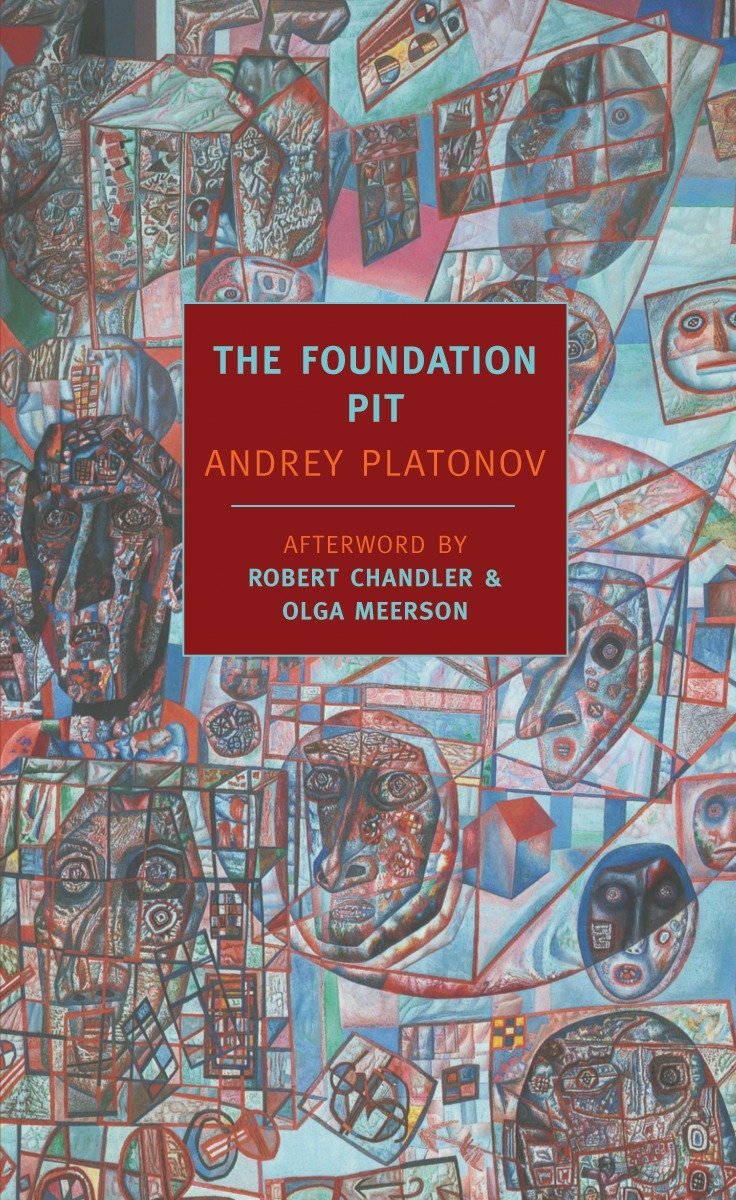
Andrey Platonov - The Foundation Pit. In the long and storied history of Depressing Russian Novels, The Foundation Pit deserves a special mention for just how especially bleak it is. It’s also incredibly weird, even in translation. Written in 1930 but not published until decades later for reasons that are obvious when you read it, Platonov’s tale of the lives of construction workers building a pit for the foundation for a new public housing development in an environment of incredible poverty and administrative failure is at once both narcoleptically mundane and intensely surreal - quotidian scenes where a worker does nothing but gather fallen leaves as a metaphor for the meaningless of the universe run into action scenes with an anthropomorphic bear who murders class enemies and works as an ironsmith. The language is also incredibly strange, a mix of supercharged party-speak and hypnotically flat poetry; a true hybrid of both socialist realism and magical realism that must have caused some real headaches for translators Robert & Elizabeth Chandler and Olga Meerson. The result is a hauntingly grim satirical novel about the lost potential in the Soviet Union’s attempts to implement socialism, which I would rank right next to Francis Spufford’s Red Plenty. Thomas Seifrid wrote a very useful companion guide to the novel which you can find online if you want to catch all of the symbolism etc, but it’s not really necessary, it’s best to just dive right into this odd, melancholy novel.

Ovid - Metamorphoses. One of my favorite books when I was younger was Edith Hamilton’s Mythology. I have reread it through the years, and its seemingly comprehensive survey of the vast landscape of Greek mythology was compelling each time. Then I read this. To my surprise, Hamilton says in the Preface to Mythology that she had such a dim view of Metamorphoses that she refused to use it as a sourcebook, preferring other authorities. Her main complaint was that he didn’t take the myths seriously as myths, accentuating the crowd-pleasing sex and violence at the expense of a sincerely religious element she felt was essential to truly appreciating them. Well, even if Ovid wrote this epic poem as blatant reappropriation of Greek culture and pro-Roman propaganda, treating the myths as mere building blocks for his own construction and not sacred works in themselves, it’s spectacular. It doesn’t have a central character, an overall plot, or even a moral (besides the obvious one in the title: get used to things changing), but there are so many captivating little stories loosely strung together that you can see why this became the standard collection of Greek myths for most of modern history, inspiring legions of derivative works to the point where it became the wallpaper of Western culture. Horace Gregory’s 1958 translation is perfect, leavening his flawless prose with the vivid metaphors which we associate with the ancient epics, and inserting all these neat turns of phrase. I am not sure that this will replace Mythology in my mental library, exactly, but Ovid’s irreverent and playful attitude towards his subject material strikes me as something I might have appreciated more as a child than Hamilton’s solemn veneration, despite (or maybe because of) the more adult presentation. But why choose?

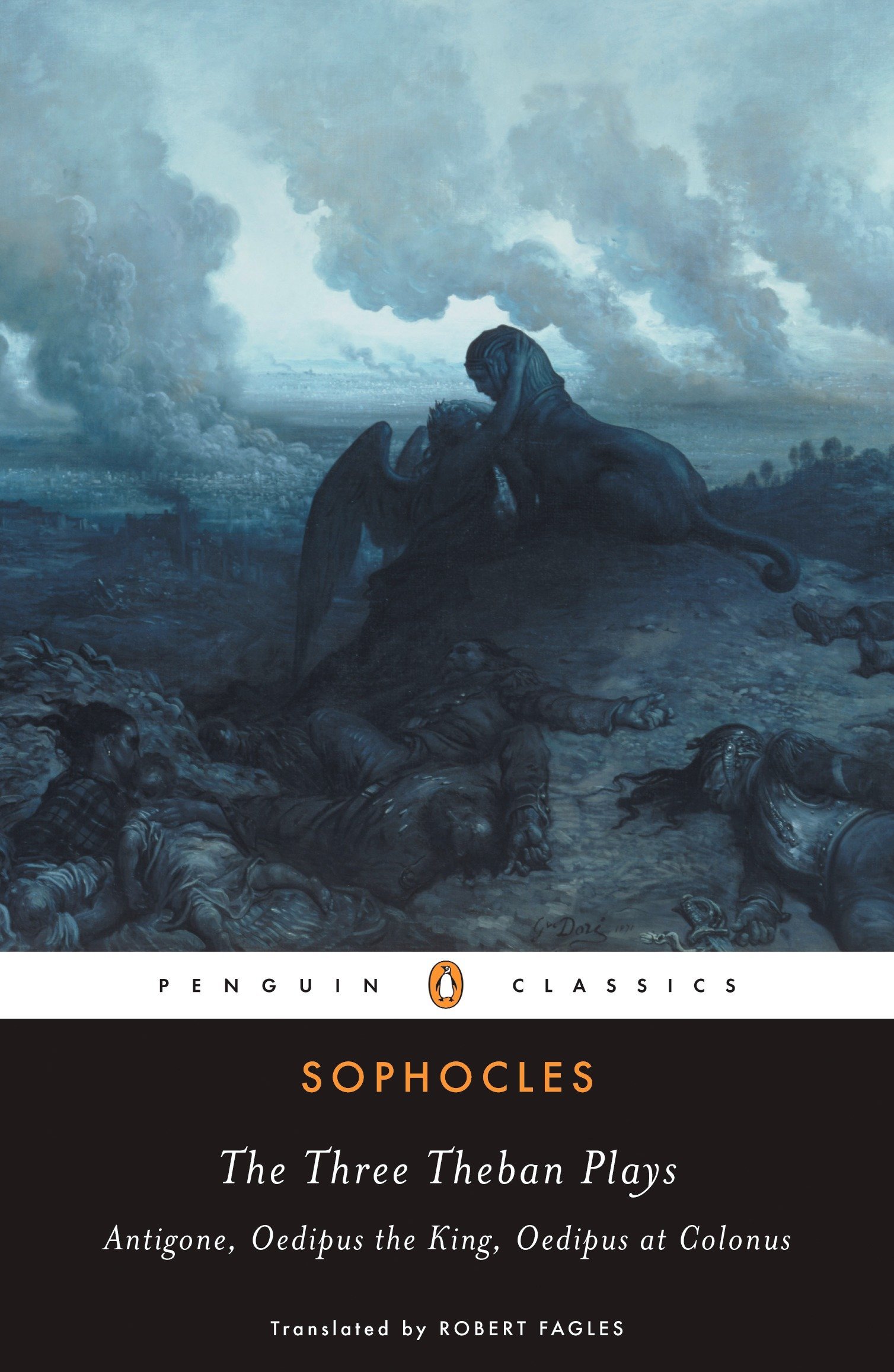
Sophocles - The Theban Plays. I had seen stage performances of both Oedipus Rex and Antigone before, but had never actually read them, or experienced the middle play, Oedipus at Colonus, at all. I actually read this in two different translations back to back: Bryan Doerries’s 2021 rendition and Robert Fagles’s more venerable 1982 version. Both have their strengths, though I preferred Fagles (as well I should, given his tremendous work on The Iliad, Odyssey, and Aeneid). I don’t feel I have much new to say about these foundational works of Western culture, but I will say that I was surprised at how affected I was by Oedipus’s relationship to his guilt over the course of the plays. Part of it was timing: I had been discussing Camus recently with family and friends, and he has a famous line about coming to terms with the absolute indifference of the universe to human affairs that “One must imagine Sisyphus happy”. All well and good, if your model of humanity is a man punished for trying to cheat death, but could it be possible to imagine Oedipus happy? Someone condemned for a crime he didn’t consciously commit, punished for acts he had no way of knowing were wrong, and sentenced despite the universal agreement that fate simply dealt him a raw deal? I’d like to see Camus explain that one! Fagles’s translation in particular really brings out the complexities of each of the characters, especially their continuous conflicts of loyalty to family, city, custom, law, and divine will, and by the end of Antigone (which was actually written first), I ended up agreeing with the consensus: Greek tragedies simply can’t be beat. What a fool I was!

Non-Fiction:

Brad DeLong - Slouching Toward Utopia. I’m sure you’ve seen those charts of historical world GDP per capita: almost perfectly flat for 99% of human history since the dawn of time, rising gradually only in the 19th century, and finally turning nearly vertical by the present day. That line represents humanity’s gradual escape from the grinding poverty of our prehistoric past into a world of, if not plenty, at least some, and if not for everyone, at least more and more, and explaining its shape - not just how but why it went from flat to exponential, changing the story of our species from questions of bare subsistence and survival to wealth and abundance - is one of the central questions of both economic history as well as any progressive politics of the future. Now, to fully describe the economic history of the entire planet over even a single year is an impossible task, let alone the “long 20th century” of 1870 to 2010, but if any mortal could even dream of such an Olympian feat, it’s DeLong. This stretch of time, from 1870 - when globalization, the industrial research lab, and the modern corporation appeared - to 2010 - the trough of the Great Recession - is populated with many disputatious characters and diverging trends, but DeLong sees the overarching narrative as a conflict between Friedrich Hayek’s market capitalism and Karl Polanyi’s social justice, refereed by John Maynard Keynes’s mixed economy, reaching an apex in the postwar mixed economies and shambling to a nadir after the Great Financial Crisis. And yet even that nadir represents a fantastic triumph of human achievement, vast numbers of people lifted out of poverty and even into luxury, and we can be confident that the story’s not over yet, even if we never reach the promised land. I’ve been reading DeLong’s econ blog for nearly 20 years, enjoying all the preview snippets of this magnum opus he would from time to time, and it was well worth the wait.

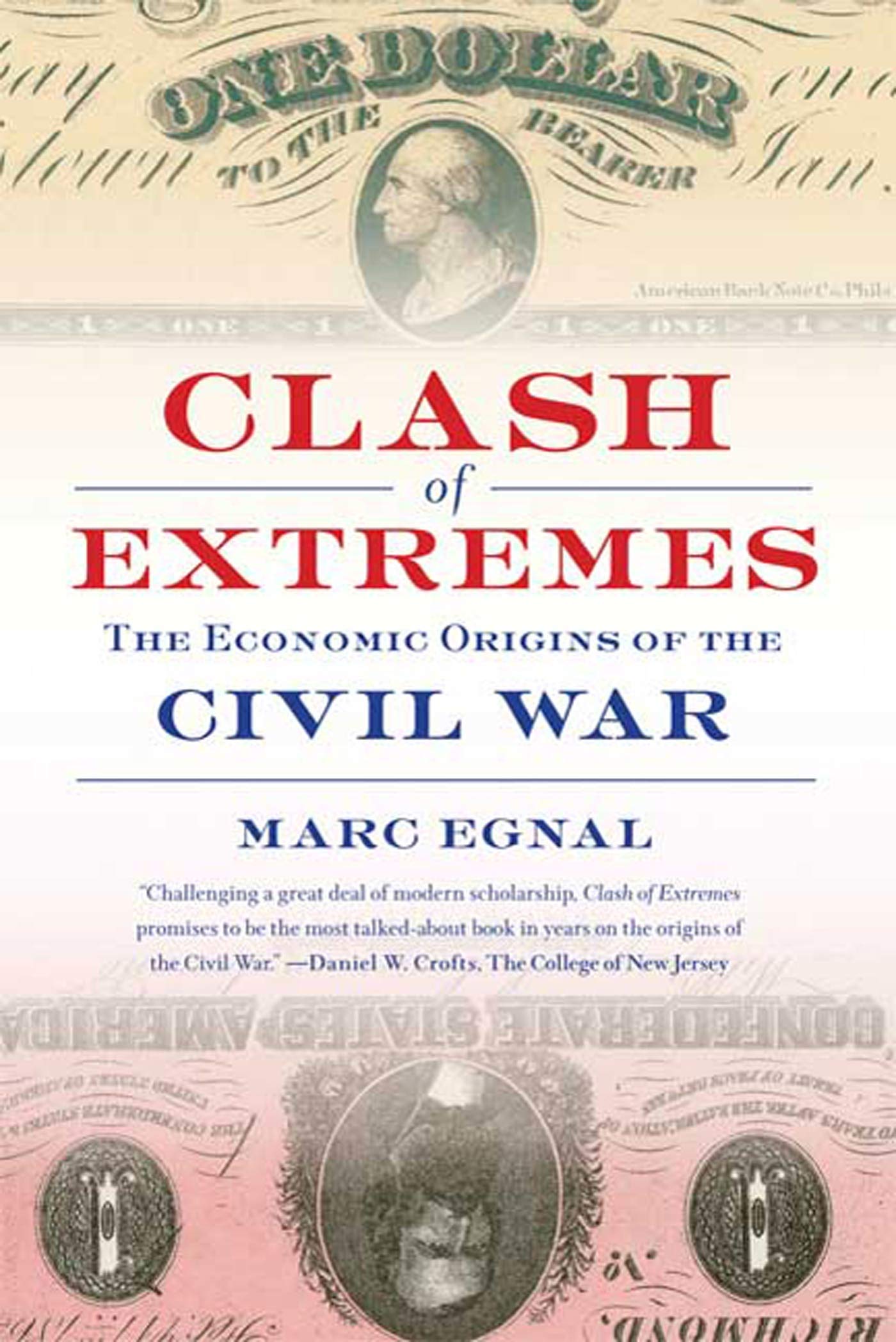
Marc Egnal - Clash of Extremes. Anyone who has passed high school US History is beyond tired of the “What caused the Civil War?” question, but “What political and economic factors made the Civil War inevitable?” is still a worthy topic of interest. If you have read Eric Foner's Free Soil, Free Labor, Free Men chronicling the formation of the Republican Party then you’ll be familiar with the political background, while James McPherson's Battle Cry of Freedom devotes a good number of its pages to the social context; this book presents the economic side of the story, analyzing how changing patterns of production, transportation, and trade in the disparate regions of the country gradually polarized the formerly ideologically incoherent national Whig and Democratic parties into implacable opponents, making some sort of conflict unavoidable as the North and Midwest boomed while the South stagnated. While not an economic determinist in the mold of Charles & Mary Beard, Egnal presents reams of data showing how the explosive growth of the Midwest (particularly areas adjacent to the Great Lakes) contrasted with declining soil fertility in the South, permanently upsetting the delicate regional balance of power and established coalitions in Congress. Peter Turchin’s Ages of Discord had a fascinating section trying to apply Structural Demographic Theory to explain why the Civil War had to happen in the 1860s specifically and not the 1850s or 1870s; Egnal agrees that the Southern plantation owner class who controlled the region’s politics were presented with the grim but inescapable choice of either forcing the issue with the North in the waning moments of their strength, or meekly accepting terminal decline relative to the rest of the country. The implicit lesson that those who run a slave economy often become slaves to that economy themselves in turn is well-taken.
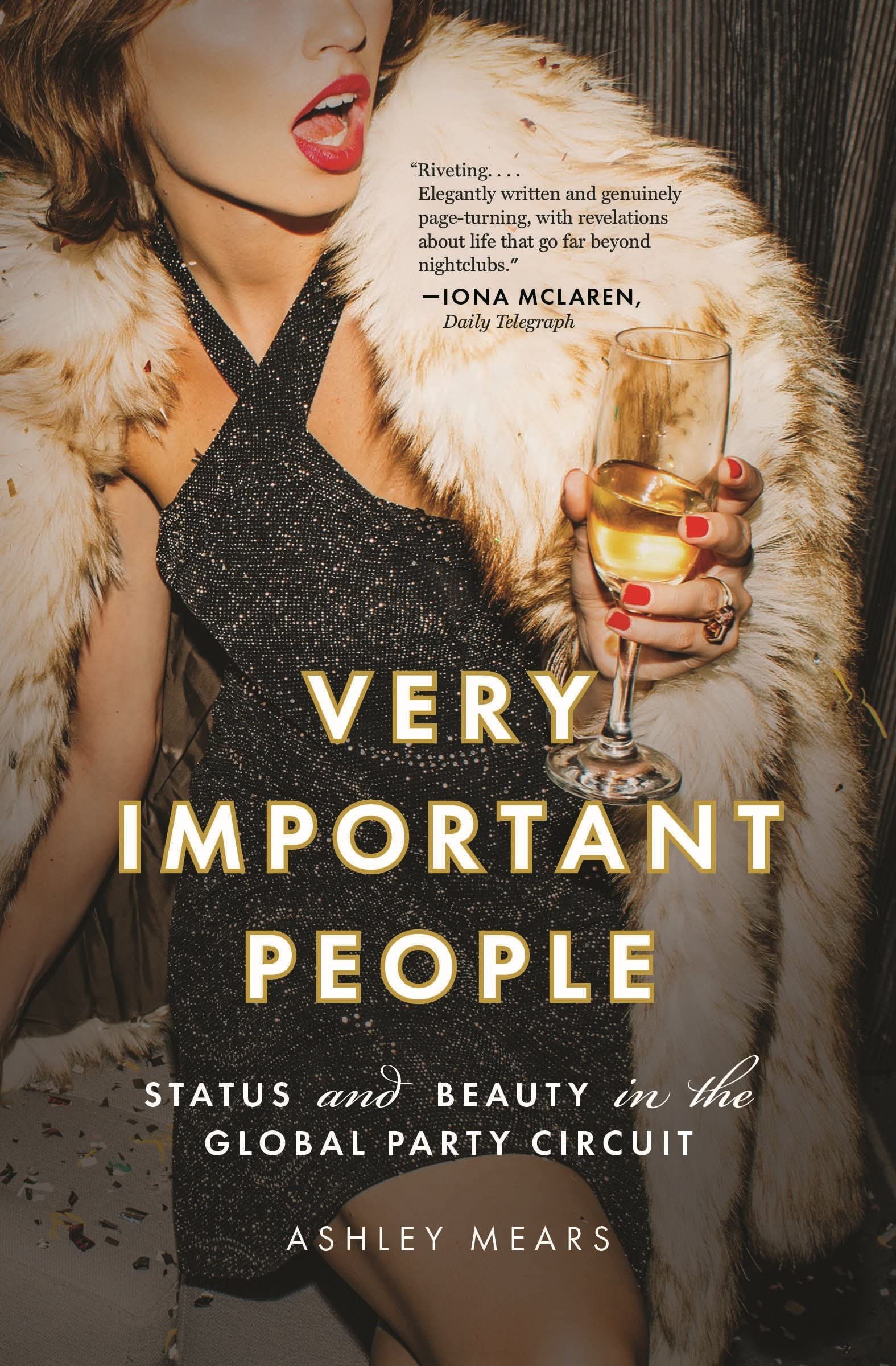
Ashley Mears - Very Important People. Everyone loves being around beautiful women, but what is it like to actually be the sort of beautiful woman who gets to party in some of the nicest and most expensive places on the planet for free, whose mere presence at a party could be worth serious money for someone else if the vibe you provide could make a party extra-special? Where is the line between beauty as an aspect of and for yourself, and beauty as a commodity to be traded and negotiated over by other people? Is a piece of designated party eye candy basically a prostitute, even if you’re not compensated in money or sex but partying itself? This performance of beauty is of course very interesting to everyone, and this is a sort of embedded ethnography on being beautiful by Ashley Mears, a model turned sociology professor at Boston University who was hot enough to pass herself off as one of the young party girls who are ubiquitous at the exclusive high-end Vegas/LA/NYC/Miami scenes we all dream of being regulars at. While ironically she doesn’t get nearly as far into the psychology of her fellow party girls as they undergo the surprisingly demanding lifestyle of party-hopping as she does into the hustlers and promoters who book them and the international high-rolling bottle service “whale” customers who are paying for it all, she uncovers some fascinating details of a stratum of life as strange as it is glamorous.

Alexander Mikaberidze - The Napoleonic Wars. Even if you think that you’re tired of the Napoleonic Wars, the subject is so rich in detail that there’s always room for a new and distinctive angle to make you pick up one more book. Mikaberidze delivered exactly what the subtitle of A Global History promised, covering how wars shifted the balance of power in Europe, as expected, but with more of a focus on how Napoleon's rise and fall created and shaped countries around the world, leaving fascinating legacies everywhere. He doesn’t spend a ton of time on the minutiae of the battles, typically limiting himself to a few paragraphs placing the tactical maneuvers in the broader strategic context of each campaign, and that frees him up to explain how first Europe and then the whole world became caught up in the escalating logic of near-total war that had such dramatic political consequences for the rest of the 19th century and beyond. While perhaps not the first volume on the Napoleonic Wars an interested person should read, it shows that there’s a whole other world out there beyond Jena and Trafalgar that was vital to how the whole affair went down.

Virginia Postrel - The Fabric of Civilization. Postrel’s 2013 book Glamour was a fascinating look at the rhetoric of desire, and this new book is similarly interesting. Textiles are by now so commoditized in rich countries as to be almost beneath notice except in unusual circumstances, but for the majority of human history they were extremely expensive and time-consuming to produce. Elizabeth Barber’s book Women’s Work: The First 20,000 Years was a great look at the historical mode of fabric production, and this is an able sequel of sorts, using explorations of how various societies have tried to solve the problem of keeping their members fully clothed as a base and layering other aspects of the clothing experience on top: how do trading patterns affect clothing, how has the question of fashion vs utility worked over time, how did scientific discoveries in fabrics and dyes affected clothing styles, to what extent did cotton production determine geopolitics, where will technological advances take clothing next, and all sorts of other questions. I have a family history in the garment business and have been to textile mills in other countries, so I was hoping for a little more discussion of labor issues (in addition to the gender aspect that Barber covered so well in her book, when I visited Bangladesh, the classic question of if risky low-wage export jobs are better than no jobs was front-page news every day), but this book both covers a lot of interesting ground itself and is an excellent jumping-off point for many other lines of reading too, which is the mark of a great work.

Friday, December 24, 2021

Best Books I Read: 2021

My reading recovered a bit in 2021, which is good news; even major life events couldn't stop me from getting my reading back on track. I did suffer a major breakdown in review-writing, but I have decided to sunset my Goodreads and switch to the friendlier LibraryThing, where I will hopefully pick the pace back up again.

Once again it is hard for me to give a single recommendation. For fiction, I have to say that the Colleen McCullough and Jack Vance books are both incredible. For non-fiction, Scott Atran and Richard Hamming would both be great picks.

Fiction:

Ayad Akhtar - Homeland Elegies. Novels that blend fact and fiction to this degree - the protagonist narrator is also named Ayad Akhtar, his family is also Pakistani, his father was also a doctor, etc - have a major challenge in that while plucking bits of your own life and placing them in a book can save you same time and effort coming up with material, the pieces you choose had better work in the context of a plot that is more entertaining than your own life, unless yours is as entertaining as Hunter S Thompson's or something. On the contrary, Akhtar was actually quite successful at writing a novel "in the era of Trump" (a dangerous but unavoidable phrase) that doesn't feel dishonest or recycled at all. In fact it's quite moving; the relationships between the protagonist and his father, mother, half-sister, and so on are an integral part of the narrative, which moves across the US both geographically and culturally. Akhtar is good at rendering the kind of conflicts over legal and medical issues that one would start to describe as "uniquely American" were it not for the fact that so many of them are handled by immigrants much like his father, and quite skillful as well at handling multiple types of polarization, not only political but also generational.

Don Graham - Lone Star Literature. Properly summing up Texas literature in a single anthology volume is a blatantly impossible task, and even doing a cursory survey is daunting, but it would be hard to do a better job in one volume than Graham has done here. Ranging from the expected cowboy/settler/ranch tales of early Texas through to the social commentary and "real literature" of the modern era circa the publication date of 2003, Graham surveys the regions of the state - rendered here as West, South, Border, and Town/City - and does a great job showcasing characteristically Texan literature, neatly avoiding the age-old identity debate of what makes a piece of work "really" about a state - does the work have to be by an author from there, or living there, or about there, or inspired by there, etc - by cheerfully selecting representatives of all of the above. Henry, Webb, Dobie, Porter, Bedichek, Caro, McMurtry, Brammer, Wright, Barthelme, Ivins - they're all here, along with plenty of other authors that you probably won't have heard of. While you could wish for a few more selections from more adventurous genres like science fiction, this is a great introduction to Texas literature. There's a whole world in here!

Ursula K LeGuin - The Lathe of Heaven. I thought of this as LeGuin's take on a Philip K Dick novel, since the premise and plot could have been lifted from any number of discarded PKD outlines. A future dystopian Portland Oregon wracked by climate change and overpopulation is existentially threatened by both the reality-warping powers of protagonist George Orr's technologically augmented dreams as well as an alien invasion. LeGuin being LeGuin however, her emphasis is not so much on the terrifying vertigo that being unmoored from reality brings, but the way that Orr tries to find peace in the stability of love. Orr's abilities are discovered by psychiatrist William Haber, who attempts to use his powers to change the world for the better. However, each time Orr falls asleep with Haber's instructions in his mind, something ends up wrong in the new world he awakes to. As he obligingly writes and rewrites history at Haber's beck and call, he slowly falls in love with his lawyer Heather Lelache, and though the Heather he sees at the end of the novel is not the Heather he originally fell in love with, LeGuin's typically keen ability to get you to feel for the protagonist emphasizes the value of learning to appreciate what you have while it's still in front of you.

Colleen McCullough - The First Man of Rome. Well-crafted and addictively paced historical fiction that vividly illustrates the world of the late Roman Republic in all its sleazy, violent, all too human glory. As familiar as the era of Julius Caesar is to us in the modern era, his parent's generation was not any less full of interest or consequence to the fate of Rome, and McCullough brings Marius and Sulla, two of the most influential people in the entire history of the Republic, to full-figured life. As the book begins Marius is only beginning his rapid ascent to being the First Man of Rome, with Sulla as his junior partner, but over the course of the book they both navigate tremendous personal and political challenges as the traditional political system of Rome begins to buckle under the weight of the growing size of the state and the overwhelming ambition of... well, men just like Marius and Sulla! Even though large chunks of the novel are told in the form of suspiciously detailed letters between the characters in order to deliver background exposition and offscreen action, McCullough makes it work through her sheer skill at characterization. Those who know their history will appreciate the dramatic irony of how the book ends with Marius and Sulla's stout friendship and seeming triumph over the forces of reaction, while even readers who've never heard of the Cimbrian War will appreciate the incredible depth of research McCullough brings to every page of this massive epic. Luckily this is merely the first of seven volumes in her Masters of Rome series.

Jack Vance - Tales of the Dying Earth. This is a collection of 4 individual fantasy novels and short stories Vance published in between 1950 and 1984, loosely related by the world all the tales are set in, and to this day it has to rank as having one of the highest entertainment value-per-page of any fantasy series you could read. I particularly loved the middle two volumes, The Eyes of the Overworld and Cugel's Saga, which focus on the unwilling wanderings of the self-styled Cugel the Clever through an incredibly rich and compelling future world. Cugel has been induced to burgle the manor of fellow magician Iucounu the Laughing Magician; when he is discovered, he is forced to go on a quest beginning on the other side of the world with a small demon embedded in his liver that will give him sharp pains if it senses that Cugel is insufficiently dedicated to his task. He proceeds through a fantastically gripping journey through a seemingly unending series of confrontations with the bizarre inhabitants of the world Vance has created and makes it home to confront Iucounu, only to mess up a spell and be transported back to his original starting point to begin his journey home yet again! The plot of the novels is filled with action and adventure and would be interesting enough on its own, but it's Vance's erudite but dryly comic diction that elevate Cugel's twin odysseys across the world to higher realms of literature. These books were incredibly influential on Dungeons & Dragons and other assorted fantasy games (to this day any magic system involving individual memorized spells is called Vancian magic), but his incredibly entertaining and astoundingly creative stories deserve to be enjoyed on their own terms as well.

Non-Fiction:

Scott Atran - In Gods We Trust. Even a committed atheist like myself is impressed at the depth and longevity of religion. Individual religions may come and go, but religiosity itself is as old as humanity, and even though secularism might seem to be on the rise, it's entirely possible that religious urges will never go away but merely change their external presentation. Atran uses the full battery of neuropsychology, sociobiology, and cognitive anthropology to do a superb job of showing how evolution has deeply embedded religious impulses in the architecture of our brains, and how everything from the omnipresence of ritual to the need to congregate makes perfect sense when religion is seen as not merely satisfying individual desires to make sense of the world, but also fulfilling vital societal functions of trust and morality. Every society that has tried to stamp out a particular religion or even general religiosity has been forced to replace it with either a new religion or something functionally equivalent to a religion, since human beings are genetically hard-wired to think and believe and behave in certain ways; even if individual humans don't have strong religious impulses, the vital nature that religion has played in enabling human groups to scale from small hunter-gatherer bands to globe-spanning civilizations cannot be ignored. This book is really useful no matter what you believe, since even though the specific future of the religious landscape is anyone's guess, it's unlikely that religions which have provided irreplaceable services week in and week out for thousands of years are going anywhere anytime soon.

Jonathan Cohn - The Ten Year War. America's incredibly complicated and expensive health care system is widely resented by nearly every one of us at one point or another, but to truly understand why it's so depressingly resistant to change, it's worth looking at what happened the last time someone tried to make a few improvements to the way health care is paid for and delivered in this country. The ten year interval in the title is between Obama's election victory in 2008, won in part because of a mandate for health care reform, and the Democratic recapture of the House in 2018, after John McCain's famous thumbs-down doomed the ACA repeal effort, but naturally Cohn covers much more than that in order to give the full context behind all of the breathless headlines we lived through and to drive home just how damn hard it is to improve the system. Bill Clinton's failed reform effort in 1994 looms large, of course, but the in order to fully appreciate the incredible difficulty involved in expanding coverage and reducing costs while not touching anyone's revenue streams you have to read about the gory details behind America's many other reform efforts: Medicare, Medicaid, CHIP, Romney's Massachussetts plan, and so on, which have gradually woven together the Gordian knot we have now. As year 1 of the Biden era closes we seem to be stuck with this incoherent mishmash of public and private payers and providers indefinitely, and it's anyone's guess what tomorrow will bring, but one can hope that we'll get to truly universal coverage someday. This makes a great companion for Mike Grunwald's The New New Deal, a similarly well-reported book about the 2009 American Recovery & Reinvestment Act, AKA the stimulus.

Ben Fritz - The Big Picture. Why is every big movie these days part of some kind of superhero franchise? What happened to the actor- or director-focused movies that we all grew up watching, which showed up in theaters like clockwork every year until sometime in the mid 10s? The cultural shift from the type of movie that Michael Eisner so memorably termed "singles and doubles" - films based on original screenplays with mid-sized stars and a capable director - to the current torrent of mega-blockbusters has been so jarring that it almost seems the product of a deliberate conspiracy. It turns out that there are a lot of factors you could blame: changing tastes, particularly with "prestige TV" as a competitor; increasingly precise demographic targeting; international growth, particularly China; studio mergers; shifts in film financing structures; the rise of streaming services as preferred viewing platforms, content distributors, and content producers. That final factor turns out to be key, and Fritz uses the 2014 hack of Sony Pictures as the starting point to reveal how the "big six" film studios struggled to compete with the rise of Netflix, Apple, and Amazon as major players in the war for viewership, profits, and prestige, eventually realizing that audiences crave familiarity to a degree previously unknown, and that therefore the safe bet was to acquire as many reliable franchises as possible, Disney being the archetype of this tendency. James Stewart's Disneywar is one of the all-time great looks at the industry but it was published in 2004; Fritz's book is an essential update on the state of the movie industry now, still as cutthroat behind the scenes as it is glamorous in front of them.

Richard Hamming - The Art of Doing Science and Engineering. It's been a long time since I read something as math-heavy as this reprint of a collection of lectures on computer science and engineering, but it came with the sort of glowing reviews you normally associate with religious texts, and after finishing it I can see why. Hamming gave these lectures at the Naval Postgraduate School in his golden years. They cover computer hardware and programming, error correction, information theory, filters, simulations, and even quantum mechanics, but math per se is not really his focus. Really what he's trying to get across over the course of these intensely intelligent and provocative lectures is that a mix of curiosity and determination is essential for someone to do something great in the world, over and above raw intellectual horsepower. We're not all as smart as Hamming (anyone who has as many mathematical techniques named after them as he does is definitely on a higher plane of IQ), but what he tries to impart to the reader while he's walking them through higher-dimensional sphere-packing and error-correction matrices and so on is that "Learning to Learn", the book's subtitle, is a skill that can be acquired. It's hard to overstate how valuable that kind of reassurance can be, no matter the domain.

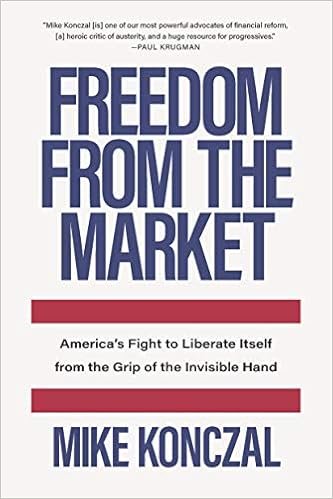
Mike Konczal - Freedom From the Market. As a committed new liberal/neoliberal I don't generally tend to see government and business as fundamentally at odds - often they're merely different means to the same end, and it doesn't matter so much what label you put on a service provider as long as something gets done. But there is almost always a major tradeoff between the flexibility and responsiveness of the market against the stability and accountability of the government, and it is worth exploring the points in American history where we made deliberate choices to have the government provide services directly to see what worked and why. Konczal reviews the moments in American history where the government directly provided land for settlement, health care, childcare, education, social insurance, and more, making a powerful case that our post-Reagan (really post-Carter) deregulatory environment may have brought vast wealth but left us less in control in some important ways. Interestingly he doesn't even mention public utilities such as the Tennessee Valley Authority or the Lower Colorado River Authority, even though those efforts were and are crucial to their states and would have made excellent examples of how little we have to fear from government-operated enterprises, but the rest of the book is a very useful history, and possibly a useful guide to the future as well, even if you are a little less bothered by market forces than he is.

Monday, January 4, 2021

Best books I read: 2020

2020 gave me the same sense of sloth it gave everyone else, so I did slacken on my reading a bit, but it hit my review writing even worse. I will catch up, since some of the books deserve fuller writeups both here and on Goodreads, but I am happy that I enjoyed the books that I did read just as much as last year. 

For fiction, Romance of the Three Kingdoms remains my top recommendation, though the Three-Body Problem trilogy was also excellent. For non-fiction, Scientists Against Time is the most relevant, though One Billion Americans is also quite timely.

Fiction:

Albert Camus - The Plague. I'm not sure if reading a novel about a pandemic during a pandemic actually counts as "escapism", but being cooped-up all day every day made me look for a novelistic rendition of my predicament regardless. I was reading a paper by Utteeyo Dasgupta, Chandan Kumar Jha, and Sudipta Sarangi titled "Persistent Patterns Of Behavior: Two Infectious Disease Outbreaks 350 Years Apart" comparing the similarities in responses to COVID-19 with the 1665 Great Plague of London as memorialized by Daniel Defoe and Samuel Pepys which referenced this novel, so I decided to check it out. This was actually only the second Camus I've read, after The Stranger, and I have to say I enjoyed it quite a bit more. The central point of Camus' absurdism - that humanity is compelled to seek meaning and purpose in a chaotic, amoral universe that won't and can't grant either - is personified far more effectively here by the hapless citizens of Oran in the face of a plague, as they all cope with its effects on their lives and attempt to find some semblance of normality, and the moral dilemmas here are more absorbing than in The Stranger. The Plague was published in 1947, 5 years after The Stranger, and I thought it was interesting that Camus put some oblique references to his earlier work here: one character overhears a discussion about a trial of the murder of an Algerian on a beach, and another character recounts a childhood experience watching his prosecutor father argue for the death penalty in a quick little vignette that sums up a great deal of the whole second half of The Stranger. My natural comparison for this novel would be José Saramago's excellent Blindness, but The Plague isn't quire so post-apocalyptic, merely remarking at the end, as the city returns to normal after months of sadness, isolation, and death, that there would be more plagues in the future. I wouldn't call Camus optimistic, per se, but there are worse endings than "life goes on".

Elena Ferrante - The Lying Life of Adults. Not quite the Neapolitan Novels, even if it would be impossible to bottle that kind of lightning in a jar only one-quarter the size of that tetralogy, but if Ferrante has a superpower, it's the ability to write such engrossing characters, with such vivid interior lives, that by the time you start to complain you notice that you've already inhaled half the book. This time instead of a journey from childhood to full adulthood, the narrative follows its protagonist Giovanna for just a brief period of her adolescence, and while this story shares many of the characteristics of its more famous predecessor - the rapid pacing, the Neapolitan setting, the way that your identity becomes entangled with those you love and hate, the ability of small symbols (the Blue Fairy short story there, a small bracelet here) to assume significance out of all proportion to their size, the rush of romance with an intelligent leading man, the subtle yet crucial importance of class and language to social status, the power of projection, the progressive disillusionment that adulthood brings - The Lying Life of Adults is distinct enough that it shouldn't simply be treated as self-plagiarism. Whereas Lenù in the Neapolitan Novels spent her whole life trying to define the personal boundary between herself and her best friend Lila, here a determination to meet the aunt Vittoria she's never known and the discovery that her father was having an affair with her best friends' mother sets Giovanna on the path of learning how to use the power of lying the way she thinks she sees the adults around her doing, as both a shield and as a sword. Ferrante's gift of creating powerfully absorbing worlds that are both inseparable from yet seemingly created entirely by the swirl of her protagonists' thoughts is still fully on display here, even if it doesn't hit quite as hard as her masterpiece.

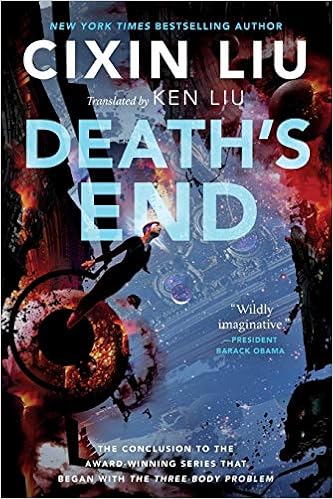
Liu Cixin - Death's End. Somehow the final volume of the Three-Body Trilogy is not just as good as but even better than the previous two, as full as several novels put together. The trilogy started off with a fairly naturalistic scenario of interstellar neighbors stumbling into war, that by this volume has grown to encompass the nature of reality itself, in the form of an exploration of higher- and lower-dimensional space over a timescale of millions of years to literally the end of the universe that's equal parts Flatland, Greg Egan (particularly his novels Schild's Ladder and Diaspora), and Olaf Stapledon's majestic Star Maker. Liu spends a good deal of time exploring what "credibility" means in the context of MAD, with successive people given the full weight of responsibility for sending the signal to doom both Earth and Trisolaris, but for me the high point was almost purely literary: a scene where a human ambassador to the Trisolarians is attempting to pass back technological secrets about FTL travel, altering the speed of light, and multi-dimensional weapons via a coded fairytale. The fairytale itself was so well-written, and the scenes where the rest of humanity try to decipher his code were such a well-dramatized meta-commentary of the nature of story interpretation, that I was in awe; it was like a condensed version of the super-textbook Primer plot thread in Neal Stephenson's The Diamond Age. Unfortunately humanity as a whole fails to fully interpret the story and does not come off so well in the conflict, narrowly dodging being exterminated like locusts by the Trisolarians and then being collapsed into lower dimensions by even more advanced aliens due to yet more short-sighted defeatist ideology. But, by the very end Liu not only makes a powerful statement about the enduring power of love, he ties that into the discovery of a way out of the iron logic of self-preservation via annihilation that's driven the universe until now: everyone just has to work together, and kindness is not a weakness. Everyone has their own preference for the line between saccharine and sweet, but I was fully satisfied by the climax of this excellent series.

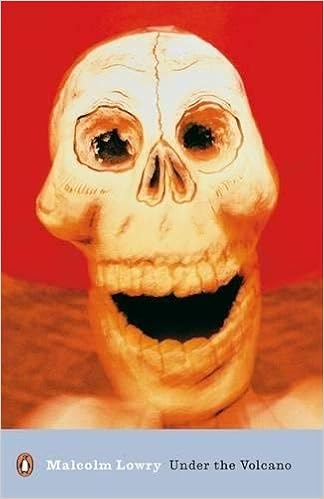
Malcolm Lowry - Under the Volcano. There have been a lot of novels about drinking, but very few that really capture what it's like - you either have to write it from a remove so it doesn't get sloppy, at the cost of losing something of the essence of the experience, or throw yourself into it and risk it becoming an unreadable mess. Hunter S Thompson was probably the all-time master of walking that reportorial tightrope, but Lowry, himself an alcoholic, uses all the techniques of modernism circa 1947 to craft a novel that takes you all the way from the first drink of the night to the next day's hangover and back again. British consul Geoffrey Firmin is an alcoholic (naturally), drinking his life away in Quauhnahuac, Mexico on November 2, the Day of the Dead, surrounded by a few loosely connected friends, fellow expats, townspeople, and his estranged wife, all of whom stagger around and perform various drinking-related activities. The plot really isn't the point; what matters is the language and technique, which are on the level of other famous modernist novels like Ulysses and Mrs Dalloway, and indeed you will be frequently reminded of them since all are set in a single day (with the exception of the first chapter here which takes place exactly a year before the rest of the action), in a single place, following a variety of perspectives, using stream of consciousness, and so forth. Under the Volcano is a bit more like Ulysses in its polyglot profusion, dropping in loads of Spanish to reflect its setting, and its heavy use of symbolism both structurally (12 chapters = the 12 months and the 12 hours on a clock, etc) and narratively (plenty of allusions to Faust, Shakespeare, Kabbalah mysticism, etc), but even though Lowry is no Joyce, he gives you the same impression of really caring about his work, every single last syllable spoken by a character in an intoxicated fervor. My edition also includes a long letter that Lowry wrote to his publisher Jonathan Cape explaining the novel's structure and justifying his writing choices that's one of the best literary analyses/critical commentaries I've ever read (yes, it's his own book, but still).

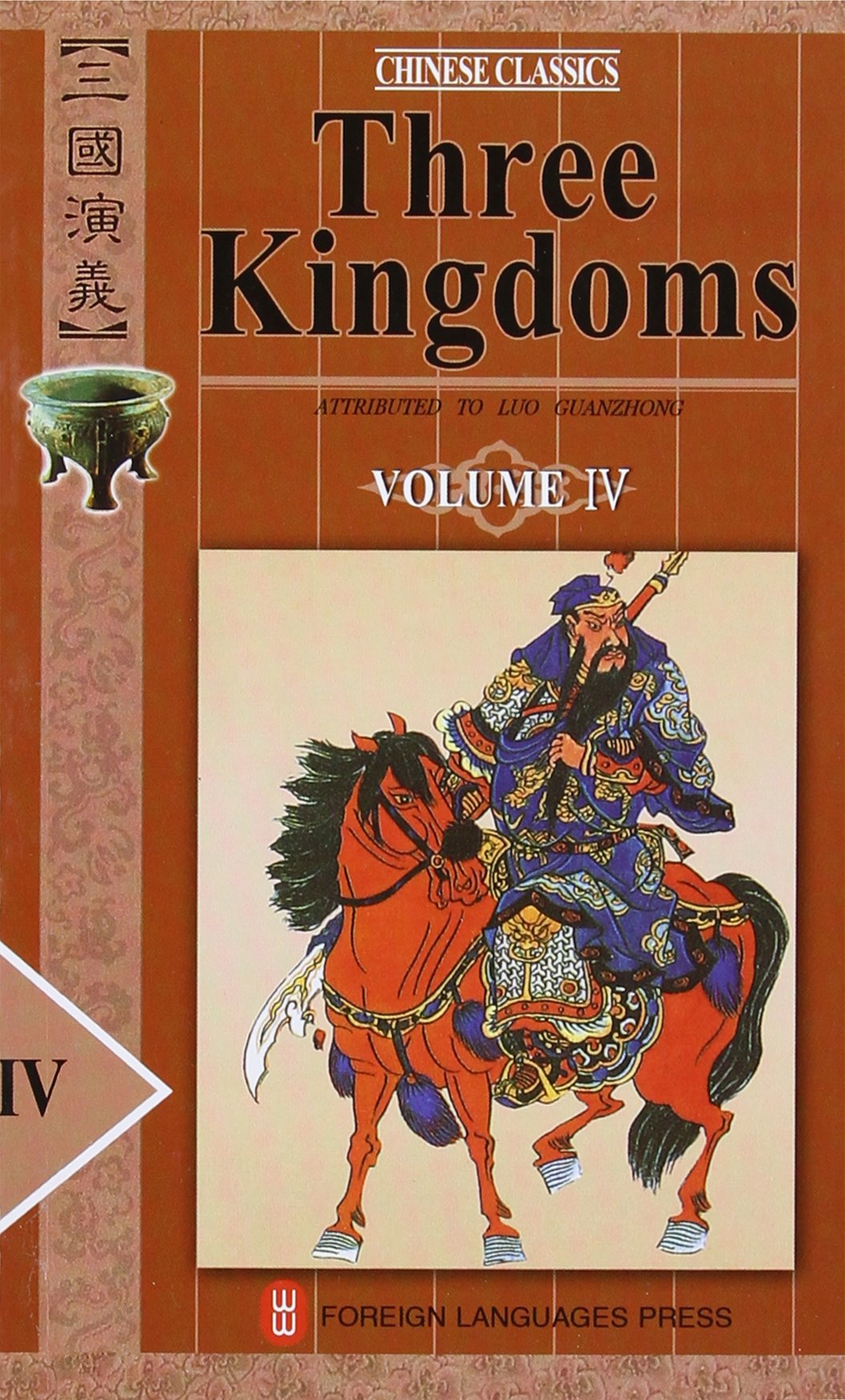
Luo Guanzhong - Romance of the Three Kingdoms Volume 4. As one of the most tremendous reading experiences of my life drew to a close, I had almost too many thoughts to write down. Since the fourth volume (chapters 95-120) ends over a hundred years after the story begins with the collapse of the Han dynasty, the reunification of the three kingdoms into the Jin dynasty is completed by an entirely new generation of characters. This may be the finest dramatization in all of literature of Machiavelli's famous distinction between virtù (the human ability to bring events under control through will) and fortuna (everything else), and it's fascinating how constrained all of these larger-than-life characters are by their predecessors' actions - even the brightest among them, like western general Kongming, who's still hanging on after the death of Liu Bei and trying to fulfill his dream, or northern general Sima Yi, who looks at Cao Cao's heirs the way that Cao Cao did at the last Han emperors, have to play the hands that they're dealt and live with the consequences of the choices made by their ancestors, who played their parts and then dropped out one by one, after what felt like several lifetimes worth of intrigues, battles, and heroic deeds. The persistent question of loyalty, whether to a brotherhood, a family, a sovereign, or to the empire as a whole, runs through every action to literally the very last page, and though it didn't end the way I would have wished (I was pulling for Cao Cao all the way), I wouldn't change a word of it. 

Non-Fiction:

James Baxter - Scientists Against Time. I first saw this 1947 winner of the Pulitzer Prize for History mentioned in a discussion lamenting the poor US response to coronavirus in essentially all of the logistical details. Back in WW2 we were able to design, develop, and distribute all over the planet fantastic quantities of goods based on completely new technology that required intense amounts of scientific research to meet vital deadlines, so why are we so inept today? Well, the full story of our decaying modern institutions is yet to be told, but this history of scientific triumph on the other hand is full of fascinating details on the Office of Scientific Research and Development, the successor to the National Defense Research Committee. It oversaw an incredible amount of stuff: inventing the modern research university paradigm, funding that basic scientific research, coordinating the pipeline from research to prototypes, running trials, sequencing manufacturing, and then getting the final products delivered anywhere on Earth. Advances like radar, aircraft, amphibious vehicles, high explosive charges, medicines, blood plasma, and many more poured out of America thanks to a shockingly simple strategy of hiring talented people, giving them clear goals but plenty of latitude to solve any problems that come up, and checking in frequently to course-correct. This doesn't sound so difficult, but it's evidently beyond us now - just compare the invention, refinement, and distribution of antimalarials back then to something as simple as facemasks now. Have we really become so much worse at project management in 80 years, against a pandemic that will most likely kill about as many Americans as died in WW2? Apparently so.

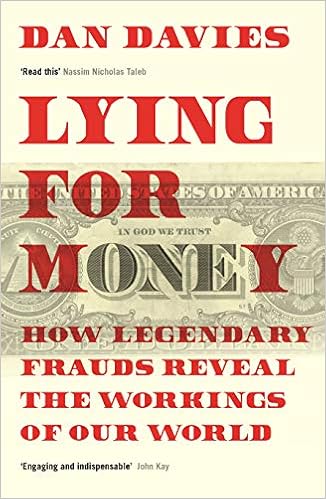
Dan Davies - Lying For Money. I've long loved reading about the blurry line between scams and legitimate ventures, so this book was right up my alley. Davies is probably most famous for his legendary 2004 Iraq War blog post "The D-Squared Digest One Minute MBA - Avoiding Projects Pursued By Morons 101", but by day his profession is high finance; you can draw a straight line from that blog post eviscerating the massive fraud used to justify that war to this thoughtful and wide-ranging assessment of financial fraud. With the air of a magician explaining how his fellow conjurors perform their tricks, Davies reviews numerous historical and contemporary frauds in order to both taxonomize them (from "long firms" through "counterfeiting" and "control fraud" to "market crimes") as well as explain how each instrument of fraud is carefully designed to exploit the web of trust that so tenuously links together every level of modern commerce, from the humble counterfeit goods retail scammer all the way up to the world-impacting LIBOR fraudsters. An important insight is that while many frauds begin with the straightforward intent to deceive, many others exist in a gray area where a simple peccadillo gradually unleashes a slow-moving catastrophe as the perpetrator is inextricably committed to a fatal course towards bankruptcy and prison, ruining what could have been perfectly legitimate enterprises via simple mistakes that just can't be undone. Theft is easy but fraud can be as complex as the economy itself, given the perpetually irresistible lure of a quick buck. As Davies says: "The English language has an irregular verb to describe the problematic effects of performance contracts, depending on how much sympathy you feel for the person at the sharp end: I respond to incentives / You game the system / He is a crook."

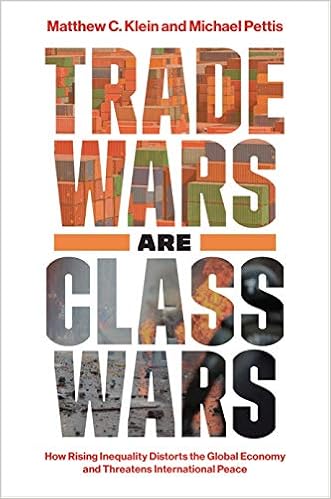
Michael Pettis - Trade Wars Are Class Wars. Klein and Pettis's model of how globalization can increase inequality, which causes anti-trade reaction is well-encapsulated by the book's title: international trade is usually treated as a sideshow to domestic economic conditions, but efforts to compete with other countries via currency exchange rates, capital controls, tariffs, quotas, and so on can exacerbate domestic inequality as the price of changing the terms of trade, and while trade policies like NAFTA and China's WTO membership generally have had beneficial impacts on net, they can cause political reactions that are reflective of distributional impact, which can then feed back into further trade surplus/deficit issues. This discussion is welcome and timely in the era of Brexit and Trump, although the authors spend some of the most interesting stretches of the book talking about historical events like the financial impacts of Germany's reunification spending on the East/West German halves of the country. Understanding how the US should respond China's rise is of course the major topic here, and so alongside discussion of America as the world's lender of last resort, and the role that Germany has played in the macroeconomics of the euro, they recommend that the US rebalance its economy so that we don't have to fight battles within and without simultaneously. 

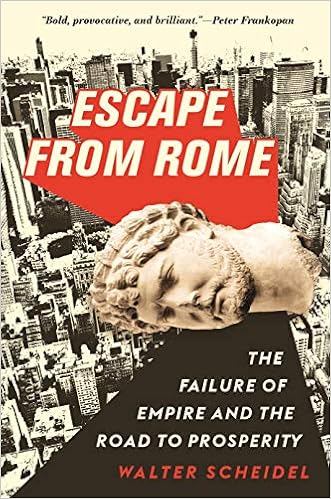
Walter Scheidel - Escape From Rome. Our list of debts to the Romans is quite lengthy, as in the famous "What have the Romans ever done for us?" scene from Monty Pythion's Life of Brian (naturally quoted here) where the characters ruefully enumerate the benefits Roman imperialism brought to Judaea, but Scheidel, on the other hand, concludes that in the long run, perhaps the best thing the Romans ever did for Europe as a whole was to stop being in charge of it. Theories on the causes of Roman collapse could fill libraries, but Scheidel's contribution is not to ask why the Roman Empire fell, but to ask how its fall was useful, even essential, for the creation of the modern world. What makes his analysis so interesting is in his method, which is full of the kind of counterfactuals that are a staple of alternative history novels but rare in academic work. He contrasts the highly-fragmented polycentrism of post-Roman Europe with the hegemonic dominance of the successive Chinese dynasties, making the case that the eventual economic divergence between Europe and China, which for most of history was far richer than Europe, in the Industrial Revolution depended on an earlier political divergence: the inability of any one power to ever permanently reassemble Roman hegemony over Europe, which contrasted against the serial reassembly of pan-Chinese empires. 

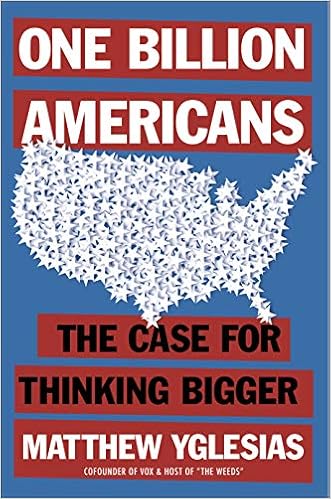
Matt Yglesias - One Billion Americans. This book is an attempt to market a laundry list of progressive wishlist items like higher immigration, universal health care, better family policy, stronger climate policy, zoning reform, and so on in a conservative-friendly format. As a progressive, I support his agenda entirely, but I can understand why it hasn't gotten the reception I think it warrants, because it's a good example of how reasonable points can seem contrarian when given a different framing. Contrarianism is assembling individually uncontroversial facts to construct a controversial conclusion, and the entire art of it lies in making your audience feel like you're genuinely trying to overturn an incorrect consensus instead of muddying the waters or just trolling. However, taken individually or together, all of Yglesias' points about the win-win nature of immigration, the benefits of overhauling our regulatory apparatus, the need to improve American child care/health care/transportation/infrastructure/climate strategy/etc, and so on should be essentially unobjectionable to most progressives, and one hopes that conservatives find them congenial as well. Even if this quite short book does feel like a takes collection rather than a proper coherent scholarly argument, I think his overall points are firmly correct - we should be allowing in more immigrants as part of a general strategy to make life better for all Americans, however many of them there may be. 

Monday, December 30, 2019

Best books I read: 2019

What's interesting about 2019, looking back on it, is how I managed to improve on last year's numbers even though I felt I was being lazy the whole time. It seemed like there were a lot of days where I just didn't feel like reading; maybe all those theories about social media and attention span are true. As always I feel like I've signed myself up for more reading to do than I will ever have time for, but isn't that a much better problem than the alternative?

I'm going to start posting all of my reviews to my blog, since I can do more links (and I don't have a word limit), but I'll still be posting to Goodreads. I read even more great fiction, and especially non-fiction, than appears here (see here for the full details), but such is the tyranny of Top X lists. If you only want 1 recommendation for a work of fiction, read Romance of the Three Kingdoms. If you only want 1 recommendation for a work of non-fiction, read Ages of Discord.

Fiction:

John Campbell - Frozen Hell. I vividly remember reading "Who Goes There?" as a child, in a sci-fi short story compilation I checked out from the library whose name I can't recall. I've completely forgotten the other stories, which were of the kind that fellow sci-fi veteran Robert Silverberg fondly but firmly sums up in the Introduction here as "wordy epics in which grim, methodical supermen repeatedly saved the world from menacing aliens by mastering, with the greatest of ease, such things as faster-than-light travel, the fabrication of matter-destroying rays, the release of atomic energy, and the penetration of hyperspace." Campbell's story about an Antarctic expedition's struggle against a shapeshifting alien was incredibly different - intensely-paced, relentless, eerie, and genuinely frightening to young me. It was a great bridge for me between more "literary" short stories like Jack London's "To Build a Fire" and other fantasy horror like H.P. Lovecraft's At the Mountains of Madness, which coincidentally was also published in serial form in the same Astounding magazine about 2 years before "Who Goes There?", which Campbell of course went on to become the phenomenal editor of.

Luo Guanzhong - Romance of the Three Kingdoms Volume 1. I'm not sure if the term "epic fantasy" applies to this work, since the standard line is that it's "70% history, 30% fiction", but whether it's shelved in "epic fantasy", "historical fiction", or even "magical realism", it's undoubtedly one of the masterpieces of literature. It's almost overwhelming in how full of everything it is: the whirlwind of characters, the unyielding pace of the action, and the seamless integration of so many little human details and emotions that give the many side-plots and minor characters a resonance far out of proportion to their brief page time. Like with all great literature, even those diversions are pure pleasure thanks to clever storytelling. Every chapter ends on a cliffhanger, each analeptic or proleptic excursion adds valuable depth and context to the main narrative, and the consistent treatment of the ways that individual honor, personal loyalty, and political duty overlap and conflict continuously give each and every decision by the main characters a real weight. Luo's account of the struggle to build a new world out of the decay of the old is as powerful as any modern work I can think of.


Sally Rooney - Normal People. What a thoughtful, infuriating, nuanced little novel. Even though I'm not predisposed to read a lot of stories about on-again, off-again teenage romances, the spectacle of these sympathetic, all-too-relatable characters making important life decisions based on poorly-understood or half-admitted emotional impulses really hit home. In a plain, unadorned language Rooney portrays many indelible moments of two young people struggling desperately to communicate something important to each other, failing because of the wrong phrasing, or an ill-timed silence, leading to them making seemingly irrevocable choices for reasons as unnecessary as they were inevitable. I couldn't count the number of times I wanted to shake some sense into both of them, yet Rooney so skillfully conveys how their presence in each other's lives is simultaneously irreplacable and unsustainable that each stage in their relationship had its own irrefutable logic. The way that crucial events were often conveyed through gaps and absences as much as by visible action made the open ending fully appropriate if not completely satisfying. Even if you thought these characters should have broken up with each other by the end of the first chapter, you're still pulling for them, in a way, all through to the end.

Upton Sinclair - Oil! The Jungle will always be Sinclair's most acclaimed work, and rightly so given its impact, but I believe that Oil! has just as much relevance to contemporary life, if not more so, and deserves to be as well-known as its more venerable sibling even if it did not spur the same reforms of the oil industry that The Jungle did for food preparation and handling. I was spurred to read it after a rewatch of Paul Thomas Anderson's There Will Be Blood, and the novel is so different from, and more complex than, the film adaptation that they probably should not be considered strictly related. Anderson's film is a small, close study, with Daniel Day-Lewis' oil tycoon patriarch a cryptic, amoral madman, whereas Sinclair's sprawling epic of ambition and capitalism has the son as its vastly subtler and more complex protagonist, arguing for and against several political philosophies against the backdrop of World War 1, the Teapot Dome scandal, evangelical religious revivalism, the film industry, and the generally explosive growth of Southern California. As always with books vs movie questions, one should decide how much the snappier running time and enhanced aesthetic experience of a film outweighs the greater richness and depth of a novel, but there is so much great stuff in Oil! that isn't the film that it deserves to be experienced as its own masterwork, particularly its exploration of how internal leftist debates interact with public opinion and the forces of big business.

Jin Yong - Legends of the Condor Heroes Vol. 1. This is the first volume of one of the most popular Chinese martial arts novel series ever written, and it reads like an excellent novelization of a kung fu film, although of course it's really the other way around given how influential this series has been on depictions of martial arts in all forms of media ever since it was first published in the 50s. If you've ever seen a kung fu movie, chances are it borrows heavily from Yong's work in tone, setting, or spirit. Naturally wuxia/martial arts novels have had a long tradition dating back centuries before these books were written (in a pleasing fan-fiction-y touch it's revealed that the protagonist Guo Jing is a distant descendant of one of the characters in Water Margin, one of the Four Great Novels), but Yong's work is fully its own despite inhabiting the well-trodden, familiar universe of medieval China. Yong evidently didn't set out to reinvent the wheel in terms of wuxia tropes, but in much the same way that a genre classic like Harry Potter outshone a whole host of similar young wizard adventure novels by being the best version of that genre, Yong's work hits the optimal sweet spot of family drama, political turmoil, patriotism, and of course plenty of incredibly-named kung fu action.

Non-Fiction:

Jason Brennan and Peter M. Jaworski - Markets Without Limits. I had an extremely polarized reaction to this book. Its central question - how exactly does money relate to morality? - is incredibly important, and its answer - if you may do something for free, then you may do it for money - is elucidated in a clear, convincing manner I've never seen anywhere else. I can't say that I fully agree with all of Brennan and Jaworski's arguments, but the main idea itself, that it's not immoral to buy or sell something for money unless it's also immoral to get or give it away for free, is worthy of a long ponder. Indeed, even though this book is clearly written from a libertarian perspective, you often encounter its central argument coming from "the left" in a surprising number of areas, even from those who don't subscribe to the infamous label "neoliberal", so it probably isn't all wrong. The notion that commodification introduces ethical problems is nearly universal, but lots of things are or were universal without being correct, and I think the logic here is strong enough that it's worthy of being promoted to the default view, in a John Stuart Mill sense, where the burden of proof should generally be on the side of market opposition and that we shouldn't restrict markets unless they can be shown to cause harm. However, the authors fail to convince in several specific areas where they don't engage with empirical evidence, such as when they try to argue that it should be legal to buy and sell votes, and their disengagement with many obvious real-world counter-examples means that even though I find the basic idea extremely compelling, much of the book falls into "nice in theory but maybe not in practice" territory.

Donald Palumbo - Chaos Theory, Asimov's Foundations and Robots, and Herbert's Dune. Probably the best close reading of these two titanic series you could ask for, Palumbo's thesis here is that in addition to being entertaining reads, one of the reasons that the Foundation and Dune series have endured for so long is due to their fractal nature: the structures of the novels recapitulate their main plots, which are themselves illustrations of their main themes. The nuances of psychohistory in Foundation and ecology in Dune are demonstrated not just by the characters talking about them, and not just by the actions they take, but also how the books in the series relate to each other, since each novel is a mostly self-contained story but each series builds and expands on the main themes in subtly brilliant fractal patterns. Even better, Palumbo made my own vague notions of how the two series' overlapping but distinct and even opposed ways of viewing the universe relate to each other much more clear - can the future be known, planned for, and managed, or will there always be elements of chance, volition, and surprise? Asimov's careful unification of short stories, novellas, novels, and entire trilogies into the Foundation "metaseries" (i.e. the initially separate Robot, Empire, and Foundation series) is itself an example of the psychohistorical vision of finding order in chaos, whereas Herbert's more shambling efforts in the Dune novels to set up and then knock down successively grander iterations of monomythical hero archetypes are themselves demonstrations of inescapable disorder in a seemingly perfectly ordered society and natural world. Debates over whether genre fiction can be as good as "real literature" are invariably as tedious as they are pointless, and as this literary analysis of two of the greatest science fiction series of all time shows, utterly wrongheaded.

Susan Scafidi - Who Owns Culture?. "Cultural appropriation" is a hot topic these days, a great example of how frustrating debate in the 21st century can be. An emotionally-charged subject with unclear boundaries and varying definitions that has deep implications for capital-letter topics like Authenticity, Identity, Ownership, and Power is an ideal engine for producing negative-sum arguments that leave everyone more angry and less enlightened than they were before. For my own edification I thought it would be helpful to read something about cultural appropriation that fit the concept into a more analytical framework. Scafidi's central ideas - group cultural property as an analogue of individual intellectual property, and cultural appropriation as an analogue of copyright infringement - are a much more useful way of thinking about the latest controversies over food, fashions, music, and so on than what you usually read. In addition to providing lots of interesting examples of cultural exchange, both good and bad, and across many types of cultures, Scafidi offers proposals to both protect sensitive aspects of culture as well as promote cultural innovation, which is an exceptionally difficult balance to strike even within a single culture. Like with many things in life, familiar concepts like respect, openness, and dignity are perhaps more important tools for this debate than any particular abstract theory of property rights, but I wish everyone who's tempted to write or read yet another clickbait article about cultural appropriation in the era of ubiquitous memes, remixes, and adaptations would read this immediately.

Peter Turchin - Ages of Discord. If anyone can claim to be making Isaac Asimov's dream of psychohistory manifest it's Turchin, who has done more work to create a truly scientific and predictive theory of macrohistorical patterns than probably anyone else. While this is of course impossible in the strictly Asimovian sense of being able to tell exactly when major crises will arise - and unlike Asimov, Turchin does not even pretend to then be able to present timely solutions via hologram - this book makes a convincing argument that we can discern real lessons about general trends in societal upheaval, while still humbly emphasizing how difficult it is to make even modest predictions about the future. Unfortunately, as the title unhappily alludes to, Turchin's prediction is that the 2020s will be even more unpleasant than today, an era of strife that echoes previous periods in history where the existing social order proved unable to accommodate internal divisions, and the political system could not easily resolve these tensions due to elite greed and status-hoarding. While not Marxist in analysis or conclusion, Turchin's Structural-Demographic Theory broadly aligns with the notion that the rich and powerful have diverted too much of society's wealth and privilege towards themselves, and general wage stagnation combined with class immobility is already having dangerously destabilizing effects on our cultural norms. Even though the book's prognosis is negative, it's just as high-quality as Turchin's other recent works, which collectively form one of the most impressive oeuvres in contemporary social science.

Carl Zimmer - She Has Her Mother's Laugh. The most important decision you can make in your life is who to have children with. This is understood more or less unconsciously by practically everyone, but the true nature of heredity - precisely what traits we inherit from our parents, and how we bequeath them in turn to our own children - is far more complex and subtle than we give it credit for. Zimmer traces our conception of heredity from one kind of ignorance to another, from our historical innocence of its genetic basis to our current incomprehension of what the ultimate consequences of our newfound power over it will be now that we have powerful tools like CRISPR. He does a great job balancing the pop sci elements of genetics 101 with the more complex cultural consequences at each stage of our understanding, so as concepts like X-inactivation, mosaicism, or epigenetics get discovered, you get crucial context as to how people used that new knowledge for both good and ill. The word "eugenics" casts a long shadow over our current attempts to consciously affect how our own heredity works, as it should, but the incandescence of real scientific knowledge is enough, or should be, to give us confidence that as we begin to use genetic engineering to deliberately reshape our genes that we don't have to simply repeat the old bigoted mistakes of the past. Our DNA might blindly attempt to replicate itself, but we don't have to, and a clear-eyed assessment of the possibilities in front of us should give us a great deal of optimism for our descendants.