Showing posts with label science. Show all posts

Wednesday, March 13, 2019

Book Review: Peter Turchin - Ages of Discord

If anyone can claim to be making Isaac Asimov's dream of psychohistory manifest it's Turchin, who has done more work to create a truly scientific and predictive theory of macrohistorical patterns than probably anyone else. While this is of course impossible in the strictly Asimovian sense of being able to tell exactly when major crises will arise - and unlike Asimov, Turchin does not even pretend to then be able to present timely solutions via hologram - this book makes a convincing argument that we can discern real lessons about general trends in societal upheaval, while still humbly emphasizing how difficult it is to make even modest predictions about the future. Unfortunately, as the title unhappily alludes to, Turchin's prediction is that the 2020s will be even more unpleasant than today, an era of strife that echoes previous periods in history where the existing social order proved unable to accommodate internal divisions, and the political system could not easily resolve these tensions due to elite greed and status-hoarding. While not Marxist in analysis or conclusion, Turchin's Structural-Demographic Theory broadly aligns with the notion that the rich and powerful have diverted too much of society's wealth and privilege towards themselves, and general wage stagnation combined with class immobility is already having dangerously destabilizing effects on our cultural norms. Even though the book's prognosis is negative, it's just as high-quality as Turchin's other recent works, which collectively form one of the most impressive oeuvres in contemporary social science.

The idea that societies have semi-regular patterns of crisis and stability is thousands of years old; Polybius' anacyclosis model in The Histories predates the Caesars, and the Chinese epic Romance of the Three Kingdoms famously begins "The empire, long divided, must unite; long united, must divide. Thus it has ever been." However, since as a rich post-Industrial Revolution nation we have escaped a simple Malthusian equilibrium that would lend itself to the easy use of closed-system dynamics, you have to get more a bit more complex in order to discern any kind of cyclical trends in American history. Picking the right variables can be extremely difficult and frankly, some of the choices Turchin makes come off as questionable; when he was describing how in addition to the steady multi-century Structural-Demographic Theory sine waves of peace --> complacency --> conflict there are also 50-year "fathers and sons" cycles, I was reminded of cargo cult science like the Dow theory model of stock prices, where you hallucinate a bunch of overlapping variable-length "patterns" of main movements, medium swings, and short swings on top of a bunch of random-walk price data in order to derive whatever trendlines look most convincing to your investors. Turchin does his best to avoid pareidolic numbers games, but his well-intentioned attempts to find proxies for inherently squishy concepts like "cooperative social mood" for SDT - measures like "visits to national parks and monuments" or "relative frequency of the phrase 'corporate greed' according to Google Ngram" - have the unavoidable air of arbitrariness, even if he does make a good case that they're measuring something real.

Still, once I got over my quibbles with his exact choice of indices, his basic theory seemed unimpeachable. The highest level of the model is simple: the Political Stress Indicator = Mass Mobilization Potential x Elite Mobilization Potential x State Fiscal Distress. Each of the right-hand terms is then composed of a few variables:
  • Mass Mobilization Potential combines measures of real wages, urbanization rates, and the relative proportion of young (20-29 years old) people in society
  • Elite Mobilization Potential combines elite income and intraelite competition for important governmental positions
  • State Fiscal Distress combines national debt relative to tax revenue, and popular + elite trust in the ability of the government to service the debt and in institutions more generally
That's it! Or nearly it, because some of the components depend on a few other variables (e.g. real wages are determined by labor supply vs demand, which is also affected by immigration levels and the birthrate and so on). It's a bit more tractable than a gigantic matrix of 330 million Lotka-Volterra equations, or the unreadably long Prime Radiant from Foundation, and though it seems almost impossibly oversimplified (no separate measures of religious sectarianism, racial strife, technological stagnation, etc?), Turchin is able to justify most of his choices well by connecting each part of the model to social science literature that I happen to agree with. The historian Arnold Toynbee had a famous line that "Civilizations die from suicide, not by murder", and in Turchin's view, societies have an amazing ability to create problems for themselves due to selfishness, interpreted broadly. So if you've read Paul Krugman's The Conscience of a Liberal, you will agree that economic inequality is reinforcing partisan polarization as the Republican Party moves ever rightward in response to the wishes of its donor class; per Jacob Hacker and Paul Pierson's Winner-Take-All Politics, our elites have gradually gotten greedier and treat our country as being more profitable to steal from than invest in; as Mark Ames' Going Postal documented, workplace shootings are a frustrated response to the decline of unions and corresponding increase in the worker-as-serf labor model; and so on. This might seem like standard left-wing/progressive/labor liberal analysis, but if you've read anything about social network analysis (Duncan Watts' Everything Is Obvious... Once You Know the Answer) or cultural multilevel selection (Joe Henrich's The Secret of Our Success), or even Turchin's own prior books on asabiya like Ultrasociety, it's hard not to nod along to descriptions of how cooperation within a society can break down over time:
These four mechanisms, (1) competition between groups, (2) competition within groups, (3) cultural distance between competing groups, and (4) cultural homogeneity within groups are not the only processes that can affect the spread of cooperation norms. However, these four processes are interesting because historical evidence suggests that all of them play a role in trend reversals during secular cycles, and because they happen to be connected by one of the most important formulas in multilevel selection theory, so in a certain sense they are just four aspects of a single, more fundamental mechanism.
I think even a conservative would agree that Democrats and Republicans right now check off all 4 of those points: they're competing intensely with each other for control, there are vicious intraparty struggles, they're far apart from each other on many issues, and they're purging moderates/dissenters via litmus tests. The key point is that they are doing all of those things to a far greater degree than they have in the past, and with no sign of abatement. Even though you can find examples of people writing "it was the best of times, it was the worst of times" about essentially every year since the beginning of time, there are plenty of social indicators that are showing worsening conflict and increasing unhappiness with how our theoretically vast prosperity is actually experienced. It probably won't get better either: vital programs like Medicare, Medicaid, and Social Security are under continuous attack, and the fiscal irresponsibility of the Republican Party is actually starting to look pretty good to left-wing proponents of Medicare For All or Universal Basic Income. Why worry about paying for useful social programs if Republicans don't feel they have to pay for their wars or tax cuts for the rich? We're not quite into the 70s radical era chronicled in Bryan Burrough's Days of Rage, with a climbing murder rate and open domestic terrorist violence, but steady background problems like housing unaffordability, wage stagnation, career precariousness, and so on have become foregrounded, because in the same way as the middle and lower classes are being squeezed, the American elite has worked to close itself off, and so frustrated would-be elites have amplified the struggles of the population at large as inequality and social immobility move up the ladder.

It might not be fully appreciated that many of history's most famous revolutionaries have not been actual poor or working class people, but upper-middle class bourgeois types who leveraged popular discontent into mass movements in conjunction with their own personal grievances. Marx, Lenin, Che, Mao - while they all might have felt genuine sympathy and identification with the lower classes, it's fairly easy to imagine that if the ruling classes had just bought each of them off with a relatively nice government post early on, they might have remained inside the system more or less happily without engaging in violent class struggle. There are many historical examples of this "closing of the patriciate" when there aren't enough elite positions to go around, and indeed the popular caricature of a contemporary Democratic Socialist of America member devoted to the destruction of capitalism is a liberal arts graduate who can't use their expensive college degree to reach the station they think commensurate with their self-identity. This is not to say that they don't have perfectly legitimate problems or that their grievances aren't as real as anyone else's, but it's an important component of Turchin's model, and I think of reality, that when there are more potential elites than elite positions available, that those frustrated elite aspirants will turn against the system more effectively than a prole would. They're certainly much more capable of upsetting the system than the stereotypical laid-off factory worker or fast-food employee who is barely keeping their head above water and doesn't have time to go to rallies and meetings and whatnot. And on the other side, those lucky elites who got in while the getting was good feel little or no broader loyalty to the society that they wield their power in, which explains why so many of them are such awful and craven apologists for a status quo that benefits them at the expense of everyone else. Relative positioning is hugely important to people, and the most common way to resolve this conflict is... conflict.

Now, surely not every single period of internal strife in every country in every historical period is due to the fact that the Marx of the day had idle hands, but Turchin convincingly applies Structural-Demographic Theory to the broad arc of American history, and he analyzes events like the Civil War in ways I had not thought of before. He doesn't deny that the Civil War was fought over slavery, but he does raise the question of why war became unavoidable in 1860 specifically. It's one thing to say that the Compromise of 1850 was "good enough" for another 10 years of peace, or suggest that by 1870 the North would have been too industrially powerful for the South to attempt secession, but Turchin's theory is capable of connecting the Civil War backwards to the Era of Good Feelings and then forward to the Gilded Age in a way that aligns neatly with more orthodox explanations like those of Eric Foner while still showing that immigration patterns, urbanization trends, and elite fragmentation made the 1860 election particularly volatile in a way that 1840 or 1880 was not. Every era has its own problems, but to get an all-consuming crisis like the Civil War, it takes a very particular confluence of internal contradictions, and even those other factors like "states' rights", nullification, or tariff disputes can easily be reinterpreted as intra-elite arguments over distributing wealth and power. I was struck by the difference in partisanship between then and now, however; Foner's excellent book Free Soil, Free Labor, Free Men described the coalescence of the Republican Party out of a whirlwind of competing parties, but these days more of the struggle is within the two major parties rather than between them and the constellation of minor parties like Turchin describes, perhaps due to more sophisticated party organizations and a more entrenched Duverger's Law:
As David Potter notes, in 1854 voters were presented with a stunning array of parties and factions: Democrats, Whigs, Free Soilers, Republicans, People's Party men, Anti-Nebraskaites, Fusionists, Know-Nothings, Know-Somethings, Main Lawites, Temperance men, Rum Democrats, Silver Gray Whigs, Hindoos, Hard Shell Democrats, Soft Shells, Half Shells, Adopted Citizens, and others. This fragmentation was a remarkable change from the situation 40 years before. During the Era of Good Feelings, after the demise of the Federalist Party, there was only one significant political party in the United States. Even when Democratic Republicans split into Democrats and Whigs, parties represented not ideologies but interests and support for specific leaders. The 1860 presidential election, by contrast, was a four-way race, in which Abraham Lincoln got only 39.8 percent of the popular vote, with candidates from other parties receiving 29.5, 18.1, and 12.6 percent.
One major criticism of SDT that I had was how immigration fits into the model. Immigration was at historic lows during the 1960s and 70s, which were a time of violent social upheaval and the decoupling of wages from productivity growth. Immigration is higher now, but for the most part immigrants are fairly positive for America (they commit fewer crimes than natives, start more businesses, bring better foods, etc) and seem to be used as easy scapegoats rather than truly being actual causes of dysfunction. Turchin ties high immigration to labor oversupply, and therefore to the wage stagnation part of the Mass Mobilization Principle, but while there might be a few visible instances of immigrants lowering wages in a particular sector, like H1-B programmers in Silicon Valley, those sectors are often actually the most supportive of increased immigration, and the areas most opposed to immigration are stereotypically places like Iowa where immigrants not only don't compete with natives, they're absolutely crucial to the agricultural sector and to rural society more generally. The relationship between immigration and political instability seems more likely to be via the channel of greater ethnic diversity lowering general public trust, although even there, the places with the most immigrants (i.e. big cities) typically like them the most, and it's the low-immigrant areas who produce the angry ranting nativist politicians. Either way I think immigration has more complex effects than are being captured in his model, though to be fair I couldn't honestly say that I believe that raising immigration empirically produces greater political stability, especially if I think of international comparisons and the global rise in nativism. Maybe the suggestion that the more the US absorbs Latin American immigrants the more we will develop a Latin American society has some uncomfortable truth to it.

But even if Structural-Demographic Theory may not be completely accurate to the level of Hari Seldon, in the main I think he has captured the dynamics of this "Age of Diminished Expectations", in Krugman's phrase, in a provocative and useful way. Certainly this book is far more readable, and more empirical, than anything Marx wrote, thanks to Turchin's careful grounding in the cliodynamic data of SESHAT and use of familiar scientific models from other disciplines, but as Robert Fitch once said, "vulgar Marxism explains 90 percent of what happens in the world", and a lot of Marxist concepts would fit in comfortably here. Of course, his prediction that the 2020s are going to be even nastier than the 10s were is a real bummer, and he doesn't even pretend to offer solutions - the collective action required to reorient ourselves to the common good is exactly the thing being eroded by elite overproduction, popular immiseration, and our likely imminent fiscal crisis - but it took us a good while to get into our current gridlock, and short of the vanguard of the proletariat violently overthrowing the bourgeoisie, which is a cure worse than the disease, it will take a while to get out of. Nobody likes the "hey guys, all let's work together!" type of liberalism, but here are my quick thoughts on ways that the Political Stress Indicator could be lowered, divided by components:
Maybe it's not possible to solve every societal problem permanently, especially inherent ones like elite corruption, but there's no reason not to try.

Tuesday, March 12, 2019

Book Review: Carl Zimmer - She Has Her Mother's Laugh

The most important decision you can make in your life is who to have children with. This is understood more or less unconsciously by practically everyone, but the true nature of heredity - precisely what traits we inherit from our parents, and how we bequeath them in turn to our own children - is far more complex and subtle than we give it credit for. Zimmer traces our conception of heredity from one kind of ignorance to another, from our historical innocence of its genetic basis to our current incomprehension of what the ultimate consequences of our newfound power over it will be now that we have powerful tools like CRISPR. He does a great job balancing the pop sci elements of genetics 101 with the more complex cultural consequences at each stage of our understanding, so as concepts like X-inactivation, mosaicism, or epigenetics get discovered, you get crucial context as to how people used that new knowledge for both good and ill. The word "eugenics" casts a long shadow over our current attempts to consciously affect how our own heredity works, as it should, but the incandescence of real scientific knowledge is enough, or should be, to give us confidence that as we begin to use genetic engineering to deliberately reshape our genes that we don't have to simply repeat the old bigoted mistakes of the past. Our DNA might blindly attempt to replicate itself, but we don't have to, and a clear-eyed assessment of the possibilities in front of us should give us a great deal of optimism for our descendants.

The first genetics class I took was in 7th grade, and the Darwin vs Lamarck debate was one of the first things we covered. I often take a dim and impatient view of science classes that insist on walking students all the way back through the buried strata of ancient debates like that - much like "ontogeny recapitulates phylogeny", in Ernst Haeckel's famous line, most intro classes force students to recapitulate the history of the development of the subject matter by dredging up lots of discarded hypotheses - but genetics is complicated enough to be worthy of a comprehensive review, since some aspects of Lamarck's hypothesis are still being debated. I'm always amazed how ancient peoples could simultaneously spend hundreds or thousands of years patiently turning teosinte into corn or wolves into sheepdogs, yet be foggy on what exactly children share with their parents or why specifically it might be unwise to follow in your ancestor's footsteps and marry your first cousin, or think it was plausible that giraffes have long necks due to stretching. Pioneers of fruit and vegetable breeding like Luther Burbank, or even Gregor Mendel himself, had to spend an ungodly number of hours untangling phenotypes, proposing, rejecting, and concocting ever more elaborate hypotheses to explain why successive batches of peas and raspberries exhibited maddening almost-regularities, so retracing their thought patterns is still valuable and relevant. I particularly sympathized with Mendel, since in class when we learned about Punnett squares, the simple example of a dominant/recessive trait we were given was eye color. This confused me since both of my parents have green eyes yet I and my two siblings all have brown eyes. Theory destroyed? No; this is perfectly explicable given that eye color is in reality controlled by multiple genes, but if I were a 19th century monk trying to figure it out I'd have thought it was quite improbable given my naive monogenetic heterozygotic model.

So in that light it's not so surprising that the ideology behind inbred dynasties like the Ptolemies, Hapsburgs, or Romanovs lasted so long: if you want your children to inherit "royalty", then the more royals in their lineage the better! And of course the notion of heredity has been used to justify not only the continued rule of the strong, but also the subjugation of the weak, such as in the awful cases of the so-called "feeble-minded" individuals Zimmer profiles who were sterilized or otherwise dissuaded from having children due to stupid ideas about inherited cretinism. Intelligence remains the most hotly-debated form of heredity, since both nature and nurture seem important. Most people, including geneticists, freely acknowledge that there is at least some environmental influence, but it doesn't seem like anyone really believes that the choice of person who provides the other half of your child's genes is completely irrelevant to their welfare. If who you had kids with truly didn't matter at all, the world would look a lot different! This knowledge that your partner matters is also true for inherited diseases, as seen by the many techniques to reduce the chances of passing on congenital conditions via genetic testing and deliberate matching. A more innocuous trait like height, which is no longer as adaptive as it used to be (instead of a reliable marker of superior health, now that basically everyone has enough to eat it usually just signifies a difficulty fitting into tiny sports cars or airplane seats), falls somewhere in between, and so it took polymath Francis Galton, Charles Darwin's cousin, many hours of staring at height charts to come up with innovative statistical concepts like regression to the mean in order to explain why the children of the tall were not always the size of their parents, or how the odd pair of short people often produced average children. He was also the guy who first systematically fitted human attributes to Gaussian distributions, vastly improving our ability to analyze psychological and behavioral traits.

But many of the more fascinating aspects of heredity had to wait for modern science to come around in order to be studied in more detail. The discovery that not all cells are the same (mitosis-using somatic cells which make up your body vs meiosis-using zygotic cells that make up sperm and eggs) was fairly recent, as was the distinction between totipotent cells (which can turn into anything), pluripotent cells (which can become any type of somatic cell), and multipotent cells (which are limited to specific cell genres). Also interesting to me were things like lyonization/X-inactivation, where clumps of cells decide at once whether or not to express certain traits and produce things like calico patterns in cats, or the distinction between mosaicism (different cell lineages inside the same organism, so your body is generating multiple lines of mutation within yourself) vs chimerism (where your body can include cells from other organisms, meaning a mother can actually back-inherit genes from her baby via reverse travel up through the placenta). The idea that your body depends on other organisms that you don't share any DNA with - things that are in you but not of you - is worth a ponder. Zimmer got the bacteria in his belly button analyzed, and found that he had 53 distinct species present, including 17 species that hadn't been seen before. Your specific intestinal ecosystem of gut bacteria is crucial for digestion. Less whimsically, mitochondria, which are crucial because they provide the body's energy via conversion of oxygen and sugar into ATP, are also separate organisms, yet are inherited almost but not quite entirely exclusively from our mothers (ancestry services like 23andMe use mitochondrial DNA to infer maternal lineage). He also relates the fascinating case of a form of infectious canine cancer which has been spreading from dog to dog for an almost unfathomably long time:
Contagious cancer is not all that different from an ordinary tumor that becomes metastatic and spreads from one organ to another. The new organ is, in effect, another animal. But unlike ordinary tumors, contagious cancers no longer face an inescapable death. Instead of gaining a few years' worth of mutations, they can gain centuries of them. After eleven thousand years circulating among dogs, for example, CTVT has acquired an impressive arsenal of mutations in genes linked to immune surveillance. And just like ordinary cancer cells, CTVT cells have stolen mitochondria to replace their own. The only difference is that they steal mitochondria from a series of dogs - at least five different dogs over the past two thousand years. From the days of the Roman Empire onward, CTVT has recharged itself like a vampire, with the youth of its canine victims.
More difficult for people to accept was the idea that the same DNA can be expressed differently based on environmental stimulus; epigenetics and gene expression seemed dangerously close to the ideas of Lamarck or Lysenko, the Soviet charlatan who thought that you could breed winter-resistant wheat by sowing the seeds in snow. Zimmer quotes geneticist Keven Mitchell expressing extreme skepticism that your life experiences as stored in your neurons could affect your sperm/eggs in order to thereby affect your children's neurons:
For transgeneration epigenetic transmission of behaviour to occur in mammals," he wrote, "here's what would have to happen:Experience --> Brain state --> Altered gene expression in some specific neurons (so far so good, all systems working normally)-->Transmission of information to germline (how? what signal?) --> Instantiation of epigenetic states in gametes (how?) --> Propagation of state through genomic epigenetic "rebooting," embryogenesis and subsequent brain development (hmm...) --> Translation of state into altered gene expression in specific neurons (ah now, c'mon) --> Altered sensitivity of specific neural circuits, as if the animal had had the same experience itself --> Altered behaviour now reflecting experience of parents, which somehow over-rides plasticity and epigenetic responsiveness of those same circuits to the behaviour of the animal itself (which supposedly kicked off the whole cascade in the first place)
Put that way, it does sound science fictional, like the genetic memory in the Dune series. Particularly that last part: if our minds are shaped by our parents' life experiences, how would we then pass down our own experiences to our children in turn without our experiences being overridden, unless all we're doing is transmitting Nth generation photocopies of particularly vivid days in the lives of our cavemen ancestors ceaselessly unto the future? But, fascinatingly, it seems that it is actually possible for plants to inherit certain gene expressions of their ancestors; whether due to patterns of DNA methylation (coatings around DNA that affect their transcription), different RNA interactions during DNA replication, or the distinct sequences of plant germ cells transforming into somatic cells, plants seem to have different tools of heredity than animals do.

Zimmer uses those teases of cellular recollection to segue into a brief discussion of the distinctly human tools of mimesis, social learning, and culture that allow us to pass on far more than our genes to the next generation. Joe Henrich's book The Secret of Our Success is my current favorite book on cultural evolution, and some of Henrich's work on importance of our cultural heritage, which Zimmer estimates as extending back to about 7 million years (!), is cited here. But it's the possibilities of genetic engineering, particularly new tools like CRISPR, that are the most exciting, as the ability to selectively edit individual genes to precisely insert desired traits opens up all kinds of obvious avenues for genetic improvement. I don't think anyone but the most determined GMO conspiracy theorist would have issues with the kind of accelerated horticulture that plant scientist Zachary Lippmann wants to do to ground cherries, like Luther Burbank on fast forward:
He would edit genes that controlled when the fruits fell from the bushes, so that farmers wouldn't have to rummage on the ground for them. He would make a change to get the plants to ripen their fruits in batches rather than a few at a time. He would adjust the plants' response to sunlight so they would start producing fruit early in the growing season. They would grow to a fixed height so that farmers could use machines to gather them.
But people are rightly more worried about what this power could mean for human beings. We still have some time to ponder the ethical boundaries of deliberate gene editing, because it's unfortunately not quite as simple as cutting and pasting genes to make ourselves supermen, though we have already taken some steps into that world. In addition to the fact that CRISPR techniques themselves are still new and unperfected (Zimmer relates the example of some edited female mosquitoes that were somehow able to revert their CRISPR edits during their development from eggs; see also the saga of Chinese scientist He Jiankui from a month ago, well after this book was published), many of the traits we're most interested in depend on thousands of genes working together in ways that are still not well understood. Furthermore, even were we to develop a gene drive that would spread some new ability throughout humanity as fast as we're able to reproduce, there are still countless potential unintended consequences of a mutagenic chain reaction. Personally I'm all for getting rid of genetic diseases, and even conscious editing to encourage health and intelligence, but we have a while before we get there. The dream of a completely deterministic heredity has not yet been achieved, and so in the meantime we can still marvel at how the characteristics that we find most attractive or unique in each other get carried on to each new generation. "Life finds a way" indeed.

Tuesday, February 12, 2019

Book Review: Tracy Kidder - The Soul of a New Machine

There are many, many project management books that purport to reveal the ultimate system for surmounting the myriad challenges to releasing a product on-time, in-budget, and with all the promised features. It's a popular and useful genre, even if much of the material is just reshuffled and rebranded old bromides, but sometimes the most helpful and memorable way to offer project management advice is to just pick a single case study and dive in deep to explore the group dynamics that result - or don't - in a successful product. I'd previously read Mountains Beyond Mountains, Kidder's excellent profile of Dr. Paul Farmer, and this much earlier work, which won him a Pulitzer, is just as detailed, thoughtful, and revealing. It's about the race from 1978 to 1980 by one team of computer engineers at Data General to develop and release a 32-bit "minicomputer" (one of the many charmingly antiquated terms that will give those who know their industry history a smile) called the Eclipse in competition with another, more-prestigious team that's been given a more glamorous project in a shiny new office, with the fate of the company looming in the background. Heroes and villains are the keys to great drama, and so as the narrative follows the protagonists, who are working on "Eagle", a 32-bit extension of the existing 16-bit line of computer hardware instead of the brand-new computer of their dreams that they imagine their counterparts are gleefully assembling, their struggles to design, build, test, debug, and actually finish a computer without more hacks, kludges, and shortcuts than are absolutely unavoidable in such a short time take on a mythic glow that anyone working on a big project in the tech industry under a tight deadline will immediately recognize, despite the passage of nearly 40 years.

If I had to pick a single part of the book that best-represents why the book would make a worthy addition to a computer engineering syllabus, it would be the chapter "The Case of the Missing NAND Gate". It's an almost self-contained episode towards the end of the book, where, late in the development cycle, several engineers are attempting to debug an erratic logic failure, which occurs just often enough to be indicative of a real problem but not so often as to be easily reproducible. Kidder relays the team's efforts to determine if this diagnostic failure is at root a software or a hardware issue, with an amusing layer of "antagonistic camaraderie" on top of their troubleshooting, as all of them had a hand in designing the machine and each wants to solve the problem but none wants to have the root cause bear their fingerprints. This was back in the era when computer design involved the frequent use of oscilloscopes and it was often a genuine question if chips on a board weren't properly spaced for optimal signal timing, so fans of vintage computing will really enjoy as Kidder walks the reader through the finer points of system caches, assembly microcode, page faults, and logic gates while various engineers, working in shifts, propose and reject theories to explain the anomaly. It's a genuine puzzle, and Kidder does a great job explaining just what the problem is and why it's so difficult to diagnose and eventually solve, translating the arcane technical details of the fault with the various components of the system architecture until it's not just lucid but even enthralling. Here's his rendition of one potential explanation from one engineer named Guyer:

"The diagnostic program originally puts the target instruction at address 21765, and then, sometime later on, it moves the target instruction to 21766. But the IP never gets word of the change, though the System Cache does. Now, sometime after the target instruction is switched from mailbox 21765 to 21766, the program directs Gollum to execute the instruction at 21766. The IP receives this command and looks through its cache. It says to itself, in effect, 'Mailbox 21766? I've got that address and there's an instruction in it. Let's run it.' But in the I-cache, the target instruction is still at 21765, and mailbox number 21766 contains an error message. In short, the I-cache contains an outdated piece of memory. Why didn't it get updated along with the other parts of the memory system? Maybe, Guyer writes, the System Cache is to blame. The System Cache is supposed to know exactly what is in the I-cache. If an instruction or data gets moved to a new address, the System Cache is supposed to tell the IP to throw away the outdated mailbox and get the new one, the one with the target instruction in it. Somewhere back in the program, Guyer figures, the System Cache lost track of what was in the I-cache. It forgot that the IP had the target instruction in mailbox 21765, and so, when the change was made in the location of the target instruction, it never told the IP to get rid of the old, outdated mailbox. Guyer likes this hypothesis. He records it with mounting enthusiasm; and describing it later, he repossesses the feeling, speaking rapidly, gesturing with both hands. Then he stops, puts his hands on the table, and says, 'Of course, it was completely wrong.'"

The book is also notable for broader reasons. Massachusetts was a much larger center of the technology industry in the 1970s and 80s than it is today, and the "Route 128" cluster competed directly with Silicon Valley for talent and prestige. However, the Eclipse team's main antagonists were not in California but in North Carolina, giving the modern reader a glimpse of the "flight to the Sunbelt" in embryo that has helped the Research Triangle, among other places, at Massachusetts' relative expense. Data General was founded by former employees of Digital Equipment Corporation; I've read articles arguing that Massachusetts' relatively strict enforcement of noncompete agreements was a major force that drove tech firms to less strict jurisdictions, but that doesn't seem to have been as large an issue here as the typical lure of lower taxes. However, prospective MBAs should scrutinize closely the decision by corporate management to have two different teams working on overlapping products, as ultimately the highly-regarded North Carolina team working on the prestigious brand-new 32-bit machine (dubbed "the Fountainhead Project", with hilarious irony) was upstaged by the "Eagle" team, whose less-ambitious 32-bit extension of the 16-bit Eclipse became a huge moneymaker for the company. Now, hindsight is 20/20, and it's obviously impossible to consistently tell ex ante if internal competition, which is often positive, will in the end have wasted resources. After all, the Eagle team did produce an extremely successful product, although we don't know how much was spent on the Fountainhead team. But lack of clear focus is always risky, and corporate politics can have damaging downstream effects on teams of even very smart people.

But any look into the subtleties of nerd psychology has to account for the fact that the drive to create cool technology is often far more powerful than any corporate folly, even and perhaps especially if that involves extremely long hours of hard work. Occasionally the concept of "mushroom management" is invoked, which turns out to mean "put 'em in the dark, feed 'em shit, and watch 'em grow", and one paradoxical upside of not being the top brass' favorite project is that, with protective leadership, that can actually mean more opportunity to produce. There's an interesting detail in the life story of Tom West, the top manager for the Eagle project: "He went to Amherst College, in western Massachusetts, where he studied the natural sciences. He did so without academic distinction, and it happened that Amherst was just then embracing a new Calvinist fad called the underachiever program: young men whose brains seemed much better than their grades were expelled for a year, so that they might improve their characters. At Amherst, certainly, and possibly in the entire nation, West became the first officially branded underachiever. It was something he'd always remember." This story takes place after the end of the naive cyberhippie movement of the Whole Earth Catalog/"All watched over by machines of loving grace" era, so that technoromance had been firmly replaced by a more modern engineering sensibility, but there's still poignancy of the ceremony at the end of the project, where the team members come to grips with how much of themselves they've put into what would be released as the Data General Eclipse MV/8000, elevates what could have been just an unusually lengthy product diary into an account of creation that justly deserved its Pulitzer. One of the engineers had a typical complaint:
What a way to design a computer! 'There's no grand design,' thinks Rosen. 'People are just reaching out in the dark, touching hands.' Rosen is having some problems with his own piece of the design. He knows he can solve them, if he's just given the time. But the managers keep saying, 'There's no time.' Okay, Sure. It's a rush job. But this is ridiculous. No one seems to be in control; nothing's ever explained. Foul up, however, and the managers come at you from all sides. 'The whole management structure,' said Rosen. 'Anyone in Harvard Business School would have barfed.'
Maybe, but the reason why his project shipped and his rival's didn't wasn't because he had superior consultants from Harvard. As Kidder recounts from attending a trade conference: "It seemed to me that computers have been used in ways that are salutary, in ways that are dangerous, banal and cruel, and in ways that seem harmless if a little silly. But what fun making them can be!"

Wednesday, December 26, 2018

Book Review: Charles Mann - The Wizard and the Prophet

Both of Mann's previous books, 1491 and 1493, described in great detail how various societies have interacted with local and global ecology, but never before has he offered such a clear framework for thinking about the reasons why humanity can't resist the urge to mold our environment to our activities and not the other way around, and drawn such clear lines between different human approaches to nature. This is a full-length expansion of "The State of the Species", his 2012 essay for Orion magazine, wherein he compared humanity to a rapidly bacteria that is just beginning to reach the edge of its petri dish, and now faces a stark choice between a catastrophic decline in numbers or a gradual accommodation to the limits of future possibilities. The first attitude he terms the Prophet mindset, personified by William Vogt, a bird ecologist whose research into guano production led him to warn that unchecked human activity would lead to calamitous resource shortages. The second stance is what he calls the Wizard mentality, represented by Norman Borlaug, a Nobel-winning crop scientist whose experiments with rice and wheat created the Green Revolution that fed billions of additional people. A worthy successor to the fascinating dialogues about environmentalism in John McPhee's superb Encounters With the Archdruid, Mann's work is a detailed and scientifically rigorous look at our efforts to defy what seems like an ecological equivalent to the law of gravity: that every species eventually hits the carrying capacity of its environment, and must choose between a calm acceptance of a ceiling to its ambitions or the grim process of decline due to overreach.

The book itself is, quite cleverly, structured into an analogue of the model of biological expansion it it proposes: an opening section discussing the philosophy of growth; profiles of the early careers of Vogt and Borlaug; four Element sections on the challenges of Earth (attempts to increase the yields of agriculture), Water (ensuring its future potability and availability), Fire (increasing the amount of usable energy), and Air (dealing with the issues of climate change); examinations of the later careers of Vogt and Borlaug as they each attempted to spread their philosophies; and then a brief final section reflecting on the difficulty of actually applying any of this knowledge in a useful way. Mann goes into more detail about the well-known Jevons paradox, where efforts to increase efficiency can actually increase the total amount of resources being used, in the appropriate Fire section, but right from the beginning you can think of the Wizards and Prophets as representing different arguments about the paradox. Efficiency by definition has a numerator and a denominator, and Wizards are arguing that since technological progress will mean that you won't run into absolute Malthusian limits on resources, you can keep population stable or even increase it as long as you also increase the efficiency of resource consumption, whereas Prophets would argue that Malthusian limits are inevitable, and therefore you either need to reduce the amount of people or accept drastically reduced standards of living.

The discovery that nitrogen played a vital role in fertilizer, and that guano's prodigious quantity of nitrogen would make it an excellent aid to crop yields, led to a run on the vast deposits of guano on Peru's Chincha Islands. Vogt helped formalize the ecological cycle of guano production: the fact that the El Niño cycle controlled the temperature of sea currents, hence affecting the quantity of plankton, hence affecting the population of seabirds, hence ultimately determining the amount of guano, placed in his view an upper bound on the rate at which guano could be sustainably harvested from the islands in order to ship off to grow crops. Meanwhile, Norman Borlaug's experiences in agronomy implied that there were not necessarily limits to seemingly immutable biological constraints. His research in Mexico focused on encouraging disease resistance in wheat: while developing a variety of wheat that was nutritious, hardy, high-yielding, good-tasting, and rust-resistant could be incredibly tedious and arduous, if a form of wheat could be developed that was resistant to blights and rusts, then at a stroke the problem of the recurrent famines that struck poor nations could be solved. Vogt's research implied that efforts to surmount an ecosystem's carrying capacity would just lead to catastrophes down the line, as seen in the recurrent booms and busts of the seabird population, but to Borlaug, there seemed to be no humane alternative but to try to provide more food.

Of course, to a Prophet, the Wizard approach seems perverse, as breeding better wheat just ultimately breeds more people, and so the four Element sections chronicle our attempts to kick the population can down the road. For Earth, Borlaug's development of better wheat fit into a grand heroic tradition of improvements to agriculture. Liebig's Law of the Minimum states that growth is limited by the scarcest factor, so past discoveries like the Haber-Bosch process to create artificial fertilizer and avoid the seabird bottleneck, and current projects, such as developing superior forms of photosynthesis like the C4 process in rice, are efforts to disprove the Malthusian maximum that population can increase geometrically while agricultural yields can only increase arithmetically. We are leaving money on the table in the form of inefficient agricultural strategies, but sustainable agriculture is difficult: corporate megafarms have acceptable yields and use little labor but are very wasteful and have a huge ecological footprint, whereas smaller and more energy-efficient farms could improve total yields but would require more labor, which for many people is a historical step backwards. Similarly, we could shift our diets to get more caloric bang for the buck, not just abandoning meat but also replacing fields of wheat, rice, and maize with fields of cassava, potato, and sweet potato and orchards of bananas, apples, and chestnuts. This would give us yields of far more calories per acre, at the cost of a radical transformation of every cuisine on earth. 

For Water, similarly vast lifestyle changes might be in order. There's a continual sense that much of the world is running on borrowed time when it comes to water supplies. Marc Reisner's Cadillac Desert painted a grim picture of what the American West might look like once all the groundwater ran out; Southern California is the poster child for water conflicts, famously depicted in the movie Chinatown, but even though it's hard to innovate water supplies in the same way as modified wheat, Mann profiles Israel's National Water Carrier project and drip irrigation systems, which are both "hard path" and "soft path" attempts, respectively, to make every drop go farther. Mann explains that there's a philosophical split between the "hard path" of large centralized water projects, like the large dams and desalinization projects beloved of engineers, and the "soft path" of smaller solutions, like collecting stormwater or reusing wastewater. Water has been treated as a semi-public good in most countries, with cheap consumer prices on top of a vast web of complex political arrangements; privatizing water supplies is anathema to most voters, and yet decisions about how to best maximize remaining groundwater supplies will have to be made, with profound consequences. Mann doesn't cite Karl Wittfogel's infamous "hydraulic despotism" thesis about how many ancient empires used their control over water supplies to maintain power, but a future of dam/canal/aqueduct/desalinization plant megaprojects might be very different politically than one of more distributed and small-scale solutions oriented around conservation and reuse, even without veering into Mad Max/Dune science-fiction territory.

This basic division between proponents of small and large solutions to problems is recapitulated in the Fire section, which concerns energy production. I remember that Peak Oil used to be in the news quite frequently in the mid-to-late 00s, as gas prices spiked, but you don't hear so much about it these days. The worry was that the suburban lifestyle was artificially cheap, due to underpriced oil, and thus doomed to collapse when gas prices made big cars/long commutes/spread-out development unaffordable. That hasn't come true (yet?), but it's interesting that people have been mispricing oil since it was first discovered (there's a funny anecdote about Andrew Carnegie digging a big reservoir of crude oil in anticipation of a big price spike caused by the exhaustion of oil supplies, seeing that there was plenty more where that came from, and then making tons of money anyway). Marion King Hubbert's idea of Peak Oil makes intuitive sense, which is one big reason why even energy corporations devote money to alternative fuels, yet the time has never seemed quite right for inventors like Augustin-Bernard Mouchot or John Ericsson to make money off of their solar power designs. 

I wish Mann had devoted more space to talking about the vast improvements in solar energy production spurred by Obama's 2009 stimulus, but often a big stumbling block is not so much the specific technology as how it's deployed; he discusses the opposition of many environmentalists to big solar or wind projects. I myself have similar annoyances with climate activists who won't just take the W and accept that replacing large coal plants might require large solar farms, since some of their objections are also disguised NIMBYism (see the opposition to wind farms off of Martha's Vineyard), but even if anti-nuclear sentiment is often overblown, it is incontrovertible that big projects can have big downsides, and that smaller solutions need more visibility as well.

The Air chapter is all about climate change. Mann spends most of the section discussing the history of atmospheric science, from Jean-Baptiste-Joseph Fourier's theories of thermostatic equilibrium, to John Tyndall, Svante Arrhenius, and Guy Callendar's discoveries of how powerful of a warming agent carbon dioxide is. I've always had a deep respect for how difficult it is to build working models of anything, and so I appreciated Mann's explication of the intellectual work it took to go from learning that the composition of the air matters to the IPCC's current efforts to build climate models that will actually tell us something useful and accurate. Of course, the science is meaningless if we ignore it, so there's some discussion of how hard it is for humans to make rational decisions in the present about hypothetical future people. It's not worth saying much about climate change deniers, who at this point aren't going to be convinced by any quantity of graphs and charts. There's simple greed and ignorance, of course, but as efforts to address climate change have shifted from specific problems like sulfuric acid rain destroying forests or CFC's destruction of the ozone layer to more abstract issues like general carbon dioxide levels, it's become harder for even well-intentioned people to decide what to do. 

A classic formulation of this dilemma is "if building coal plants is necessary for China to industrialize and therefore reduce poverty, is it moral to tell them to industrialize more slowly by using renewables instead, since the poor people are alive right now but most of the people who will suffer the consequences of climate change haven't been born yet?" If you're pondering the exact relations among economic growth, environmental destruction, and planetary limits, it's not obvious you'd start with limiting China's development as opposed to, say, here in the US. Mann visits China and points out that industrialization brings costs right now via air pollution, but even if you agreed that there's got to be a better way, it's not like even fairly stodgy solutions like carbon capture are uncontroversial, and geoengineering proposals range from wackier options like dumping sulfur dioxide in the stratosphere to more plausible ones like Dune-style tree planting in the Sahara and the Outback. Shifting to renewables would bring vast new costs as well, and he relates a funny example of how difficult it would be to completely replace fossil fuels in the US:

Altogether, the Jacobson-Delucchi team estimated, the United States would need to build:

  • 328,000 new onshore 5-megawatt (MW) wind turbines (providing 30.9 percent of U.S. energy for all purposes)
  • 156,200 offshore 5-MW wind turbines (19.1 percent)
  • 46,480 50-MW new utility-scale solar photovoltaic power plants (30.7 percent)
  • 2,273 100-MW utility-scale concentrated solar power (i.e., Mouchot-style solar mirror) power plants (7.3 percent)
  • 75.2 million 5-kilowatt (kW) home rooftop photovoltaic systems (3.98 percent)
  • 2.75 million 100-kW commercial/government rooftop systems (3.2 percent)
  • 208,100 1-MW geothermal plants (1.23 percent)
  • 36,050 0.75-MW devices that harness wave power (0.37 percent)
  • 8,800 1-MW tidal turbines (0.14 percent)
  • 3 new hydroelectric power plants (all in Alaska, 3.01 percent)

As lagniappe, the nation also would convert all cars and trucks to run on electricity and all planes to run on supercooled hydrogen - all the while building underground systems that store energy by heating up rock under most of the buildings in the United States.

Mann returns to the fates of Vogt and Borlaug, after World War 2 when the new international order was being determined. Vogt attempted to raise environmentalism's profile by organizing events like the International Technical Conference on the Protection of Nature and working for Margaret Sanger's Planned Parenthood, eventually alienating everyone but also inspiring influential works like MIT's The Limits to Growth and Paul Ehrlich's The Population Bomb. Much like Gifford Pinchot's hopeful vision of stewardship over nature won out over John Muir's anti-civilization wilderness promotion, people wouldn't have liked to hear Vogt's jeremiads even if he'd been more personable. Meanwhile, Borlaug tried to spread his hard-won knowledge to collaborators in other countries, like Mankombu Sambasivan Swaminathan in India. There's a really fascinating story of how Borlaug tried to ship some precious seeds of new wheat to Swaminathan from Mexico to India via Los Angeles during the Watts riots and the Kashmir War between India and Pakistan. There's also further thoughts on how even miracles like this wheat can struggle if they aren't adapted to the local palate. The wheat Borlaug had sent was western-style, which required further crossbreeding and irradiation to turn it into the Sharbati Sonora wheat that made acceptable roti to the Indians, which brought to mind current innovations like the non-meat Impossible Burger, which people are happy to eat, just as long as it looks and tastes exactly like a regular burger and fits exactly into current foodways and avoids "GMO" technologies that people don't understand. Science is always working uphill. 

Mann closes the book with an account of an 1860 Samuel Wilberforce-Thomas Huxley debate about evolution. One of the key jabs that Wilberforce, who was arguing against evolution, tried to land was asking Huxley if he was descended from apes on his grandmother's or his grandfather's side. Hidden in there is a serious question about if humanity is subject to the same laws that seem to govern every other species. Earlier in the book Mann ruminated on a memorably depressing conversation with infamous biologist Lynn Margulis:

Was Margulis correct that we are fated by natural law to wreck our own future? History provides two ways of approaching this question. The first draws on the inspiring manner in which a group of scientific eccentrics and outsiders slowly built up today’s picture of climate change just in time to use that knowledge to halt its worst effects. The second focuses on the discouraging way that political institutions have been unable to grapple with the challenge and climate change became the subject of a cultural battle over symbols and values. The second approach leads to the conclusion that Margulis was correct: indecision and political tensions will give the opportunity for our wastes to destroy us. Only the first approach leads us to do something about climate change, following the path either of Wizards or of Prophets.

While Mann is hopeful that we can come to an accord with the world around us, even seemingly dramatic precedents in our history that imply that humanity can change, like women's suffrage or the abolition of slavery, come with plenty of caveats, most notably that they take time. All around us, there are warning signs of a world that is being profoundly shaped by human behavior, the "edge of the petri dish" is in sight, and it's quite uncertain that we will ever be able to work harmoniously within Earth's limits (sci-fi schemes of extraterrestrial colonies, à la Elon Musk, are a tacit acceptance of this). All we can do is try.

Tuesday, August 28, 2018

Book Review: Yasha Levine - Surveillance Valley

Usually the news stories fretting about how much power tech companies have over our lives that appear every day are framed as the cost of doing business: for example, the reason why Google makes it so hard to turn off location tracking is that they just really want to serve you targeted ads. But while those privacy concerns can and often do boil down to simple greed, one reason why problems of tracking and control are so endemic is that Silicon Valley is intimately connected to the national security state/military-industrial complex, and though most popular histories of computers and the internet emphasize the free-spirited glamour of the hacker culture, one might as well think of the suite of apps on a typical phone as a voluntary counter-insurgency program that we carry out on ourselves. As Levine chronicles, much is made of the power of technology to aid people's fight for freedom, as in coverage of how the organizers of the Arab Spring revolutions used Twitter and Facebook, but less attention is paid to how governments use that same technology to monitor dissidents, control demonstrations, and prevent unrest before it ever occurs.

The connections between tech companies and law enforcement go much deeper than that police departments sometimes also use Gmail. Levine relates many seminal historical events like IBM's collaboration with Nazi Germany, the internet's origins in ARPA, the funding of many supposedly liberatory technologies like Tor by the government, the activities of figures like Peter Thiel who bridge PayPal and Palantir, and the CALEA mandate for telecom companies, showing that for every starry-eyed visionary who saw computers as "bicycles for the mind", in Steve Jobs' phrase, there was another steely-eyed capitalist with no qualms about furnishing governments with whatever they needed to keep tabs on restive populations. It's not that people don't care about privacy, as periodically NSA programs like PRISM become big news for a while, but anyone truly interested in issues like internet freedom has to pay attention to Silicon Valley as well as Washington. It may be that the idea that anyone could use the internet without being watched was always a fantasy, but while Levine doesn't present quite as bleak of a world as, say, Adam Curtis, who he cites a few times, anyone who's seen a few of Curtis' documentaries ("They had a vision of a new world, free from politics... but then something strange happened") will find much that's unhappily familiar here.

Wednesday, August 1, 2018

Book Review: Limor Shifman - Memes in Digital Culture

The MIT Essential Knowledge Series is the perfect venue for a book on something like this, and in keeping with its subject there's a lot packed into a small space. Memes and viral content are ubiquitous, and even if individually each shared image is trivial, in the aggregate they present a fascinating window into a fundamental aspect of human communication that the internet has vastly amplified. Richard Dawkins was the first person to fix the idea of the meme in the public consciousness, proving his own point by giving the amorphous concept of an informational analogue to the gene a compact, shareable name and definition. However, Shifman mentions two main conceptual difficulties with a neat meme-gene analogy: firstly that people commonly refer to a "meme" as both an individual unit of selection (a gene) and as a unit of transmission (a virus), which are different things; and secondly that people are not helpless vectors for meme reproduction but are actors and meme creators themselves. This is not simple nitpicking, since borrowing terminology from evolutionary biology and epidemiology without care can only lead to confusion and obscure actual insights, and though the book's 2014 vintage makes it practically antediluvian in its examples, its careful analysis of both human and memetic behavior is perfectly undiminished by time.

In one sense, the internet is merely the latest transmission vector for memes, not truly a qualitatively different medium from the books, TV, audio recordings, etc that people used to use to share ideas in the before-time. But even in addition to offering, for the very first time ever, the tantalizing prospect of quantified empirical data on idea transmission, the internet has vastly transformed three key aspects of memes: longevity, fecundity, and copy fidelity. Pity our ancestors: one imagines a poor farming family in the depths of Nebraska in the 1800s, waiting anxiously on the porch of their sod-roofed homestead for a quarterly meme update from the big cities back East tucked neatly next to the Sears Roebuck catalog... no longer! Thanks to what Shifman terms the "hypermimetic logic" of the internet, in practical terms there are more memes than it is possible to humanly experience, with memes mutating and spawning new clades and taxa so rapidly that much of the attention-based economy of the modern internet is based on either exploiting something that's already viral or trying to manufacture something viral out of nothing.

But again, a meme is not a piece of viral content, although the two are often used synonymously (side note: "piece of viral content" is a clunky phrase and "virus" sounds bad; would something like "vireme" work better?). Exact definitions are tricky to make, and nearly impossible to sustain, but the basic idea is that a piece of viral content is a single thing that spreads to many people, while a meme is a "group of content units", each of which could be modified while the whole thing is recognizably descended from a single image, which could then also spread virally. Thus, to use one of her examples, the infamous "Leave Britney alone!" video is a piece of viral content, which then became a meme once people latched onto various aspects (the hair, the eyeliner, the bedsheet, the "Leave X aloooone!" plaint) to make their own parodies/imitations/tributes. Some viral items are rich enough in imagery and hooks to inspire vast families of memetic descendants, "Gangnam Style" being the current best example, but even relatively absurd and meaningless viral content like planking or "Kilroy was here" can be memeified, as the latter was referenced with hilariously nerdy panache as a Kilroy-shaped band-pass filter by Thomas Pynchon in his novel V. It's very rare for something to go viral without also getting memed, but there's still a useful distinction between a dendritic "founder-based meme" such as "Leave Britney alone!" that has a clear original viral basis, and a rhizomatic "egalitarian meme" like LOLcats, where theoretically there must have been a single original Ur-funny cat image but currently consists of an endless sea of comedically equal variations.

Of course, truly proving why one thing goes viral and spawns a million memes while something seemingly identical doesn't is a vast and almost certainly impossible goal. Christian Bauckhage had a 2011 paper titled "Insight Into Internet Memes", lamentably uncited here, which fit the popularity (using Google search results) of various memes into a few distributions, but refrained from entering the "why" debate, as it seems beyond the power of data science alone to explain "why" one meme's popularity fits a log-normal distribution and another's doesn't. Surely it must be some mix of inherent latent virality and the random luck of being in the right place at the right time shared by the right people, if we could ever break down the exact factors. Duncan Watts' superb book Everything Is Obvious (Once You Know the Answer) raised many of these same questions in the context of influence in social networks and how some people get to be so influential while most of the rest of us won't ever be, or how some songs become popular while others don't.

Shifman has a more sociological theory of virality, however, and as she says, successful viral content checks off as many of the 6 Ps as possible: 

  • positivity
  • provocation of high-intensity emotions
  • packaging
  • prestige
  • positioning in social context
  • participation, maybe the most important factor. 

This makes intuitive sense - boring irrelevant crap made by nobodies that no one ever sees is unlikely to go viral almost by definition - yet for all the countless YouTube videos out there that master some combination of relatable protagonists, flawed masculinity, humor, simplicity, repetitiveness, and whimsical content that Shifman identifies as crucial to viral success (see Mark O'Connell's excellent short book Epic Fail for a more poignant meditation on the appeal of watching people fail at something), there are even countless more videos out there that no one besides their creators will ever see. The numberless descendants of "Gangnam Style" might make it the Genghis Khan of memes, yet it too exists in a meme ecosystem where the overwhelming majority of similar K-pop music videos make barely a ripple on the international stage.

And it is on that international stage where the potential existence of a formula for virality and memetic success can be most clearly investigated. The somewhat ugly term "glocalization" refers to the ability of viral content to originate in one culture or context, spread to another, and then acquire memetic aspects specific to its new home. Shifman uses the example of "I upgraded Girlfriend 7.0 to Wife 1.0!" and its gender-reversed counterpart as examples of an incredibly hackneyed joke that is nevertheless extremely popular worldwide because it plays on such familiar stereotypes (although with some significant modifications for some cultures, such as Arabic or Japanese, which don't always have exactly the same cultural signifiers). Same with the American meme Successful Black Man becoming Humanist Ultra Orthodox Man in Israel. Political memes often resist translation, since although some complaints with government are universal, others - the Pepper-Spraying Cop at UC Davis, the "grass mud horse" of Chinese battles against government censors, satires of Benjamin Netanyahu or Nicolas Sarkozy's attempts to take credit or be present for everything - require just a bit too much cultural specificity to go global. Political meme urges are universal, but as Tip O'Neill might have said, all political memes are local.

The final chapter is an admirably humble call for further research on a number of memetic avenues, all of which I second:

  • The politics of meme participation. With rare exceptions, the demographics of successful meme creators, influencers, and users looks remarkably similar to the demographics of just about every successful anything: young, well-off, straight white males front and center. If the internet theoretically gives everyone an equal voice, what gives?
  • Memes as a language. People use memes to pithily communicate an incredibly broad variety of mental and emotional states to others, yet not all of them translate well. What's the general distribution of memetic communication on the "universal" to "extremely niche micro-sub-culture" spectrum, and why do particular memes fall where they do?
  • Memes and political change. Some political memes become popular, and some are then successful, but these paths are neither universal nor uniformly paced - how should we interpret the varying success of memes like "I am the 99%" vs "repeal the death tax"? What about "Carthago delenda est" vs "54-40 or fight"?
  • Viral and memetic success. Here's where research like Duncan Watts' or Christian Bauckhage's is important: a better typology of memes can help with the etiology. Once we know the "what"s, then the "how"s and "why"s of memes become much easier to study.

And yes, the book does end with a meme.

Sunday, July 1, 2018

Book Review: Hans Rosling - Factfulness

When Bill Gates read this book, he liked it so much that he not only gushed copiously about it on his blog, he also offered to cover the cost of the ebook for every college graduate in the United States. Dang! In fairness to him, Factfulness is basically a Gates-seeking missile - it's a slim, efficient volume focused on exactly the issues of global poverty and economic development that he's spent the last few decades thinking about, and it's not only packed with interesting data but also accompanied with a neatly itemized mental checklist for identifying and countering some major cognitive biases that affect the interpretation of that data. Its author, who created the excellent data visualization site Gapminder, sadly passed away before the book's release, but his children/cofounders cleaned up his manuscript and published it in the belief that its framework was too important to abandon. I agree - while individually each of these cognitive biases are familiar, rarely do you see them so neatly categorized, or so clearly applied to such important issues. Best of all, its positive conclusions are hopeful without being too airy, and its message of data-supported optimism is needed immensely in a world that seems tailor-made to dishearten us.

Even people who "don't pay attention to the news" pay attention to the news, they just tend do it badly, and they are not alone: all of us have an incomplete view of the world, almost by definition. It's true enough that there's enough news about war, poverty, deprivation, disease, and unhappiness in the world to depress just about anyone, yet being depressed about the world is exactly what this book is warning against. All of us have cognitive biases that affect how we process information, particularly about faraway strangers living lives that don't have much to do with us directly, and that's not helped by the media's well-known "if it bleeds, it leads" tendency, which we unfortunately encourage. Life truly is not as bad around the world as it seems, but in order to appreciate the dramatic progress the world has made in recent years, you not only have to filter out a big percentage of the shouting, you also have to unlearn some cognitive biases. Context is key, but that's exactly what we don't often get from the news, and so we have to supply it on our own.

Rosling uses many examples from his home country of Sweden to that effect, showing that many of our beliefs about foreign countries should look different with a bit of context. For example, no one should feel good when reading about a high rate of child mortality in developing nations, but learning that that statistic is actually lower than the equivalent number for most Western nations in the early part of the 20th century not only lowers your blood pressure, it makes you appreciate the tremendous work of governments, companies, NGOs, and the people themselves. It also helps you think more clearly about what's still to be done, since without context, foreign problems can seem utterly intractable. We often forget that while civilization doesn't always progress evenly in each part of the world, it usually does progress, and though it's very easy to simply toss news items into the Good or Bad bucket, especially in a rich Western country consumed with its own issues, life is getting better for more people at a faster rate than at any point in human history.

If you're like me, whenever you read a statement like "life is getting better!" you almost automatically leap to provide counterexamples of world tragedies, but, cleverly, this book provides its own tools to prove its thesis! Normally books that try to prove themselves are to be taken extremely skeptically ("of course the Bible/Koran/Torah is true, it says so itself!"), but I really don't think it's possible to argue against any of its 10 Rules of Thumb, especially when applied to the data herein, because even if you might decide that one or another of them isn't applicable, they are inarguably useful. Rosling presents a list of 10 instincts that we all have, and recommends some strategies for whenever we notice them in ourselves reacting to the daily parade of horribles:

  1. The gap instinct - Factfulness is recognizing when a story talks about a gap, and remembering that this paints a picture of two separate groups, with a gap in between. The reality is often not polarized at all. Usually the majority is right there in the middle, where the gap is supposed to be.
  2. The negativity instinct - Factfulness is recognizing when we get negative news, and remembering that information about bad events is much more likely to reach us. When things are getting better we often don't hear about them. This gives us a systematically too-negative impression of the world around us, which is very stressful.
  3. The straight line instinct - Factfulness is recognizing the assumption that a line will just continue straight, and remembering that such lines are rare in reality.
  4. The fear instinct - Factfulness is recognizing when frightening things get our attention, and remembering that these are not necessarily the most risky. Our natural fears of violence, captivity, and contamination make us systematically overestimate these risks.
  5. The size instinct - Factfulness is recognizing when a lonely number seems impressive (small or large), and remembering that you could get the opposite impression if it were compared with or divided by some other relevant number.
  6. The generalization instinct - Factfulness is recognizing when a category is being used in an explanation, and remembering that categories can be misleading. We can't stop generalization and we shouldn't even try. What we should try to do is to avoid generalizing incorrectly.
  7. The destiny instinct - Factfulness is recognizing that many things (including people, countries, religions, and cultures) appear to be constant just because the change is happening slowly, and remembering that even small, slow changes gradually add up to big changes.
  8. The single perspective instinct - Factfulness is recognizing that a single perspective can limit your imagination, and remembering that it is better to look at problems from many angles to get a more accurate understanding and find practical solutions.
  9. The blame instinct - Factfulness is recognizing when a scapegoat is being used and remembering that blaming an individual often steals the focus from other possible explanations and blocks our ability to prevent similar problems in the future.
  10. The urgency instinct - Factfulness is recognizing when a decision feels urgent and remembering that it rarely is.

Note that unlike many "Rules for X" lists out there, these are not ideological prescriptions masquerading as objectivity. It seems like it's usually conservatives urging delay or inaction on any given issue (which in fact is one of the primary definitions of "conservative"), but none of these heuristics support, for example, reducing or ceasing efforts to lower child mortality; in fact all of these strategies could just as well be used on the claim that child mortality is nothing to worry about. This means that it's also totally fair to use these tools to argue we should be more concerned about something than we already are. So yes: any tools that help us reckon the magnitude of our problems, fairly weigh evidence, and accurately determine solutions are welcome in our struggles with wars, diseases, famines, poverty, and climate change. This book did not invent any of its strategies, but I have never personally seen them gathered together in once place like this, so in spite of its slim size it makes an extremely convenient handbook. Perhaps Gates was not wrong to consider it as necessary for college students as any official textbook.

Tuesday, May 1, 2018

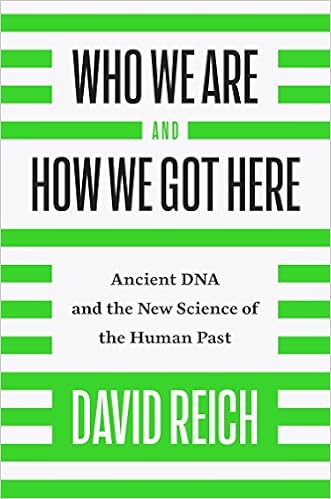
Book Review: David Reich - Who We Are and How We Got Here

This is absolutely the book to read if you're interested in genetic history, either your own or humanity's. Reich zooms out tens and hundreds of thousands of years ago, far past most Big History books, discussing how the latest research on recent discoveries of ancient DNA has begun to make sense of the vast movements of peoples in the dim unremembered mists of time from before we have written records. The rapid pace of technological advancement in genetics research, to the point where we can reconstruct detailed models of peoples we know only from scattered bone fragments, is challenging a lot of what we thought we knew about the past (did humans really evolve solely in Africa? how many waves of migration from Asia to the Americas? how recently did modern racial categories form?), and as astonishing as it is to imagine that we can track the migration and reproductive patterns of long-vanished ethnicities and even extinct subspecies like Neanderthals and Denisovans, genetics has advanced to the point where we can even identify "ghost populations" in our modern genomes - long-dead ancestors who have left no trace of language, settlement, or literature, but whose migrations and mixings live on in our DNA. The rapid pace of discovery in this field means many specific conclusions might be in flux, but as Reich shows, the wealth of knowledge unlocked by DNA sequencing means fields like history and anthropology already have plenty to chew on. I haven't found this kind of rigorous, sustained investigation of the deep roots of our ancestry anywhere else.