Showing posts with label politics. Show all posts

Thursday, June 25, 2020

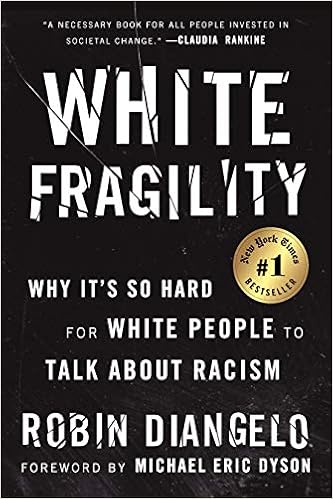
Book Review: Robin DiAngelo - White Fragility


Imagine a guy arguing with his girlfriend by simply repeating "you're too emotional" at her for a few hours, and that's DiAngelo's book in a nutshell. One of the most depressing things about racism, apart from its immorality, injustice, etc., is how stupid it makes us all. I don't know how else to explain the popularity of this cynical, predatory cash-in, other than that emotionally-charged subjects like race remove our ability to think critically. Scam artists like DiAngelo claiming to palliate racism through word games, sophistry, bad history, and gimmick corporate seminars should remind us of medieval physicians waving leeches at us to treat an imbalance of the humours, but here we are sending her book up the charts in a desperate effort to avoid real work about racism and systemic inequalities

A rational society would think twice about the incentive structure behind DiAngelo's business model - a white person paid thousands of dollars an hour to tell other white people what the correct opinions about minorities to have are - but an increasingly bureaucratized America addicted to rebranding its social problems as HR issues will naturally turn to familiar corporate solutions like this. Anyone who's had to sit through mandatory training knows that it's easier to just turn off your brain, let this stuff wash over you, and check the box marked Training Complete at the end: who wouldn't rather do that than real work? This book is short, repetitive, and written at bozo level, so if you are a white American who's feeling lazy, then buying and reading it might be a fairly cost- and time-effective alternative to activism, independent thought, self-education, or, god forbid, actually talking to a person of color.

Like many people, I came across this book just after the George Floyd protests. I think active anti-racism is incredibly important, and anyone with a conscience should be disgusted and outraged not only by specific instances of police brutality, but about the entire social system behind events like that. We have an obligation to each other and ourselves to speak up when something is wrong, and there's absolutely no shortage of work to be done. Part of that work is self-education, which is why I have such a viscerally negative reaction to this vile little tract, which DiAngelo frankly admits is not designed to convince open or even closet racists to be less racist. Quite the opposite - its goal is to convince well-meaning white people trying to be not-racist that in fact they were actually racist all along without them having known it. This is a strange tactic if your goal is to reduce the overall goal of racism in a society, but DiAngelo's real goal is to maintain her lifetime sinecure of bullying hapless victims in corporate workshops with carefully constructed trap-door arguments about privilege that are impossible to engage in good-faith dialogue with. 

A great example of how poisonous DiAngelo's approach is comes in chapter 5, which begins with the banal observation that the world is not neatly divided between bad racism and good anti-racism, and ends concluding that thinking some more about anti-racism is the best thing to do (or something; it's often hard to tell what her point is, especially when she starts "conceptualizing myself on an active continuum"). DiAngelo shares a story from one of her workshops where a participant related an interaction she had with some parents protesting against the black-white achievement gap in schoolchildren. In retelling the incident, which concludes with the teacher admitting that one particular protestor was correct to point out that she didn't understand the schoolchildren and so she needed to do some further thinking, the participant imitated the protestor in a way that was "bordering on racial mockery".

DiAngelo heroically points out the participant's problematic racism-adjacency, the particpant gets a bad case of white fragility and quits the workshop, and DiAngelo is acclaimed by the rest of the participants, white and black alike, for her virtue (no, DiAngelo is not being a white savior, how dare you even think that). To DiAngelo, all that matters is that one white person might have told a difficult personal story of vulnerability and growth, in a workshop theoretically designed for that very purpose, in a problematic way; to anyone else, this is a near-criminal exercise in missing the point. What about the black-white achievement gap in schoolchildren? How is DiAngelo helping those children via her terrible facilitation skills? Is DiAngelo actually accomplishing anything at all here?

This book is a master class on how not to run a seminar, in particular chapter 10, where she systematically explains why normal rules for facilitators like Don't judge, Don't make assumptions, Assume good intentions, and Respect don't apply to her. Throughout the book, DiAngelo takes advantage of the fact that an effective debate tactic is to choose your terms so that it's definitionally impossible to respond to you. This makes you come off like an asshole, but in scenarios where you don't actually care about having a real dialogue - you're in high school debate club, or you don't care if your girlfriend breaks up with you, or you're leading a mandatory corporate seminar and your audience effectively isn't allowed to disagree with you - it works great. The classic example is accusing your opponent of being "disagreeable", which gives your victim 3 basic options to respond:
  1. Disagree, which means they prove your point
  2. Agree, which means they concede your point
  3. Try to deny the premise indirectly, which is usually too difficult to do on the fly and makes them look like they're dodging the question
This kind of vague character-based attack often works because it's very difficult to instantly refute, and partially because if you do it right it's undeniably true, up to a point: of course every single person disagrees with at least something at some point in their life. We all know people who genuinely are disagreeable, in the sense that they are exceptionally quarrelsome or disputatious, but there isn't a bright line between those people and you or I, because basically all interesting human behavior exists on a spectrum. This means that the term usually isn't very meaningful as an insult, and so we need to reserve it for exceptions; throwing out the accusation "disagreeable" in an argument with the goal of scoring a point will serve only to shut down discussion and annoy most people, who correctly recognize it as a cheap debate trick, while paradoxically making the actual disagreeable people delighted - after all, they love to disagree! Apparently the fancy term for this is "Kafka trap", from his novel The Trial, and it works similarly with any other charge where your only real goal is to wrong-foot your opponent (accusing someone of being "defensive" is another classic). Heads DiAngelo wins, tails you lose!

This rhetorical snare is DiAngelo's entire shtick with "white fragility", a term she invented herself and which she finds everywhere she looks. (Does the term "white fragility" logically imply related terms like "white robustness" or "black fragility"? It's better not to ask.) Maybe it's impolite to notice that DiAngelo makes a lot of money off of her white fragility concept (in 2019 she charged the University of Kentucky $12,000 for a 2 hour workshop, and she does plenty of these events), but you just can't help but be skeptical about the convenience of her circular logic as she continuously diagnoses everyone who questions her premises as exhibiting more white fragility. She writes about the idea of white fragility at great length, yet for much of the book there is no simple handy definition for the reader to be able to know it when we see it as we page through her muddled sociology and examples of her victims getting reacting poorly whenever she lobs the term at them. As far as the reader is concerned, "white fragility" seems to boil down to "doesn't like to be called a racist", but much like with calling someone "disagreeable" this isn't very helpful: yes, you would expect a racist to react poorly to being called out, but you would also expect that from a non-racist. The closest intelligible definition of white fragility we get is a bullet point list in chapter 4, which she says is the "foundation" of white fragility:
  • Preference for racial segregation, and a lack of a sense of loss about segregation
  • Lack of understanding about what racism is
  • Seeing ourselves as individuals, exempt from the forces of racial socialization
  • Failure to understand that we bring our group's history with us, that history matters
  • Assuming everyone is having or can have our experience
  • Lack of racial humility, and unwillingness to listen
  • Dismissing what we don't understand
  • Lack of authentic interest in the perspectives of people of color
  • Wanting to jump over the hard, personal work and get to "solutions"
  • Confusing disagreement with not understanding
  • Need to maintain white solidarity, to save face, to look good
  • Guilt that paralyzes or allows inaction
  • Defensiveness about any suggestion that we are connected to racism
  • A focus on intentions over impact
There are a handful of bullet points in this list that DiAngelo is unambiguously correct about: yes, someone who prefers racial segregation is definitely a racist. Most of this list, though, has less to do with racism and more to do with "doesn't react well to DiAngelo". This conceptual slipperiness behind the title concept should bother a fair-minded person in any setting, but DiAngelo leads workshops, which is where much of the book is focused. She spends a lot of time gleefully recounting the confusion and hostility of her workshop participants, yet it genuinely seems not to occur to her that vulnerable employees in a workplace setting might react poorly to being accused of any amount of racial insensitivity in front of people they have to see and work with the next day, or that she could simply be wrong.

DiAngelo is Seymour Skinner in that immortal Simpsons meme, wondering "Am I so out of touch? No, it's the recipients of my incredibly correct racial insights who are wrong". Only a liar or an idiot would deny that workplace racism is a serious problem in America, but only a grifter like DiAngelo would conclude that the best way to address discrimination at places of employment is to hire an academic to facilitate struggle sessions for non-unionized workers when the wrong word could be the kiss of death. She only barely alludes to and doesn't discuss in detail any of the countless actual instances of explicit racial discrimination in hiring, promotion, retention, or salary structure that have come up over the entire history of the United States and persist today, all she's interested in are vague thoughtcrime sentiments, because word games are her bread and butter.

For anyone hoping to actually learn anything from this book, that's probably the single biggest obstacle. She's using terms like "racism", "white supremacy", etc differently than normal people, in classic academic jargon fashion, so that you can then hire her to explain it to you. There are thousands of books debating race as biological vs sociological vs legal construct, but most people have converged on basic common understandings of words like "racism" as "an act of discrimination based on someone's race", or "white supremacy" as "the belief that white people are inherently superior to other races", and so forth.

That's not enough for DiAngelo, who is trying to ensure a broader market for her services by connecting racism to as many other concepts as possible, even theoretically neutral ones. It's one thing to point out (correctly) that in practice, America's rhetoric of individualism, meritocracy, and so forth has not matched its practice, or that racists have often couched their appeals in the seemingly neutral language of small government, low taxes, and neighborhood character. It's quite another to identify those very concepts themselves with white people, because that leads her to say weird things like this:
Whiteness rests upon a foundational premise: the definition of whites as the norm or standard for human, and people of color as a deviation from that norm. Whiteness is not acknowledged by white people, and the white reference point is assumed to be universal and is imposed on everyone. White people find it very difficult to think about whiteness as a specific state of being that could have an impact on one's life and perceptions.
The reason that it's difficult to think that way is because the only people who take thought patterns like that seriously are white supremacists! DiAngelo is almost too interested in getting white people to explicitly think of themselves as white people, in a manner that should set off alarm bells in your head. Hitler jokes aside ("You know who else really wanted white people to think about whiteness as a specific state of being?"), reading this book is to discover that DiAngelo actually sees the world very similarly to white supremacists, just with the sign reversed. In anecdote after anecdote, DiAngelo is incapable of understanding the world through any frame but one: white people are history's protagonists and everyone else is sort of along for the ride, forever outsiders, incapable of agency or defining their terms of their existence on their own, caught in a web of white supremacy that they can never escape (unless someone pays DiAngelo a lot of money, presumably). 

DiAngelo can get away with this because, as she says, her primary audience is white people, specifically white people in the Anglophere, but really just the United States. So if you are among the more than 95% of the planet who is not a white American, this book is basically just a testament to the true force of white narcissism at maximum intensity. This extends to her scholarship: a few nonwhite people get quoted from time to time, but never in a manner that indicates that DiAngelo is actually in dialogue with them, only that she's willing to appropriate their words for her own project. Let's not even discuss her historical inaccuracies, which a less polite person might term "lies".

I will try to find some good things to say about the book, because DiAngelo does at least mention many true facts: it is possible for well-meaning people to be complicit in or promoters of racism; there are massive racial disparities in power, wealth, health, and social status in America; American history is littered with criminal racial violence from the beginning up to this very day; racism hurts everyone, including white people; white people could stand to consider the impact their thoughts and actions have on others even if they didn't think they were being offensive; white people often artificially separate elements of non-white American culture like food, dress, music, and history from "mainstream" American culture into special non-white ethnic categories; patterns of racism and segregation are frequently maintained using carefully-chosen neutral phrases and legal regimes to disguise disparate impacts; merely to live your life in America as a white person can mean taking much for granted without even realizing it (white privilege is absolutely real); all of us could do more to make the America and the world a gentler and kinder place.

But you solve no problems by giving DiAngelo a single penny, whether by buying this book (I didn't) or ponying up for one of her seminars. When you get right down to it, DiAngelo's efforts to focus all attention on your individual thoughts and behaviors and none on America's broken laws are exactly identical to all the tedious debates you hear about whether it's fair to force people to not use plastic straws, when meanwhile fossil fuel plants are burning billions of tons of CO2 a year. If you actually care about climate change, then it's a complete waste of time to guilt-trip people about straws - you should be helping to get clean energy laws passed (and given that people of color are disproportionately affected by climate change, you'd be doing even more good). Go donate money to sustainable energy groups! Support the Green New Deal! But then there wouldn't be any money left to pay a straw fragility consultant thousands of dollars an hour to lecture you about how even if you don't use straws at all you're still destroying the planet, and as it turns out strawmen, are DiAngelo's entire business model.

Tuesday, December 31, 2019

Book Review: Inga Clendinnen - Aztecs: An Interpretation

The pre-Columbian Aztecs are a tough people to really know, not only given their own tendencies towards self-glorification, but also because the systematic Spanish attempt to eliminate the existing structure and memory of Aztec society in order to replace it with something more palatable and familiar was successful, and therefore scattered records and summarized codices are in large part all we have. Clendinnen has written a very sympathetic, very detailed attempt to capture what Aztec society felt like for the average person - warriors, priests, merchants, women - and to recreate as much as possible of the world that was lost. This means that her interpretive efforts are therefore more than a little speculative in many parts, yet she does a magnificent job of conveying the appeal of the culture while not downplaying the miserable relationship the Aztecs had with their neighbors, in particular the grim horrors of their most infamous ritual practice.

One of the interesting things about the Aztecs is how different their attitude towards empire was than that of natural comparisons like the Romans. From their founding as the "Triple Alliance" union of the city-states Tenochtitlan, Texcoco, and Tlateloco in 1428, they fought nearly continuous wars against nearby cities until the Spanish conquest in 1521, but instead of aggressive expansion and incorporation of subject peoples in order to increase their strength for the next war, they preferred to merely acquire fealty from the enemy nobility and exact regular tribute. There might be several reasons why the Aztecs did not have the same urge to imperiogenesis as other civilizations: James Scott's book Against the Grain argues in part that grain cultivation is uniquely well-suited to despotism, and perhaps corn is less so; or perhaps the mountainous terrain in central Mexico is more similar to Greece, which also remained hard to consolidate for a long time, than the easy plains of Italy, making lasting conquest more difficult (though compare against the Incas to the south). There was a good chapter in Peter Turchin's Ultrasociety that explored how the nearly impassable mountains of Papua New Guinea allowed just enough contact between tribes to permit warfare, but not enough to make lasting conquest feasible. This did not encourage peaceful coexistence: the near-constant low-level warfare was less deadly in any given clash than in, say, a typical Roman battle, but there were far more of them, and so overall mortality in war was higher in a society of small-scale villages then in large-scale complex societies. Clendinnen emphasizes the almost nonexistent unifying forces at work in the imperial hierarchy:
It is worth taking time over this oddly based polity, crucial as it is for an understanding of the city's workings, as for the process of its final destruction. Tenochtitlan was no Rome, despite the magnificence of its monuments, the steady inflow of tribute goods, and their spectacular consumption in a state-financed theatre. Subjugation did not mean incorporation. There was no significant bureaucracy in the Mexica 'empire', and few garrisons either. Marriage alliances linked the leading dynasties, while lesser local rulers were typically left in place and effectively autonomous, at least for as long as their towns delivered the agreed tribute to the imperial city. Even in those rare cases when the defeated ruler was killed, the dynasty was usually allowed to survive. But if local rulers spent months in the Mexica capital, they did not thereby become Mexica, and when their military contingents were called on to fight for the Triple Alliance they did so under their own leaders and banners. The 'empire' was an acrobats' pyramid, a precarious structure of the more privileged lording it over the less, with those poised on the highest level triumphant, but nervously attentive to any premonitory shift or shuffle from below.
The human sacrifice is of course the most famous form of tribute the Aztecs demanded, like Theseus and the Minotaur on a much larger scale. Sacrifices were done as triumphs after a successful military campaign, as commemorations of important events like the ascension of a new ruler or the completion of a major temple, or to propitiate the rain god Tlaloc as part of the regular rotation of harvest festivals like Tlacaxipeualiztli, Etzalqualiztli, Ochpaniztli, and Panquetzaliztli. About this practice of human sacrifice, which is rightly the become the main thing people know about Aztec culture, perhaps the only thing that can be said is that those unhappy victims had plenty of company, as Aztec culture was pretty brutal even for Aztecs:
When the spoils of war and the tribute from other towns subject to the conquered overlord city came into the hands of the Mexica ruler, he chose to distribute them not to the collectivities of the calpullis, but to specially distinguished warriors in the form of offices and titles, with attendant privileges and worked lands, so, it is said, creating a nobility and a bureaucracy at a blow.
Warrior arrogance always commanded a wide social space in the city. Given their reward-by-privilege expectations and their systematic elevation over lesser men, extortion was always a tempting possibility. From time to time it was discovered that warriors had levied an unofficial tribute on the town, 'perchance of chocolate (cacao), or food'. Such gross invasion of the prerogative of the state invoked the punitive violence of the state, and Mexica state justice was summary, brutal, public, and often enough lethal. Most offenders against Moctezoma's laws died most publicly, with the marketplace the favoured venue, where adulterers were stoned or strangled and habitual drunkards had their heads beaten in by Moctezoma's executioners.
Fun stuff. Clendinnen is careful to note that, as with all societies, vicious cruelty lived alongside warmth and humanity, and she works as hard as she can to convey the magnificent grandeur of the Aztecs. The reader can judge for themselves which aspects of Aztec culture were most affecting, but by the end of the book, as the Aztec's neighbors and subjects joined with the Spanish to destroy their vampiric clench, I still felt for them, though not too much. The Spanish had plenty of admiration for the Aztecs as builders and administrators, and indeed as Clendinnen points out, it is telling that one of the laments written after the Spanish conquest is really mourning for the city more than it is for the people:
Broken spears lie in the roads;
we have torn our hair in our grief.
The houses are roofless now, and their walls
are red with blood.
Worms are swarming in the streets and plazas,
and the walls are splattered with gore.
the water has turned red, as if it were dyed,
and when we drink it,
it has the taste of brine.
We have pounded our hands in despair
against the adobe walls,
for our inheritance, our city, is lost and dead.
The shields of our warriors were its defence,
but they could not save it.

Tuesday, September 24, 2019

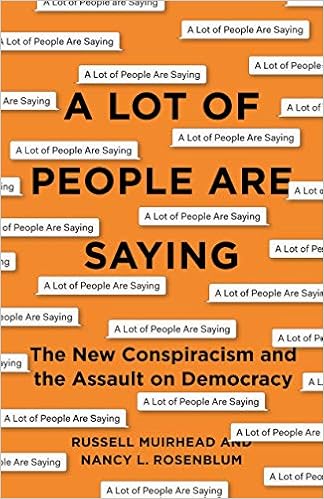
Book Review: Russell Muirhead, Nancy Rosenblum - A Lot of People Are Saying

I was predisposed to agree with Muirhead and Rosenblum's main thesis (roughly that "the relatively unmoderated chaos of the internet has allowed Republicans to spew more bullshit faster than ever before, accentuating a general crisis of confidence in institutions") before even reading the book, but reading their argument at length gave me a bit more to chew on. I'm not sure that the "new conspiracism" of the subtitle ("a conspiracy theory without the theory") is really so different than the old-school conspiracy theories they use as a comparison, since both "conspiracy" and "theory" are not so easily defined, and it's often hard to see a real distinction between stupid things people believe now and the stupid things they've always believed. However, I do think there is a good case that something has changed about how controversies are treated in the media, which allows for stupid beliefs to persist and even flourish in a way that they haven't been able to before, and therefore the sheer volume of persistent conspiracy theories that's accumulated has poisoned the well of public discourse. Muirhead and Rosenblum have impeccably logical explanations for how Donald Trump et al's style of habitually repeating malicious lies destabilizes institutions in a negative feedback cycle, and even though "cranky right-wing idiot" is a familiar archetype across both American history and the world stage, the fact that someone of his caliber was able to be elected President says more about our rotten institutions than it does about him. They're predictably less useful on the solutions front, but they're hardly alone in that.

Their thesis is that there is a difference between "classic" conspiracy theories and the "new conspiracism". Classic conspiracy theories identify an event or state of the world, posit an explanation for that event or state, and tie that explanation to a political theory. For example, JFK wasn't randomly killed by Oswald the lone nut, he was deliberately assassinated by the Mafia over RFK's prosecution of organized crime, or by the CIA over the Bay of Pigs fiasco, or by LBJ over his ambition to be President, and the resulting change of administration either directly or indirectly benefited the parties involved (they also have the fantastic example of the Declaration of Independence as a conspiracy theorist document, which is both hilarious and also a little goofy). In contrast, the new conspiracism is just an endless series of unfalsifiable negative assertions, where it's basically irrelevant if any specific claim happens to be true. Pizzagate is a representative example, where prominent Democrats like Hillary Clinton and John Podesta are supposedly running a child sex slavery ring out of the basement of a Washington DC pizza joint as fronts for a global network of Satanic elites, and the most maximally tortured possible reading of Podesta's hacked emails are used to find coded messages that confirm a worldwide human trafficking network and all these other nefarious deeds. If any particular detail doesn't seem to hold up to scrutiny, there's always another "but what about THIS?!" accusation that, unless exhaustively disproven, serves as yet more proof that Hillary Clinton and company are Sandusky crossed with Dahmer raised to the power of the Rothschilds.

So their main distinction between the new conspiracism and the old is that conspiracy theories are now unkillable, and in fact oddly nihilistic, since their proponents don't actually expect anyone to do much about these supposed crimes (e.g. QAnon adherents have to invent ever more elaborate explanations for why all these people are not in jail if they're so obviously guilty, whereas independence was the "solution" for the American revolutionaries). Instead of being able to say "actually, John Podesta's risotto recipe is just a risotto recipe, therefore it's not evidence of a sex dungeon in a pizza restaurant, therefore Hillary Clinton is probably not running a pedophile ring" in the same way as you used to be able to say "actually, the single bullet explanation is consistent with how JFK and Connally were seated relative to each other, therefore it's not evidence of multiple gunmen, therefore there probably weren't any shooters other than Oswald", the hapless normal person attempting to respond to this stuff will always be confronted by new accusations of vile perfidy with proof perpetually just over the horizon, an endlessly wearying vista of fever dreams to beat back. The rise of the internet has propelled this new conspiracism from the fringes to the center of our discourse, allowing unscrupulous figures like Donald Trump to rise to power on a tidal wave of bullshit, since we're all drowning in information and our pudding-like brains will just accept whatever confirms our prior beliefs, and even if in theory the left and the right should be equally susceptible to nonsense, right-wing new conspiracism is aimed directly at institutions themselves, which furthers even more the sense of a world adrift without any adults in charge.

Stated in that way their distinction sounds reasonable, but I'm skeptical if there's a true difference, or if the internet has just presented us with far more information to have to analyze while simultaneously destroying our attention spans and critical thinking skills. It's hard to say that new conspiracy theories like Birtherism or the products of the Arkansas Project are different and more unkillable than JFK conspiracy theories when the JFK conspiracy theory industry is still alive and kicking after over 50 years (the conspiracy merch vendors outside the Sixth Floor Museum all stand by their products). To their detriment, Muirhead and Rosenblum never try to actually define what the "unit" of a conspiracy theory is, so we can't really say if conspiracy theories have gotten more elaborate or implausible or unfalsifiable over time. Matt Taibbi once had a great article called "The Hopeless Stupidity of 9/11 Conspiracies" mocking the bizarre mental contortions required to even begin to make sense of the supposed 9/11 plot (which M & R oddly classify as an old-school conspiracy theory), but it's obviously never been the case that most people actually write down every step of the whole chain of logic in their pet theory from the very beginning, they'll just take it for granted that someone else has already done the legwork and build on that foundation. These days adherents share increasingly inscrutable conspiracy memes with each other on Facebook, but I'm sure the John Birch Society's tracts and pamphlets were not much different. I grew up watching The X-Files, an incredibly prescient show which they somehow don't cite even once, and watching it gave me appreciation for how fun it is to spin lurid tales of shadowy conspiracies, as well as how little sense most conspiracies make once you start looking at them critically, but even then, an overarching conspiracy that's incoherent as a whole can look very plausible on the day by day or episode by episode level.

All of this is in novels like Foucault's Pendulum, but another example of that's near and dear to my heart is Alex Jones. Back when I was in high school, he had yet to make his unfortunate transformation from Austin's "lovable local nutcase" into a nationally infamous deranged hoax promoter, and I would sometimes listen to his radio show for kicks on my drive home from school. Alex Jones would think nothing of having a rant about how global warming was obviously fake and a UN plot to steal our freedoms and make America a fascist socialist police state segue smoothly into a rant about how global warming was actually all too real and would be exploited by crony capitalist elites like Bill Gates and the Bilderbergs to get third world countries hooked on GMO foods and surveillance technology. To a rational outsider, the coexistence of plainly incompatible conspiracy theories like that should give you pause - perhaps either hypothesis might be true, but both can't be true at the same time, and if someone persists in this simultaneous contradiction for too long, the safe bet is to discount their whole belief system entirely. And yet for many people, the opposite happens, and each individual pseudo-fact becomes just another data point that they can plug into their own private X-Files, drawing their personalized conspiracist constellations atop the infinite sky of suspicious stars.

After all, all conspiracy theories exist on a continuum of plausibility, and, unfortunately sometimes conspiracies are actually real. Pizzagate isn't real, but what about Jeffrey Epstein? Oswald may have been a lone gunman, but isn't it true that he had an enormous number of truly odd and questionable connections to important figures of the day, and hasn't the US supported exactly these kinds of shadow coups abroad? The whole world is a Pynchon novel that we're all trapped in, and when you start linking individual theories together there's no end to the mischief you can cause. A semi-normal person who started out believing in "plausible" conspiracy theories like the Clinton Foundation stuff and was predisposed to right-wing tribalism could easily be gradually led into the swamps of Pizzagate and QAnon, never to return, no matter how vigorously the original entry point was debunked, because once they cross the Rubicon everything they read just feeds into the unshakeable conviction that "Hillary Clinton is part of an evil cabal". A diagram of the supposed "Clinton body count" victims might look crazy to an outsider in the same way that the central conspiracy of The X-Files doesn't make much sense if you try to write the whole mythology out on paper, and yet at the same time the idea that Hillary Clinton has had dozens of people directly murdered is an effectively impossibly daunting mountain to scale for the brave soul who's trying to deprogram their Fox News-poisoned relative, especially when they won't trust any outside sources of information.

The problem of "epistemic closure" is another depressing facet of this phenomenon, perhaps the main one. Julian Sanchez first applied the philosophical term to politics in a 2010 blog post titled "Epistemic Closure, Technology, and the End of Distance" which has held up extremely well, even down to his specific example of how conservatives tuned out reality when the rest of the country objected to their being pointlessly cruel to a teenager (liberals are of course not immune to this tendency either, but it's obviously nowhere near to the same degree). There's a few books out there - Anna Merlan's Republic of Lies, Martin Gurri's Revolt of the Public - which delve more deeply into the logic of the collapse in public trust in media figures, but it's hard to see a good way out of this based solely on mass media literacy. Centralized big media companies have well-known flaws, but the solution to ossified corrupt hierarchies probably shouldn't be random people with blogs, except that it probably also shouldn't be unaccountable algorithms deciding what's trustworthy and what's not. The ceaseless, self-reinforcing rage storm that gets called "populism" is incompatible with a pluralist society, yet populist leaders (invariably grifters who feed on the stupidity of their supporters, as in Trump) just start to delegitimize any sources of disproof, since as the saying goes "you can't reason someone out of something they didn't reason themselves into".

Muirhead and Rosenblum effectively have no solution to our political structure circling the drain, beyond general calls to stand up for democracy and institutions, but I didn't really expect them to solve the result of decades of of determined efforts to build a right-wing alternate reality machine in a <200 page book. Last year Michael Bang Petersen, Mathias Osmundsen, and Kevin Arceneaux won an award for their paper "A 'Need for Chaos' and the Sharing of Hostile Political Rumors in Advanced Democracies", which bears directly on this problem. Their conclusion was that a big motivator for people who just really love stupid conspiracy theories was economic stagnation, which gets translated into a general "some men just want to watch the world burn" mentality. So theoretically a better economy coupled with electoral reform coupled with enforcement penalties for bad actors à la House Democrats' proposals in HR1 will somewhat reduce this poisonous conspiracism, except that ironically conspiracists also love voting for right-wing con artists who won't do anything at all to aid the economy and will in fact just entrench themselves further to use the levers of power to steal from the public commons. I think the best solution is to support liberal/progressive/left-wing political candidates who will break the stranglehold of the elites, but that's a lot easier said, even if a lot of people are saying it too, than done.

Thursday, June 6, 2019

Book Review: Luo Guanzhong - Romance of the Three Kingdoms Volume 2

This second volume of Romance of the Three Kingdoms, covering chapters 33 to 63, was just as awesome as the first. The breathlless pace of the action seems to move faster than the story, as each chapter is still crammed with detail, and so it's often hard to judge how much time is passing within or between scenes, but the expansion of the storyline to include the real beginnings of the infamous division into three kingdoms unfolds in a logical and seemingly inevitable way, one stratagem, double-cross, and blood oath at a time. Despite the inclusion of the most epic battles yet, it's a study in decision and indecision as well, as more powerful warlords like Liu Biao and Sun Quan risk repeating the fate of Yuan Shao in the face of Cao Cao's relentless ambition. It starts off with Cao Cao consolidating the north, his son Cao Pi marrying Yuan Shao's widow Lady Zhen, and ends with Liu Bei riding off west into the Riverlands to found his own kingdom, but there's seemingly entire books in between.

This volume made me think more about the problem of leadership, specifically of how the characters attempt to enforce or encourage loyalty. This has been one of the underlying themes of the book from the very beginning, of course, but it's in this stretch of the story that the Emperor fades into the background and the three kingdoms begin to solidify, and loyalty is no less important in the destruction of one regime than in the creation of another. In an environment like the collapse of the Han dynasty, where there's a nominally all-powerful Emperor but in practice a nearly unlimited amount of autonomy for essentially independent petty warlords, individuals are confronted by an extra layer of moral choice that informs their actions. How should one balance allegiance to the sovereign with filial duties, and obedience to liege lords against an oath sworn to brothers? Watching the many characters grapple with their moral compasses in the face of all the momentous decisions they make in life-or-death situations each chapter is a real pleasure, even if they're unsure of the right course themselves, and even through Luo's determined editorializing between the Big Two. Liu Bei, the hero who, we're continually told, draws men to him through his virtuous nature and noble deeds, has the same problem of winning his own place in the world as his duplicitous antagonist Cao Cao, who's universally derided as a crafty yet corrosive force, yet it's often difficult to see a principled difference between them.

For example, towards the end of the volume, at a crucial moment in the balance of power between the north and the south, Zhang Song travels to Cao Cao near the end to offer him the vitally strategic area of the Riverlands, but he gives up because they're each too stubborn and prideful, and he simply offers the territory to Liu Bei instead. This momentous decision is presented as right and proper, a result of the magnetic attraction of Liu Bei and repulsion of Cao Cao, yet it's not so different than Pang Tong's disagreement and reconciliation with Zhang Fei, and in fact it's also quite similar to the many minor instances where a governor will surrender a town, or a general will defect at the end of a battle, and the decision to reward or execute them for their shift in fealty seems arbitrary rather than appropriate. There's probably literature out there on how Confucianist or Legalist ethics, or prestige and dominance leadership styles, could be formulated in game-theoretic terms, and how each individual conundrum of whether to keep an oath or do the most expedient thing fits into a coherent framework of morality; ultimately I decided to just sit back and enjoy my suspense and outrage cycles as the two decided whether the latest hapless provincial commander would be rewarded for switching sides or beheaded for his treachery as the circumstances above and beyond him shifted.

The real breakout star of this volume isn't Liu Bei or Cao Cao, however, but Kongming. The legends of his sagacity are so great that Liu Bei travels three times to convince him to come work for him, to the consternation of Guan Yu and Zhang Fei, whose jealousy at Kongming seeming to supplant them in Liu Bei's heart is a nice bit of character development. And the legends are true! If ever there was a character calculated to delight and entertain audiences, it would be the Sleeping Dragon, an impossibly clever advisor who can concoct ruses subtle enough to fool even Cao Cao and has a handy ability to summon up powerful winds to aid in battle. My favorite example of his ridiculous skill was the scene where Sun Quan's henchman Zhou Yu wants to offer Liu Bei a sham marriage to Lady Sun in order to take him hostage and force him to surrender the strategic province of Jingzhou, which Liu Bei was dragging his heels on relinquishing after the death of his kinsman Liu Biao. This is a dangerous trip for Liu Bei, but no worry: Kongming not only arranges matters so that Liu Bei keeps Jingzhou, but that he successfully marries Lady Sun for real, via the hilarious mechanism of literally giving general Zhao Zilong three sacks with instructions to open each one at the right time to get Liu Bei out of each of Zhou Yu's traps. The buddy comedy friendship between Kongming and fellow wizard Pang Tong is also a real highlight, as each occasionally drops in to make fun of the other before revealing their latest scheme.

Of course, Kongming is far more famous for his deceptive prowess at the Battle of Red Cliffs, which takes up a substantial portion of this volume. Once again I was left marveling at the skillful pacing and ingenious plotting: almost more space is devoted to the feints, deceptions, and betrayals leading up to the battle than to the action itself, and yet as Cao Cao's ill-fated expedition to conquer the south is left routed and shattered, thanks to Kongming's wheels-within-wheels ploys and last-minute conjuration of an east wind, you are never lacking for excitement. You're almost spoiled, too, since right before that is an equally-exciting chapters-long running fight as Liu Bei's retreating army and mass of villagers try to cross the Yangtze for safety in the south, and Cao Cao's forces are only barely held off in the Battle of Changban, where the (in my opinion underrated) Zhang Zilong makes one of his many clutch saves by rescuing Liu Bei's son against great odds (and not for the last time). The heroism and dramatic tension don't let up for a bit, and while there are many points where the ratio of clearly fictional "how could he have known?" strokes of impossible genius against more plausible Nth dimensional chess moves that real people might make gets a bit much, it's all so much fun you don't mind for a minute.

Now's no time to stop reading.

Wednesday, May 29, 2019

Book Review: Jason Brennan & Peter Jaworski - Markets Without Limits

I had an extremely polarized reaction to this book. Its central question - how exactly does money relate to morality? - is incredibly important, and its answer - if you may do something for free, then you may do it for money - is elucidated in a clear, convincing manner I've never seen anywhere else. I can't say that I fully agree with all of Brennan and Jaworski's arguments, but the main idea itself, that it's not immoral to buy or sell something for money unless it's also immoral to get or give it away for free, is worthy of a long ponder. Indeed, even though this book is clearly written from a libertarian perspective, you often encounter its central argument coming from "the left" in a surprising number of areas, even from those who don't subscribe to the infamous label "neoliberal", so it probably isn't all wrong. The notion that commodification introduces ethical problems is nearly universal, but lots of things are or were universal without being correct, and I think the logic here is strong enough that it's worthy of being promoted to the default view, in a John Stuart Mill sense, where the burden of proof should generally be on the side of market opposition and that we shouldn't restrict markets unless they can be shown to cause harm. However, the authors fail to convince in several specific areas where they don't engage with empirical evidence, such as when they try to argue that it should be legal to buy and sell votes, and their disengagement with many obvious real-world counter-examples means that even though I find the basic idea extremely compelling, much of the book falls into "nice in theory but maybe not in practice" territory.

One of the best running gags in Philip K Dick's Ubik, one of my favorite science fiction novels, is how awful a completely commodified future could be. Point of sale transactions are everywhere, and there's a great scene where the main character has to pay the door in his apartment to pass through it; without enough change to pay the door, he grabs a knife to start unscrewing it while the door threatens to sue him. Ever since I read it I agreed with the unspoken anti-capitalist logic: some things can be monetized out of great necessity, but by default market transactions are alienating and impersonal, and to pass through a door without paying is the very nexus of free and freedom. Yet after reading this book, I think there's a different lesson to be had: it's not that paying for doors is somehow wrong (after all, it costs money to make a door, thousands if not tens of thousands of people pay for door installation without a second thought every single day, and essentially all of us have paid for doors directly or indirectly via rent or mortgage payments), it's just that the micropayments model is inappropriate for doors for exactly the same reasons that Clay Shirky explained made it inappropriate for websites way back in 2000: transaction costs make many small payments far more inconvenient than a single simple door purchase. That's not the same thing as saying that doors shouldn't cost money, still less that buying and selling doors is immoral, and the authors expand on this basic idea and run with it for 200 pages. They outline 7 dimensions of market manner, and argue that many objections to markets are really objections to particular combinations of market manners, when other combinations would be perfectly fine. Those 7 dimensions are:

  1. Participants (buyer, seller, middleman, broker, etc.)
  2. Means of exchange (money, barter, local currency, bitcoins, gift cards, etc.)
  3. Price (high, low, moderate, etc.)
  4. Proportion / Distribution (how much each party gets)
  5. Mode of exchange (auction, lottery, bazaar, co-op, etc.)
  6. Mode of payment (salary, scholarship, tip, charitable contribution, etc.)
  7. Motive of exchange (for-profit, public benefit, cost-recovery, non-profit, charitable, etc.)

A socialist would immediately respond that even the mundane door market you find at Home Depot is still inherently immoral for the same reason that all markets are immoral: the exploitation and alienation of worker labor is wrong, full stop. I'm not a socialist and I disagree with that analysis, so a more interesting debate to have in my opinion is how the decision to buy or sell something affects our understanding of its "inherent" worth, given the failure of alternative models like the labor theory of value (as they astutely point out, "Marx thought that the value of the product was determined by the value of the labor that went into the product. On the contrary, it’s closer to the truth that the value of the labor that goes into the product is determined by the value of the product").

Libertarianism is hardly a less controversial framework than socialism for analyzing value, of course, but one benefit of neoclassical economics, or whatever you want to call the logic behind capitalism, is that it gives us perhaps the closest thing to a true utilitarian methodology we've yet discovered to compare the worth of things to different people, and the more you go looking for examples of seemingly "purely moral" situations where markets have not only not corrupted morality but improved people's lives the more you find. Karl Polanyi's fascinating The Great Transformation argued that markets have social contexts, and that even though the gradual introduction of markets irrevocably transformed the communal peasant societies of Europe into the liberal capitalist societies we see today, that there is no such thing as true laissez faire because you cannot truly separate a marketplace from the people in it, who act to protect themselves from its negative aspects. But are the downsides of markets inherent to markets as a whole, or only particular marketplaces where the 7 dimensions have been combined inappropriately? The Ubik door scene shows that it's possible to make door shopping into a completely normal and mundane part of life rather than a nightmarish dystopia, but there are plenty of other examples of where creating markets in things that were previously off-limits is not only normal but good.

One of Brennan and Jaworski's go-to examples is life insurance, particularly for children. In a world where life insurance doesn't exist, putting a price on the life of a child by means of paying a monthly premium to a company that will cut you a big check if the child dies sounds incredibly immoral and outrageous, if not like a perverse incentive for infanticide. However, in a world where life insurance is normal, it's opting out of life insurance that seems, at best, like a personal idiosyncrasy, whereas insuring your child is the adult and responsible thing to do. Furthermore, proposals to make the payouts of the gigantic life insurance system called Social Security stronger, and to bring more people into the gigantic health insurance system called Medicare, are not only perfectly orthodox left-wing ideas, they're supported even by socialists! So it's tough to argue that putting a price on human life is wrong in all contexts (note that paying for Medicare via payroll taxes instead of monthly premiums does not change the logic here), and it's easy to show that pricing human life can actually make us more careful and aware of each other. Remember that the idea is that markets don't introduce immorality where there was none before, so while it's still possible to have callous individuals and even murderers in a universally insured population, if they would have committed their murders anyway then it's hard to argue that insurance made them do it. And while murders for insurance money do of course happen, I think most people correctly see that scenario as an extremely rare perversion of an otherwise well-functioning system, and would hardly welcome the abolition of life insurance to "solve" that problem.

In that spirit, the authors group moral objections to commodification into 7 types, with the seventh having three forms:

  1. Exploitation: Markets in some good or service - such as organ sales - might encourage the strong to exploit (to take unjust advantage of) the vulnerable.
  2. Misallocation: Markets in certain goods and services - such as Ivy League admissions - might cause those goods to be allocated unjustly.
  3. Rights Violations: Markets in some good - such as slaves - might violate people's rights.
  4. Paternalism: Markets in some good or service - such as crystal meth or cigarettes - might cause people to make self-destructive choices.
  5. Harm to Others: Markets in some good or service - such as pit bulls or handguns - might lead to greater violence.
  6. Corruption: Participating in certain markets - such as buying luxury goods for oneself or Disney Princesses for one's daughters - will tend to cause us to develop defective preferences or character traits.
  7. Semiotics: Independently of objections 1-6, to allow a market in some good or service X is a form of communication that expresses the wrong attitude toward X or expresses an attitude that is incompatible with the intrinsic dignity of X, or would show disrespect or irreverence for some practice, custom, belief, or relationship with which X is associated. Three forms of this:
    1. The Mere Commodity Objection: Claims that buying and selling certain goods or services shows that one regards them as having merely instrumental value.
    2. The Wrong Signal Objection: Claims that buying and selling certain goods and services communicates, independently of one's attitudes, disrespect for the objects in question.
    3. The Wrong Currency Objection: Claims that inserting markets and money into certain kinds of relationships communicates estrangement and distance, and is objectionably impersonal.

In many cases, it seems like the fundamental objection is not the exchange of money, but the thing itself, and the most classic example of the intersection of money and morality where the typically "left" position is to support commodification is prostitution. Again, a perfectly consistent socialist position is that sex work, like all work, is fundamentally exploitative, but in practice, support for the legalization of exchanging money for sex is hardly a right-wing or exclusively libertarian idea in America today, and there are many impeccably leftist organizations attempting to alter prostitution regulations to protect workers or to organize them into unions to increase their bargaining power (i.e. to increase their wages, among other things). It's hard to see how legalizing prostitution harms sex workers relative to the status quo, and likewise, if a government were to suddenly criminalize a previously legal prostitution market, I don't think we would see that as helping or empowering them either.

Any use of those 7 moral objections about worker safety, consumer protection, power imbalances, or even sexual morality against a market for sex work has to grapple with the fact that most of them apply equally to the current absence of a market for sex work. The argument of "if you may do it for free, you may do it for money" is that there is no moral dividing line between a consensual one-night stand and a consensual visit to a prostitute, and that the addition of money doesn't in and of itself turn something that was okay into something that's not okay or vice versa. That seems correct to me, and it tracks with a similar argument about money in sports: at one point Olympic athletes were lauded as the same kind of "noble amateurs" that NCAA athletes are today; now no one blinks at Olympic athletes being firmly embedded in commerce, and it seems inevitable that college athletes will someday be paid as well, since it's the lack of payments to players which is the exploitation there. Brennan and Jaworski have many similar examples.

I don't want to sound unabashedly positive about the book, because I'm not. They insist correctly that empirical evidence should be the standard, but evidence is mighty scanty in the book itself, and their attempts to sum up vast fields of research in just a few "some studies say" paragraphs in order to argue for more markets are often spectacularly unconvincing. There's a bit on how paying for college admissions is just fine that feels particularly ill-timed in light of the "Operation Varsity Blues" admissions scandal, and at various points they weigh in on such weighty topics as whether markets necessarily "solve" racism or sexism, or whether school choice/vouchers have reduced costs without sacrificing quality, or whether it's a good idea to introduce tiered pricing for adopted babies based on their race and market demand, etc, in a manner that's anything but empirical. Does private industry or the government build better roads? A smart person could think of all sorts of philosophical rationales for one or the other, or even a combination of the two, but the fact that there is not a single obvious answer in the real world should make you skeptical of claims to be able to produce definitive public policy guidelines based on pure logic alone. These digressions are especially frustrating because strictly speaking they have nothing to do with the book's core thesis whatsoever. A government department building a road via tax revenue is in practice not much different than a private contractor building a road via bonds backed by expected future toll revenue, and though I agree that things like congestion pricing, which is a market for space on the highway during rush hour, would be helpful, it's not like you don't have underpaid women/minorities, failing charter schools, or discriminatory restaurants in the real world.

The nadir of their style of argumentation is in chapter 19, which is about vote-selling. Specifically, Brennan and Jaworski hope to show that, using the same "if you may do it for free, then you may do it for money" theorem which has served them so well so far, since it's totally fine for us to attempt to persuade each other to vote a particular way using words, that it is therefore perfectly kosher to take the next step and simply allow paying people to change their vote or stay home. Politicians already compete for votes in a market-like manner, voters in safe states already sometimes "trade" votes with voters in swing states, and spending money on campaigns is already often enough to make the difference in close elections, so let's just go ahead and legalize the outright purchase of votes. A lot of the heavy lifting in this chapter is done offscreen, by way of references to The Ethics of Voting, another of Brennan's books (he thinks that since most people are fairly uninformed, they shouldn't vote), and since it's boring to dive too deeply into artificial theories of voting on Justified True Beliefs wherein I the rational actor attempt to translate my ethical convictions into policy outcomes via the ballot box based on mechanistic cost-benefit incentives, I'll refrain.

Instead I'll just say that their thought experiment involving Ignorant Ignacio, Careless Carla, and Lackadaisical Loren to "prove" that buying votes is fine given the existence of stupid or lazy voters is wholly unsatisfying, and the complete absence of engagement with literally any political science literature is so brazen as to be almost comical, and in fact when I read this chapter I was in danger of throwing out the whole book in a rage despite agreeing with so much of it. I don't care if you think Citizens United was a good or bad decision, or if you think George Soros is better or worse than the Koch brothers, or how much public choice literature you have or haven't read, or if you do or don't generally trust politicians - anyone can set up a trolley problem where the moneyed elite being able to buy elections is good, actually, but reading about literally any corruption or election fraud scandal in history should be reason enough to pause when someone says that abandoning the democratic franchise in favor of giving powerful interests even more power will work out just great, trust me. Imagine using and trusting this system for even something as trivial as American Idol winners and it's laughable. Not even the Libertarian Party would choose to run its party primaries in this manner, allowing anyone with enough money (gold bars?) to simply purchase the nomination. It's like they read libertarian pundit PJ O'Rourke's quip that "When buying and selling are controlled by legislation, the first things to be bought and sold are legislators", and thought "yes, more of this".

Now, Brennan and Jaworski are perfectly aware of reactions like mine, and the final section of the book is devoted to why I'm wrong to have strong negative emotional reactions to insane proposals to legalize vote-fixing. Once again, in the most abstract terms their analysis makes perfect sense: time and again in history, people have said that markets are bad, and yet after markets were introduced, they turned out to be just fine and indeed irreplaceable. Douglas Irwin's excellent book Against the Tide recounts how weak arguments against the concept of free trade have been unkillable for thousands of years no matter how many times they're refuted, and Brennan and Jaworski are going for the same sort of thing here with respect to introducing markets in general. Disgust is a strong but unreliable guide to morality, and organ sales are a good example of how deadly emotion-based thinking can be - we laud an individual who donates a kidney to help out a stranger, but a real market in kidneys and other organs would be vastly more efficient, and we shouldn't let urban legends or sci-fi dystopias scare us out of saving many lives via market mechanisms in the same way as we shouldn't eliminate insurance systems because of lurid but extremely rare tabloid murders. So they are correct, in a sense, that my occasionally incredulous reactions fit into a general reactionary pattern, and that since I and many other liberals happily donate money to political campaigns to get our desired outcomes achieved via electoral success, it could theoretically be cheaper for us all to just cut out the campaign middlemen and simply pay our fellow citizens directly to vote our way.

Well, maybe. I feel bad concluding that "the authors are correct in a general sense yet incorrect in specific examples for reasons that I won't explain", so I will instead say that they include enough great examples of how markets not only don't corrupt virtues but enhance them to earn them a place in my mental toolbox regardless of the CITATIONS NEEDED sections, particularly with their taxonomies of market dimensions and moral objections to markets. They're absolutely right that we shouldn't think that store-bought flowers for a loved one are worse than garden-grown flowers, or that pet owners who have bought their pets from a store love them any less than owners who were given their pets by friends, or that managing demand by charging higher prices is less moral than creating giant queues (the BBQ joint Franklin in my city of Austin is infamous for forcing people to waste their time in 4-hour lines because Aaron Franklin refuses to either raise his brisket prices or expand his capacity beyond his personal control). In fact, one of the examples that they used in their own book, where they sold various levels of acknowledgements in a tiered pricing model, was disarmingly funny enough that it also seemed profound: if the concept of meaningful, heartfelt acknowledgements isn't ruined for everyone by a few authors deciding to auction off inclusion instead of following the typical spouse/children/parents pattern, what else could safely accommodate this model? Quite a lot, it seems, because one of the major advantages of capitalism is that it can transform zero-sum conflicts into positive-sum transactions. Just perhaps not quite as many transactions as they claim.

Wednesday, April 3, 2019

Book Review: Luo Guanzhong - Romance of the Three Kingdoms Volume 1

I'm not sure if the term "epic fantasy" applies to this work, since the standard line is that it's "70% history, 30% fiction", but whether it's shelved in "epic fantasy", "historical fiction", or even "magical realism", it's undoubtedly one of the masterpieces of literature. It's almost overwhelming in how full of everything it is: the whirlwind of characters, the unyielding pace of the action, and the seamless integration of so many little human details and emotions that give the many side-plots and minor characters a resonance far out of proportion to their brief page time. Like with all great literature, even those diversions are pure pleasure thanks to clever storytelling. Every chapter ends on a cliffhanger, each analeptic or proleptic excursion adds valuable depth and context to the main narrative, and the consistent treatment of the ways that individual honor, personal loyalty, and political duty overlap and conflict continuously give each and every decision by the main characters a real weight. Luo's account of the struggle to build a new world out of the decay of the old is as powerful as any modern work I can think of.

My edition of the Moss Roberts translation is split into 4 volumes for ease of reading. This volume begins with the immortal incipit "Here begins our tale. The empire, long divided, must unite; long united, must divide. Thus it has ever been." and the oath in the peach orchard between Liu Bei, Guan Yu, and Zhang Fei, and ends with Cao Cao's defeat of Yuan Shao at the battle of Jizhou (chapter 32 out of 120). You could spend a long, long time exegizing every aspect of the novel - its elastic grounding in the historical record and subsequent authorial "improvements"; its biases of heroism and colorations of personality that turn these real people into Homeric archetypes; the slight supernatural touches like the summoning of convenient storms, fatal hauntings of vengeful ghosts, or complex portents and astrological divinations; the way the actions of individuals recapitulate the recurrent patterns of imperiogenesis and imperiopathosis in Chinese history - but a few specific observations came most readily to mind as I finished the first quarter of the tale.

First, imperial power is a fascinating contradiction here. As the saying goes, "civilizations die from suicide, not by murder", and the slow disintegration of the Han dynasty amid the famines and religious fervor of the Yellow Scarves movement (interestingly, this colored clothing rebellion will be echoed several times more at similarly turbulent junctures in Chinese history) is reminiscent of a hollow, gradually rotting tree. While the Emperor's authority is nominally unlimited and he commands (nearly) universal respect, in practice the various warlords, rogue generals, and aristocrats seem to rule with complete independence, and the actual personage of the Emperor is treated somewhat like the puppet Roman Emperors after the Crisis of the Third Century (which by historical happenstance took place only a few decades after the events here), meaning that control of the military is paramount, and to be a successful general is almost synonymous with being a potential imperial claimant yourself. Many years later during the Yuan dynasty, in fact just as Luo was writing the collection of plays that this novel was compiled out of, someone coined the saying that "the mountains are high and the emperor is far away" as a way of highlighting how notional autocracy and practical independence can coexist simultaneously in the vastness of the Chinese landscape when a failing dynasty surrenders power to the court bureaucracy and a succession of generals.

Military strategy is also pretty thought-provoking, both for its realism and for its more whimsical moments. Many novels, even ones that make real efforts at military realism, often skimp on mundane details, like the importance of supply line logistics, the need to post sentries at night, how important the disposition of your troops are in pitched battles, or the finer points of besieging cities. Often lazy authors will describe their heroes as strategic geniuses, but leave the actual demonstrations of their acuity up to the reader's imagination. Not here! All the ingredients of military prowess are on full display, with Cao Cao in particular shown as a true mastermind of deception and consistently able to turn seemingly any setback into an opportunity thanks to his cleverness and willingness to listen to sound advice. The sheer quantity of his cunning feints and countermoves would be truly impressive even if they weren't (mostly) based on real history; both his wit and his opponents' foolishness are very convincingly rendered, as Luo also faithfully depicts the many ways that superior forces can be defeated by a leader's ill-timed vacillation, inconvenient bouts of drunkenness, stubbornness and inflexibility, or by just plain better tactics and superior hustle.

The flip side is that all of the major characters are all invincible superheroes with plot armor that would make the most hack fanfiction writers blush. Take a drink every time one of the protagonists kills an opponent with a single mighty blow, or fights through a crowd of enemies miraculously unscathed, or gets out of a jam by the impossibly convenient arrival of reinforcements just in the nick of time, and in just a few chapters you will be drunker than Zhang Fei himself! It's one of the fictional scenes, but when Guan Yu slays a series of six generals on a single journey to reunite with Liu Bei, it feels like you're reading a novelization of the Dynasty Warriors video games, which are based on this material, and not the other way around. Even when a main character finally dies, it's invariably in a protracted, grandiose boss battle. And yet somehow the comic book-like action sequences, or the occasional appearances of magic, never feel out of place or untrue to the broader story, as malefactors like Dong Zhou appear and then are vanquished according to the inscrutable dictates of the heavens as well as the familiar laws of villainous peril and heroic resolution.

And thanks to Luo's consistent editorializing to let you know who's good and who's bad, the main characters are all memorable and sympathetic to the point where you can't help but get emotionally invested in their fates like the worst kind of nerd fanboy. Luo's obvious cheerleading for Liu Bei and his oath-brothers Guan Yu and Zhang Fei comes off as almost charming, even though I can't be the only person who got a bit sick over how exaggeratedly noble and virtuous Luo makes him appear at every opportunity. And by the same token, Cao Cao really doesn't seem like as bad a guy as Luo tries to paint him; not only is he the smartest guy around and sincerely reluctant to seize the throne illegitimately, he consistently tries to persuade his enemies over to his side and forgive their past enmities whenever possible. His occasional ruthlessness is of the "it's all in the game" variety, and his "big transgression" of honestly taking credit for killing the deer on the royal hunt when the Emperor missed it is so laughably petty that, when the rest of the imperial court flipped out, I wanted him to just take power right then and there. We're reminded that the Han dynasty is rotten and corrupt every single chapter; might as well let someone with some talent take the reins. I'm firmly on Team Cao Cao, for now at least.

I can't imagine anyone reading this far and not continuing to the next volume as quickly as humanly possible.

Wednesday, March 13, 2019

Book Review: Peter Turchin - Ages of Discord

If anyone can claim to be making Isaac Asimov's dream of psychohistory manifest it's Turchin, who has done more work to create a truly scientific and predictive theory of macrohistorical patterns than probably anyone else. While this is of course impossible in the strictly Asimovian sense of being able to tell exactly when major crises will arise - and unlike Asimov, Turchin does not even pretend to then be able to present timely solutions via hologram - this book makes a convincing argument that we can discern real lessons about general trends in societal upheaval, while still humbly emphasizing how difficult it is to make even modest predictions about the future. Unfortunately, as the title unhappily alludes to, Turchin's prediction is that the 2020s will be even more unpleasant than today, an era of strife that echoes previous periods in history where the existing social order proved unable to accommodate internal divisions, and the political system could not easily resolve these tensions due to elite greed and status-hoarding. While not Marxist in analysis or conclusion, Turchin's Structural-Demographic Theory broadly aligns with the notion that the rich and powerful have diverted too much of society's wealth and privilege towards themselves, and general wage stagnation combined with class immobility is already having dangerously destabilizing effects on our cultural norms. Even though the book's prognosis is negative, it's just as high-quality as Turchin's other recent works, which collectively form one of the most impressive oeuvres in contemporary social science.

The idea that societies have semi-regular patterns of crisis and stability is thousands of years old; Polybius' anacyclosis model in The Histories predates the Caesars, and the Chinese epic Romance of the Three Kingdoms famously begins "The empire, long divided, must unite; long united, must divide. Thus it has ever been." However, since as a rich post-Industrial Revolution nation we have escaped a simple Malthusian equilibrium that would lend itself to the easy use of closed-system dynamics, you have to get more a bit more complex in order to discern any kind of cyclical trends in American history. Picking the right variables can be extremely difficult and frankly, some of the choices Turchin makes come off as questionable; when he was describing how in addition to the steady multi-century Structural-Demographic Theory sine waves of peace --> complacency --> conflict there are also 50-year "fathers and sons" cycles, I was reminded of cargo cult science like the Dow theory model of stock prices, where you hallucinate a bunch of overlapping variable-length "patterns" of main movements, medium swings, and short swings on top of a bunch of random-walk price data in order to derive whatever trendlines look most convincing to your investors. Turchin does his best to avoid pareidolic numbers games, but his well-intentioned attempts to find proxies for inherently squishy concepts like "cooperative social mood" for SDT - measures like "visits to national parks and monuments" or "relative frequency of the phrase 'corporate greed' according to Google Ngram" - have the unavoidable air of arbitrariness, even if he does make a good case that they're measuring something real.

Still, once I got over my quibbles with his exact choice of indices, his basic theory seemed unimpeachable. The highest level of the model is simple: the Political Stress Indicator = Mass Mobilization Potential x Elite Mobilization Potential x State Fiscal Distress. Each of the right-hand terms is then composed of a few variables:
  • Mass Mobilization Potential combines measures of real wages, urbanization rates, and the relative proportion of young (20-29 years old) people in society
  • Elite Mobilization Potential combines elite income and intraelite competition for important governmental positions
  • State Fiscal Distress combines national debt relative to tax revenue, and popular + elite trust in the ability of the government to service the debt and in institutions more generally
That's it! Or nearly it, because some of the components depend on a few other variables (e.g. real wages are determined by labor supply vs demand, which is also affected by immigration levels and the birthrate and so on). It's a bit more tractable than a gigantic matrix of 330 million Lotka-Volterra equations, or the unreadably long Prime Radiant from Foundation, and though it seems almost impossibly oversimplified (no separate measures of religious sectarianism, racial strife, technological stagnation, etc?), Turchin is able to justify most of his choices well by connecting each part of the model to social science literature that I happen to agree with. The historian Arnold Toynbee had a famous line that "Civilizations die from suicide, not by murder", and in Turchin's view, societies have an amazing ability to create problems for themselves due to selfishness, interpreted broadly. So if you've read Paul Krugman's The Conscience of a Liberal, you will agree that economic inequality is reinforcing partisan polarization as the Republican Party moves ever rightward in response to the wishes of its donor class; per Jacob Hacker and Paul Pierson's Winner-Take-All Politics, our elites have gradually gotten greedier and treat our country as being more profitable to steal from than invest in; as Mark Ames' Going Postal documented, workplace shootings are a frustrated response to the decline of unions and corresponding increase in the worker-as-serf labor model; and so on. This might seem like standard left-wing/progressive/labor liberal analysis, but if you've read anything about social network analysis (Duncan Watts' Everything Is Obvious... Once You Know the Answer) or cultural multilevel selection (Joe Henrich's The Secret of Our Success), or even Turchin's own prior books on asabiya like Ultrasociety, it's hard not to nod along to descriptions of how cooperation within a society can break down over time:
These four mechanisms, (1) competition between groups, (2) competition within groups, (3) cultural distance between competing groups, and (4) cultural homogeneity within groups are not the only processes that can affect the spread of cooperation norms. However, these four processes are interesting because historical evidence suggests that all of them play a role in trend reversals during secular cycles, and because they happen to be connected by one of the most important formulas in multilevel selection theory, so in a certain sense they are just four aspects of a single, more fundamental mechanism.
I think even a conservative would agree that Democrats and Republicans right now check off all 4 of those points: they're competing intensely with each other for control, there are vicious intraparty struggles, they're far apart from each other on many issues, and they're purging moderates/dissenters via litmus tests. The key point is that they are doing all of those things to a far greater degree than they have in the past, and with no sign of abatement. Even though you can find examples of people writing "it was the best of times, it was the worst of times" about essentially every year since the beginning of time, there are plenty of social indicators that are showing worsening conflict and increasing unhappiness with how our theoretically vast prosperity is actually experienced. It probably won't get better either: vital programs like Medicare, Medicaid, and Social Security are under continuous attack, and the fiscal irresponsibility of the Republican Party is actually starting to look pretty good to left-wing proponents of Medicare For All or Universal Basic Income. Why worry about paying for useful social programs if Republicans don't feel they have to pay for their wars or tax cuts for the rich? We're not quite into the 70s radical era chronicled in Bryan Burrough's Days of Rage, with a climbing murder rate and open domestic terrorist violence, but steady background problems like housing unaffordability, wage stagnation, career precariousness, and so on have become foregrounded, because in the same way as the middle and lower classes are being squeezed, the American elite has worked to close itself off, and so frustrated would-be elites have amplified the struggles of the population at large as inequality and social immobility move up the ladder.

It might not be fully appreciated that many of history's most famous revolutionaries have not been actual poor or working class people, but upper-middle class bourgeois types who leveraged popular discontent into mass movements in conjunction with their own personal grievances. Marx, Lenin, Che, Mao - while they all might have felt genuine sympathy and identification with the lower classes, it's fairly easy to imagine that if the ruling classes had just bought each of them off with a relatively nice government post early on, they might have remained inside the system more or less happily without engaging in violent class struggle. There are many historical examples of this "closing of the patriciate" when there aren't enough elite positions to go around, and indeed the popular caricature of a contemporary Democratic Socialist of America member devoted to the destruction of capitalism is a liberal arts graduate who can't use their expensive college degree to reach the station they think commensurate with their self-identity. This is not to say that they don't have perfectly legitimate problems or that their grievances aren't as real as anyone else's, but it's an important component of Turchin's model, and I think of reality, that when there are more potential elites than elite positions available, that those frustrated elite aspirants will turn against the system more effectively than a prole would. They're certainly much more capable of upsetting the system than the stereotypical laid-off factory worker or fast-food employee who is barely keeping their head above water and doesn't have time to go to rallies and meetings and whatnot. And on the other side, those lucky elites who got in while the getting was good feel little or no broader loyalty to the society that they wield their power in, which explains why so many of them are such awful and craven apologists for a status quo that benefits them at the expense of everyone else. Relative positioning is hugely important to people, and the most common way to resolve this conflict is... conflict.

Now, surely not every single period of internal strife in every country in every historical period is due to the fact that the Marx of the day had idle hands, but Turchin convincingly applies Structural-Demographic Theory to the broad arc of American history, and he analyzes events like the Civil War in ways I had not thought of before. He doesn't deny that the Civil War was fought over slavery, but he does raise the question of why war became unavoidable in 1860 specifically. It's one thing to say that the Compromise of 1850 was "good enough" for another 10 years of peace, or suggest that by 1870 the North would have been too industrially powerful for the South to attempt secession, but Turchin's theory is capable of connecting the Civil War backwards to the Era of Good Feelings and then forward to the Gilded Age in a way that aligns neatly with more orthodox explanations like those of Eric Foner while still showing that immigration patterns, urbanization trends, and elite fragmentation made the 1860 election particularly volatile in a way that 1840 or 1880 was not. Every era has its own problems, but to get an all-consuming crisis like the Civil War, it takes a very particular confluence of internal contradictions, and even those other factors like "states' rights", nullification, or tariff disputes can easily be reinterpreted as intra-elite arguments over distributing wealth and power. I was struck by the difference in partisanship between then and now, however; Foner's excellent book Free Soil, Free Labor, Free Men described the coalescence of the Republican Party out of a whirlwind of competing parties, but these days more of the struggle is within the two major parties rather than between them and the constellation of minor parties like Turchin describes, perhaps due to more sophisticated party organizations and a more entrenched Duverger's Law:
As David Potter notes, in 1854 voters were presented with a stunning array of parties and factions: Democrats, Whigs, Free Soilers, Republicans, People's Party men, Anti-Nebraskaites, Fusionists, Know-Nothings, Know-Somethings, Main Lawites, Temperance men, Rum Democrats, Silver Gray Whigs, Hindoos, Hard Shell Democrats, Soft Shells, Half Shells, Adopted Citizens, and others. This fragmentation was a remarkable change from the situation 40 years before. During the Era of Good Feelings, after the demise of the Federalist Party, there was only one significant political party in the United States. Even when Democratic Republicans split into Democrats and Whigs, parties represented not ideologies but interests and support for specific leaders. The 1860 presidential election, by contrast, was a four-way race, in which Abraham Lincoln got only 39.8 percent of the popular vote, with candidates from other parties receiving 29.5, 18.1, and 12.6 percent.
One major criticism of SDT that I had was how immigration fits into the model. Immigration was at historic lows during the 1960s and 70s, which were a time of violent social upheaval and the decoupling of wages from productivity growth. Immigration is higher now, but for the most part immigrants are fairly positive for America (they commit fewer crimes than natives, start more businesses, bring better foods, etc) and seem to be used as easy scapegoats rather than truly being actual causes of dysfunction. Turchin ties high immigration to labor oversupply, and therefore to the wage stagnation part of the Mass Mobilization Principle, but while there might be a few visible instances of immigrants lowering wages in a particular sector, like H1-B programmers in Silicon Valley, those sectors are often actually the most supportive of increased immigration, and the areas most opposed to immigration are stereotypically places like Iowa where immigrants not only don't compete with natives, they're absolutely crucial to the agricultural sector and to rural society more generally. The relationship between immigration and political instability seems more likely to be via the channel of greater ethnic diversity lowering general public trust, although even there, the places with the most immigrants (i.e. big cities) typically like them the most, and it's the low-immigrant areas who produce the angry ranting nativist politicians. Either way I think immigration has more complex effects than are being captured in his model, though to be fair I couldn't honestly say that I believe that raising immigration empirically produces greater political stability, especially if I think of international comparisons and the global rise in nativism. Maybe the suggestion that the more the US absorbs Latin American immigrants the more we will develop a Latin American society has some uncomfortable truth to it.

But even if Structural-Demographic Theory may not be completely accurate to the level of Hari Seldon, in the main I think he has captured the dynamics of this "Age of Diminished Expectations", in Krugman's phrase, in a provocative and useful way. Certainly this book is far more readable, and more empirical, than anything Marx wrote, thanks to Turchin's careful grounding in the cliodynamic data of SESHAT and use of familiar scientific models from other disciplines, but as Robert Fitch once said, "vulgar Marxism explains 90 percent of what happens in the world", and a lot of Marxist concepts would fit in comfortably here. Of course, his prediction that the 2020s are going to be even nastier than the 10s were is a real bummer, and he doesn't even pretend to offer solutions - the collective action required to reorient ourselves to the common good is exactly the thing being eroded by elite overproduction, popular immiseration, and our likely imminent fiscal crisis - but it took us a good while to get into our current gridlock, and short of the vanguard of the proletariat violently overthrowing the bourgeoisie, which is a cure worse than the disease, it will take a while to get out of. Nobody likes the "hey guys, all let's work together!" type of liberalism, but here are my quick thoughts on ways that the Political Stress Indicator could be lowered, divided by components:
Maybe it's not possible to solve every societal problem permanently, especially inherent ones like elite corruption, but there's no reason not to try.