
Friday, November 30, 2018
Book Review: Jo Walton - The Just City

Tuesday, November 27, 2018
Book Review: Paul Cooper - River of Ink
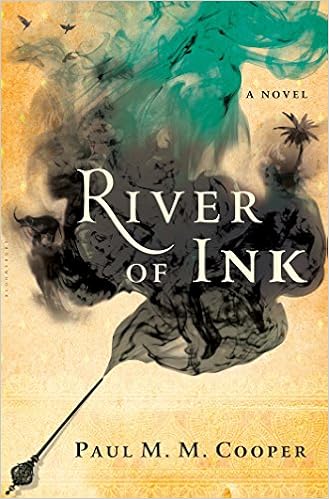
The protagonist is Asanka, a nebbishy court poet to King Parakrama and Queen Dayani of Sri Lanka in the Sinhalese royal capital of Polonnaruwa. After the crown prince Kalinga Magha arrives from the mainland and executes the royal family, Asanka is given the task of translating the epic poem Shishupala Vadha from the more academic Sanskrit into vernacular Tamil in order to promote the culture of the invaders as well as to raise the new king's status for posterity as a bringer of literature, since he has a chip on his shoulder about being the bastard youngest son of his royal family. Unfortunately, the Shishupala Vadha is incredibly difficult to translate well, being both dense in complex poetic imagery and heavily reliant on ingenious structural tricks (anagrams, palindromes, double meanings, visual puns, etc), and Asanka's burden of an impossible deadline is additionally complicated by the new king's desire to take Asanka's mistress Sarasi as the new queen. But if Asanka can keep his wits he can keep his head, as he plans an escape with Sarasi and embeds secret messages of defiance into his translation for the commoners to rally around. This subversion of Magha's desire for fame with unflattering comparisons to infamous tyrants is a sort of inverse of Virgil's flattering of Augustus in the Aeneid by linking the imperial dynasty to glorious Homeric myth.
At first I had some complaints about the novel's characters and themes. Even though it's written as a first-person diary/letter to Sarasi, Asanka generally comes off like a rich but uncharismatic dilettante, so it's hard to figure out why the two other main characters put up with him so much. Sarasi is much tougher and self-reliant than he is, to his chagrin, and her affection for him doesn't really seem warranted by his actions, which mostly range from uncaring and distant to cowardly and embarrassing. It seems like she would have dumped him a long time ago, even despite his influence with the new king, and the enduring sincerity of her feelings is out of proportion to anything he does on the page. Magha's continual trust in Asanka until almost the very end of the novel is even odder: a brutal conqueror without a lot of compunctions against killing those who displease him overlooks a long series of incredibly suspicious acts by this holdover poet from the old regime, and Asanka does not seem to have such a high Value Over Replacement Poet that Magha wouldn't have had him executed and replaced several times over. I realize that keeping Asanka alive was necessary to accomplish a few threads of dramatic irony - pay attention to the repeated lament that "poetry makes nothing happen", reader! - yet the sudden appearance of drought-breaking rain at the climax of the novel where the subversive power of literature is exhibited is just too perfect. Even Asanka's fear of elephants gets a callback right before he's reassured that, actually, poets are the real heroes, and the ending revelation of who had been writing Asanka helpful secret messages related to his work is groan-inducing.
But on further reflection these criticisms miss why Cooper set those things up that way. The novel is a deliberate echo of the great poetic epic that Asanka is translating, and just as the deliberately florid similes that various characters deploy attempt to connect the frequently-insufficient power of language to the real qualities of the thing they're trying to describe, the often-stylized actions of the characters connect the messiness of reality to the larger-than-life archetypes that populate the Shishupala Vadha. Asanka doesn't seem good enough for Sarasi to the reader; well, he doesn't seem good enough to himself either! Especially not when all he does is scribble words on the page, what a waste of time... until his works turns out to be actually meaningful to people. It's easy to lose count of how often the characters, Asanka included, denigrate literature ("poetry makes nothing happen"), but we're fooling ourselves if we think it doesn't matter, and even if words aren't real, they have real effects through our beliefs. Cooper did a marvelous job bringing this world of smoke, ink, and rain to life. A fantastic debut novel.
Friday, November 16, 2018
Book Review: George MacDonald Fraser - Flashman

It's a really neat trick: Flashman's interior monologue is unfailingly unpleasant, but his universal cynicism doesn't spare himself or his fellow British as they arrogantly bumble themselves into a hostile occupation of an unwilling country, pointlessly disrupting its politics and eventually getting over 15,000 soldiers and civilians massacred in the the unmitigated disaster of the 1842 retreat from Kabul. Along the way, Flashman's only principle is to look out for #1, as he advises the reader to do as well, and by the end of this sarcastic demolition of the hero myth, where he's given a visit with the Queen and celebration as a hero, universally lauded by a public ignorant of the real truth, you're forced to admit that he has a point: everyone else in this book is awful too. Don't let the vintage jingoism distract you from a surprisingly fun, insightful, and historically rich adventure story. Better yet, it's the first of a dozen.
Tuesday, November 13, 2018
Book Review: Lauren Groff - Florida

Sunday, November 11, 2018
Book Review: Chapo Trap House - The Chapo Guide to Revolution

This book is fine, read it if you like the show. But I want to spend some time talking about the Iraq War, because both the book and the show would be incomprehensible without first understanding the long shadow cast by that moral failure. The Iraq War is why I'll never vote Republican, why I didn't vote for Hillary Clinton in 2008, and why many still couldn't vote for her in 2016. At age 34 I don't think I'm alone in my thinking, and even younger progressives have to grapple with the fallout of many prominent Democrats failing that moral test and giving in to the Republican urge to war. If you're a liberal, what do you do with the inescapable knowledge that many of the politicians and pundits that define your party and your ideology voted to support the completely unnecessary deaths of hundreds of thousands? The cowardice of Clinton, Kerry, and so many others has come to define liberalism for leftists, offering a crystal-clear example of the ethical bankruptcy of compromise-first liberalism, and it presents a real problem for anyone interested in a system of politics that can beat the hate/fear/greed of the right. The contempt that Chapo has for mainstream Democrats is amply deserved, and I won't make excuses for those Democrats who voted for that stupid, senseless, evil war.
But, as I read the many long sections of the book making fun of the Diet Evil tendencies of liberalism, recognizing that the Iraq War vote was the prism through which all of liberalism was being viewed, I realized that it's important to understand the structural reasons that encouraged Clinton etc. to make such an obviously dumb vote, since this sort of thing happens again and again in all sorts of contexts. Exactly why did all of these people, routinely pilloried by their enemies as far-left extremists, supinely acquiesce to these transparent lies and indeed actively defend them, to the bafflement of actual far-leftists?
The historian Adam Tooze once laid out a fascinating explanation for why the German Social Democratic Party decided to support funding for World War 1 (bear with me here, it's the 100th anniversary of Armistice Day and it's on my mind), and though the phrase "It's time for some game theory" is beyond parody at this point, adapting the 2 x 2 decision matrix in Tooze's lecture 14 of his WW1 series to the Iraq War is surprisingly revealing. On the show Chapo correctly pays a lot of attention to the media because media perception is often reality (indeed, they fulfill the role of the media themselves for their listeners in the same way as the much-reviled Daily Show did), and the credulous, self-important, and hawkish press, deciding that it truly represented "public opinion", played an important role in shaping incentives for the Iraq War:
- If Democrats vote Yes and the Iraq War is a success: Democrats are on the winning side and hopefully seen as strong, righteous, and loyal supporters of victory in the War on Terror; surely Republicans will never attack our patriotism again!
- If Democrats vote Yes and the Iraq War is a failure: This is kind of what Democrats like Kerry were actually saying afterwards in 2004, like "you didn't send enough body armor, or bomb the right targets, or pay enough attention to Afghanistan", in the hopes that voters would prefer slightly more competent warmongers.
- If Democrats vote No and the Iraq War is a success: Democrats would look unpatriotic to the Beltway press, the ultimate horror. Plus, even though winning the Gulf War obviously didn't re-elect George HW Bush, theoretically the American people love winners, and so not being a loser is all that matters.
- If Democrats vote No and the Iraq War is a failure: Hey, don't blame me! Without their fingerprints on it, Democrats look like geniuses, even though according to the popular press only hippies were against the war, and can you really trust someone who isn't willing or even eager to slaughter foreigners?
So from the perspective of prominent Democrats like Clinton or Kerry, petrified of being accused of being insufficiently willing to bomb foreigners, voting No offered only political downside, while voting Yes would, at the very least, claim you would have bombed foreigners better in some hopefully unspecified way, thus allowing you to be dubbed Serious by the people who mattered (i.e., not the foreigners in question). Setting aside the genuinely enthusiastic Democrats, who are thankfully now almost entirely gone, pure political self-preservation was the rule for the remainder.
This calculus of cowardice applies to many situations throughout our history, but the poor SPD does look somewhat better in the historical rear-view mirror: Germany was not actually the bad guy in WW1; defeat in that war would have been, and actually was, far worse for Germany than the US just wasting trillions in Iraq; and by participation in the "patriotic truce" of Burgfriedenspolitik the SPD hoped to gain some much-needed political reforms as opposed to the nothing that Democrats got in exchange for their votes. I completely sympathize with anyone who won't forgive Democrats. Sometimes politicians fuck up, and people die, and no rebrands or glitzy ad campaigns can erase those dead people, and the knowledge that elected politicians are actually afraid of what some circle-jerking idiot news dispensers decide is consensus should give you incandescent rage.
I think that's a worthwhile exercise to go through, because, for all Chapo's completely valid criticisms of mainstream liberalism, like many leftists their response to these hard truths about American politics head-on is essentially limited to jokes. Yeah, a huge percentage of the population is simply awful, the press is not anyone's friend, the system is rigged, the support of elites is usually all that really matters, we're surrounded by freaks and mutants.
All of that is true, and yet a turn to irony socialism and podcast radicalism would not actually avoid any of those obstacles or address any of those problems. Take the press, for example, and how bizarre it is that so many idiots are paid to pontificate on politics at all while wielding enormous power to destroy careers, gatekeep out new voices, and set the agenda. Gary Hart's 1988 Presidential bid was destroyed in a media frenzy over a picture that is laughably tame by today's standards. Howard Dean yelled funny in 2004 and that was it; Kucinich couldn't even get off the ground. Hillary's emails. Donald Trump can barely complete a sentence and he's shown rambling and openly lying for hours at a time, the press eagerly rolling over for it, countless gigantic scandals immediately forgotten, but simultaneously there's no such thing as too much sneering at liberals, and leftists might as well be in a different galaxy. The Cillizzas of the world make doing the right thing very hard, and as satisfying as it is to imagine all of those people in gulags, it's just not going to happen, so how do you work within that awful system? It's like Keynes' famously brilliant "Trotsky On England" book review, and what makes Robert Caro's works so fascinating.
I'm writing this just after the 2018 midterms, which gives both liberals and leftists ambiguous takeaways. Some left-wing candidates did better than centrists, but others did worse. Many states voted for very progressive policies, while simultaneously electing awful reactionaries in landslides. Important media outlets continued to be worthless, because for them it's all a game, and it doesn't really matter who won. What should non-Republicans learn from this election? This is a book of jokes ("Sir, this is an Arby's drive-thru"), but Chapo can't provide a satisfying answer of how they or DSA or anyone else who wants to work around the shambling hulk of the Democratic Party and our rotten electoral system would be able to do better systematically, to avoid the incredibly powerful incentives for good people to do bad things, to have 2018 look like 2006 in another 12 years (remember when the prospect of Speaker Pelosi portended unspeakable Jacobin horrors to come?).
It's immensely frustrating that socialism, of all possible ideologies, seems to have all the moral energy behind it, given what a dead end that is, but perhaps encouraging socialists to participate in the Democratic Party is the only way to keep it grounded. Compromise is not a principle, as they so ably point out, and Robert Frost's line about how "A liberal is a man who won't stand up for his own side of the argument" means that sometimes a party drunk on appeasement needs a sober friend to take the keys away. It would be truly depressing if this was the best political system we could possibly hope for, but since we're stuck with it for now, we might as well laugh along the way.
Saturday, October 27, 2018
Book Review: Robertson Davies - The Merry Heart

First things first: "Fiction and the Future", the penultimate entry within, is by far the worst thing I've ever read from him, a long tirade against science and modernism he delivered in 1994 that comes off less like his typical good-humored uncle persona and far more like a Fox News Grandpa. Now, normally I'm a connoisseur of cranky reactionary rants; I imagine that one of the chief pleasures of getting old is finally having the power to force everyone to listen to every resentful diatribe I've been saving for my dotage, and so I appreciate heartfelt examples of the form. Complaining is a cherished human pastime for us all, and there's no reason that it can't be as fun to read as it is to do. But while science fiction is just about the last genre I'd ever imagine the firmly classicist Davies to ever express useful opinions on anyway, he goes far beyond the considered apprehension of the possibilities of technology I'd expected and unleashes all kinds of frankly stupid resentments on things like genetic engineering and nanotechnology that are beneath him.
Now, Davies was born in 1913, and I would no more expect an avowed "technomoron", as he dubs himself later on, to suddenly reveal an Isaac Asimov futurist side than I would my grandmother (who also attended Queen's University just a few years before he did). I mean, there's a whole other essay in here, "Literature and Technology", complaining about all writing technology newer than the typewriter; he just wasn't made for these times. Still, it's unpleasant and unnecessary to read these tirades about political correctness and how modern society is making science into a new religion that could have come from any bargain-bin Wall Street Journal op-ed hack. He does have some decent riffs on the kinds of plots that technology permits a writer (for example, he prefigures the movie Gattaca during his genetics meanderings), but the tone is almost shockingly ill-tempered, and I hope for everyone else's sake that my eventual senescent harangues won't be this bad.
What's especially jarring about "Fiction and the Future" is that "Literature and Technology", which deals with extremely similar concepts from a different angle, was written just 5 years earlier in 1989, and it's great. Instead of asking what technological advancements will do to the contents of novels, it's about how technology relates to the writing process itself. Predictably, Davies justifies his dismissal of newfangled inventions like word processors with the standard old dog/new tricks argument, as well as various clever metaphors about the distinction between quantity and quality. "Mere bulk is not the measure of a literary artist's capability. He does the best he can, and like a cow we judge him by his butterfat content and not by the number of pails he fills."
Yet, as you would expect for a writer so fascinated throughout his career by the power of the irrational currents sweeping throughout our subconscious minds, his real argument is that technology is fundamentally orthogonal to creativity, and the real questions we should be asking are about where the forces of truly great fiction spring from to begin with, and not how they're translated to the page. Part of it is unaccountable genius, part of it is keen observation, part of it is hard work: "To ask an author who hopes to be a serious writer if his work is autobiographical is like asking a spider where he buys his thread. The spider gets his thread right out of his guts, and that is where the author gets his writing, and in that profound sense everything he writes is autobiographical. He could not write if he had not seen it and felt it deeply." The true effects of technological progress on creativity might forever remain ambiguous; if the internet is any guide, technology enables good writers to get better but also makes bad writers worse. But Davies' final points about the inability of writing aids to duplicate inspiration or style, while perhaps overstated (I've never heard anyone complain that it's too easy to search electronic notes), clearly do have some merit.
"Literature and Moral Purpose", from 1990, is a real treat. One of the reasons Davies loves Dickens so much as a reader is that Dickens was really good at creating memorable characters who experienced morally charged events in a relatable way; as a writer, Davies has the highest respect for his ability to organically communicate inner pathos out to the audience. The real secret to creating such immersive worlds in his view is not so much a good prose style, though that doesn't hurt, as he discusses in more detail in a future speech, but primarily the ability to ask tough questions, and then being willing to follow them wherever they lead. I can't do better than to quote him at length:
For me [a moralist] meant not someone who imposes a moral system upon his art, but someone who sees as much of life as he can, and who draws what conclusions he may. What courses of action lead to what results? Are there absolute standards of good and evil? To what degree is what appears to society rooted in the truth of a particular man or woman? To what degree may the acceptance of a popular or socially approved code of conduct define or perhaps distort a character? Where do the springs of behavior lie; to what degree may they be controlled; how far is a human creature accountable to his group, or his country, or his professed belief (or unbelief) for what he does? How far is it permissible to talk of what a human creature 'makes' of his life, and to what degree does an element of which he may be unaware in himself 'make' his life for him? How far may we accept the dictum that life is a dream, and that we are the creatures in that dream, which is being dreamed of which we have no knowledge? These, it seems to me, are the concerns of the true moralist. He is an observer and a recorder; he may not permit himself to be a judge, except by indirection.
Good questions! That last part is perceptive, and is a great part of what separates great authors from lesser ones. For example, Ayn Rand was a huge fan of Victor Hugo (my copy of Hugo's Ninety-Three has a lengthy introduction by her), and her novels are clearly meant to deal with moral subjects of the kind that Hugo did, in much the same Grand Epic Novel way. But while Hugo tries to draw complete portraits of human beings struggling with weighty choices, connecting even bitterly opposed characters to sentiments and desires common to all humanity, in Rand's hands there is no illusion whatsoever of being in a real world with real people, because she's already got the answers, and the characters are just means to that end. As other perceptive works of literary analysis like René Girard's Deceit, Desire, and the Novel also discuss, the essentially imitative process of our moral struggles means that are no definitive answers to life's moral questions even in theory; to be alive is to question, because if someone had figured out how to live the perfect life in a way that can be duplicated, you'd know it by now. As Davies says, in the meantime all we can do, and all writers can do, is think deeply about deep questions, and faithfully transcribe our partial answers as best we can.
He expands further on the craft of writing in the second of a pair of speeches he also gave in 1990, straightforwardly titled "Reading" and "Writing". "Writing", as expected, is all about what sort of attitude makes a true writer, as opposed to a dilettante. I agree with him that writers are born needing to write in some sense. Even though Davies himself didn't start on his novels until he was 38, he'd been a journalist and playwright before that, and the vast asymmetry of difficulty in literature production versus consumption means that although plenty will try writing, very few will persevere to be writers. I'm always cheered when I read that authors I like didn't start until late; even if it would have been better to start earlier, in order to give the world more of yourself, better late than never, right? But in a way, it might be better for some writers to assemble some stability in life before they attempt their art. The life of an author is famously unglamourous because writing is in a sense using the author to produce itself. Davies makes fun of a magazine targeting credulous aspiring writers who are "unsophisticated enough to believe that writers live marvellous social lives, eat and drink very high on the hog, and have access to unlimited apocalyptic sex." By no means are all writers miserable wretches, but often misery and wretchedness are unavoidable companions. All this, though, is secondary to his discussion of "shamantsvo", a term Vladimir Nabokov plucked from Russian that loosely means "enchanter-quality" (as in "shaman"). This is style, language, skill at communicating to the reader. He doesn't cite the famous quote, which like many others is often arbitrarily attributed to Oscar Wilde, that writing is "spending all morning inserting a comma and spending all afternoon taking it out again", but his discussion of the eldritch art of using the right words to make the right feelings come across in the right way is, as you would expect, full of apt phrases.
"Reading", the other half of that pair, is notable because in comparison to the number of pieces on how to write well, you see far fewer discussions on how to read well. We're all familiar with statistics showing a general decline in number of books read, thanks to TV/the internet/video games/etc, but what would it mean to see a similar decline in comprehension? That's inherently a subjective measure, so Davies appeals to elite understandings of what it means to "read well"; he gives an example of a fellow student from long ago who had done all the required readings for her English degree but remained unedified by it. For Davies, to be "well-read" in the best sense is to cultivate your sympathies and ability to feel. As he's elsewhere alluded, this mental and moral ability is not something that is enhanced by technology (I can only imagine what he'd think of the distracting power of the internet or the smartphone), or anything that reduces our ability to pay the kind of close attention that he associates with a real aesthetic experience. Superficial reading is like listening to a symphony as background music, or treating poetry as abstract word patterns, or experiencing any type of art as something other than the main thing that you are doing. If you are reading, then read! Often real appreciation comes from rereading, which sadly is something I myself have done less of these days. He quotes a now-forgotten author John Middleton Murray: "a truly great novel is a tale to the simple, a parable to the wise, and a direct revelation of reality to a man who has made it part of his being." I've gotten a great deal out of rereading, and much like I've listened to my favorite albums to the point where the notes become my thoughts, perhaps I need to slow down and revisit a few of my favorite novels. Even if you're not out to be a member of the "clerisy", just about everyone could benefit from tips on being a better reader, and who doesn't want to be among "those who read for pleasure, but not for idleness; those who read for pastime but not to kill time; those who love books but who do not live by books"?
Another of the more interesting speeches is 1992's "World of Wonders", which deals with a stage adaptation of his novel of the same name, the final volume in the Deptford trilogy. Davies REALLY dislikes having to explain his novels to people (some variant on "if you want to know what it's about, just read the damn thing" appears in several other speeches), but here, when he talks about what it means as a fellow playwright himself to see someone try to translate his novel to a very different medium, he spends a bit of time of time on the differences between how the two forms attempt to compare the same ideas, and a surprising amount of time on the ideas in the novel itself. A play can dispense with much of a novel's abstraction, and condense many pages of action into just a few scenes, but the tradeoff is that in a play, you can't really just have a character explicate a subtle theme that's taken many chapters to develop with a line of dialogue saying "boy, several people's experiences of the same life event can be very subjective, and small actions can have large and unpredictable effects, and all of us contain unexpected multitudes, and life pitilessly destroys our illusions with extremely painful lessons", without it sounding just as awful as that. He spends some time insisting that his own idiosyncratic experiences with and understanding of religion are at the heart of his work, but I think "You gain the mastery of your art at the cost of your innocence" is an aphorism that stands above whatever your relationship to Jungian psychology is. Either way, it's always a treat to talk about subjects he knows so well.
Some other good essays cover Christmas, a topic near and dear to his heart. 1991's "Christmas Books" discusses how essential it is to really believe in the magic of the holiday to write a good Christmas story. Like in the other speeches where he insists upon the primacy of the non-rational, be it traditional religion or modern psychologies, to him there must be something otherworldly about a Christmas tale in order for it to be effective, or otherwise it's just a story that happens to be set around December 25th. I'm reminded of the perpetual nerd debate over whether Die Hard is "really" a Christmas movie; perhaps he's right, and without some openly supernatural event or happening beyond the mundane, you haven't really captured the spirit of Christmas. As you'd expect, Dickens' A Christmas Carol is exhibit A, as it also is in 1993's "An Unlikely Masterpiece". This one is great for how well he conveys Dicken's abilities as a showman, both as a crafter of spellbinding stories, and as a performer when he would read his own works. When I was at the Dickens Museum in London a few years ago, there were many exhibits that discussed his tours, and Davies really conveys well how brilliantly Dickens bridged the divide between the page and the stage. His love of show, his tugging on heartstrings, his embrace of the supernatural to reveal new truths of the world, his larger than life persona - it's no mystery at all why such an extraordinary work has had such a lasting presence in our literature, and in our drama, and in our repertoire of art that conveys essential truths about the most beloved time of the year.
There's more of his speeches and essays to discuss, but as he might say, why read about them when you could just read them? For the most part, you will find exactly what the title promises: an author somehow still near the top of his game, having a grand old time trying his best, with all of his considerable skill, to get you to have one as well.
Friday, October 26, 2018
Book Review: Warren Treadgold - A History of the Byzantine State and Society

While the Roman Empire will forever be more highly esteemed by laymen for how they steadily assembled their pan-Mediterranean state (everyone loves watching winners conquer one enemy after another), over the course of the book I developed a grudging and then unabashed respect for how the Byzantines did their best to adapt that rigid, ethnocentric, coup-prone Roman governance model to maintain a surprising amount of coherent identity in a multi-ethnic, multi-faith, multifariously-threatening world. They may have failed eventually, but you try creating an empire that lasts for over a millennium!
One of my main thoughts when reading was that I'd been previously been underrating the Great Man theory of history, or at least the ability of powerful individuals to redirect nations on different courses. Treadgold is scrupulously polite towards even plainly inept rulers - he will refrain from more than a few mildly critical adjectives of inarguably terrible emperors, and well-meaning emperors who had events beyond their control wreck their reigns get "he did as best as could be expected given the circumstances" - but it's striking how even the vast machinery of an ancient empire could be utterly upended by the whims of its leader. Peter Turchin's Seshat project, as well as his structural demographic theories of imperiogenesis and imperiopathosis in books like War and Peace and War, remain invaluable for understanding broad historical trajectories and "inevitabilities", but as I read the various expansions under successful emperors like Justinian I, Constantine VII, and Basil II, and the following contractions under unsuccessful emperors like Valens, Phocas, Romanos IV, and many others who ruled for about 10 minutes, I started trying to construct a mental model of the empire's varying health, with the ruler at the top of the pyramid:
- "hard" quantitative factors like GDP, population, territory
- "soft" qualitative factors like religious concord, social unity, "asabiya"
- random accidents and enigmas of chance
- personal qualities of rulers
Obviously no ruler, no matter how personally gifted, could completely prevent a plague, a revolt, or an invasion of Persians, (or Bulgarians, or Serbs, or Arabs, or Turks, or Crusaders, or...), and plenty of perfectly capable individuals suffered grievous misfortunes, yet it was striking how frequently, given the nearly unlimited authority vested in the emperor, their mistakes had vast consequences that took decades or even centuries to correct, if at all. In this the Byzantines were hardly unique, of course, but their exceptionally long existence gives you many more opportunities to watch one emperor carefully save money, reconquer land, and heal religious divisions, only for his idiot son to ruin everything and waste golden opportunities to defend against their enemies. This fundamental instability was exacerbated by their tendency towards conspiracy, famously memorialized today in the adjective "byzantine". Here was one of my favorite incidents of conspiracy, from the year 780 AD, in the midst of the Iconoclasm debate:
Irene, an orphan in her mid-twenties from the shrunken provincial town of Athens, had keen political instincts, a strong will, and some devoted allies in the bureaucracy. The precariousness of her position seems to have given her a sense of urgency. A month and a half after her husband's death, she foiled a plot, led by the postal logothete and the domestic of the Excubitors, to put Constantine V's second son Nicephorus on the throne.
There's no exact contemporary parallel, but imagine how we'd react if, in the middle of a near-civil war over whether to make flag-burning unconstitutional, Donald Trump suddenly died, leaving Melania as regent for Barron (ignore Ivanka and Tiffany for a moment), and she thwarted a scheme by the head of the Secret Service and the Postmaster General to put Don Jr in the White House by having them all declared felons and exiled to Guam.
Now imagine that tended to happen every few decades! Every other major power struggled with the same issues of succession and legitimacy to some degree, but despite their impressive longevity the flaws of the Roman governance model were clearly key to Byzantine difficulties. They may not have ever been able to reconstitute the Roman Empire of old (and in fact they wisely stopped trying to reconquer obviously unattainable lands after a while), but while experiments like the senior/junior emperor system, the creation of the Themes, and professionalization of the bureaucracy gradually made the empire more resilient, up until the very last minute they perpetually had multiple claimants for the throne inviting foreign powers to aid them by promising vast rewards, and these allies would of course then immediately turn on the empire for protection money or simple plunder. It's no way to run a country.
The Byzantine religious controversies, which have earned the rightful scorn of scholars going back to Gibbon, are another great example of unnecessary conflict, given the sheer amount of time wasted and blood spilled over them. Diarmaid McCullough's Christianity: The First Three Thousand Years has a lot of great details on how the idea of a single "Christianity" has always been a fiction, as the Biblical material has been layered on top of an enormous variety of existing Mediterranean religious traditions (for a modern analogy, see the way that indigenous Mexican religious elements like the Virgin of Guadalupe, Santa Muerte, or Maximón have been smoothly and syncretically incorporated into a Catholicism that's not quite the same as in Europe or Africa). So to some extent you would have to expect some major disagreements as diverse traditions chafed under a single unified theology, particularly as the Patriarchs determined orthodoxy more or less independently from the geographically and culturally distant Popes in the west.
But to a modern reader it's striking how frequently the empire was nearly brought to its knees at key moments by violent conflicts over arcane controversies that, one thinks, a calmer scholar like Thomas Aquinas would have wasted barely a few pages resolving with some choice Aristotle quotes. Here's a vastly oversimplified cheat sheet I kept for some of the major heresies, in chronological order:
- Arianism - Christ had a separate nature from God, though the two also share one nature in the Trinity, somehow differently than in "correct" Trinitarianism
- Nestorianism - Christ had two natures
- Monophysitism - Christ had one nature
- Monoenergism - Christ had one energy
- Monothelitism - Christ had one will
- Iconoclasm - Images of Christ/God/etc are blasphemous
- Paulicianism - Armenian Gnosticism, taking Christianity back to its mystical roots
- Bogomilism - Bulgarian Gnosticism, taking Christianity back to its mystical roots
- Palamasism - Performing hesychasm (meditative prayer) allows direct experience of the "uncreated" light of the Transfiguration, which is of God yet not the Trinity
Many of those theological controversies acted as synecdoches for those larger questions of cultural identity, of course (as I type this, the Russian Orthodox Church has momentously severed from the Patriarchate of Constantinople over their recognition of a separate Ukrainian Church in response to the Russia-Ukraine conflict, which is the biggest split since the Great Schism in 1054), yet I would love to be able to ask the various religious figures of the era exactly what they thought they were accomplishing by launching one acrimonious empire-wide quarrel after another over these openly meaningless nitpicks while various hostile powers slowly closed in; the phrase "quibbling while Rome burns" comes to mind.
And that doesn't even cover the political, non-theological controversies that had consequences for religious unity, such as the alternations of strong Patriarch/weak Emperor and weak Patriarch/strong Emperor, or the Patriarch and the Pope fighting over bishop appointments and excommunicating each other out of spite. It's poignant to watch the East and West churches slowly squabble each other into the permanent Great Schism for no real theological reason, periodically attempting half-hearted reunions like a broken-up couple that can't quite bring themselves to move on, repeated Crusades and ecumenical councils achieving nothing but greater recrimination.
But again, whatever criticisms you have of the Byzantines, you have to be impressed by their surprising resilience in the face of continuous threats from all directions. While the western half of the Roman Empire collapsed and faded fewer than two centuries after the division under Diocletian, the eastern half maintained its heritage for a millennium. And what the Byzantines did was arguably harder than what the Romans did: it's very common for a single high-asabiya warlike group to expand their empire until there are no more worlds left to conquer, but it's far more difficult to then stably administer that empire, particularly if it's much more heterogeneous (as it should be, if your wars have gone well), particularly if you're not interested in further expanding your territory, and particularly in a high-risk area with multiple vulnerable frontiers. The Byzantines never really tried to conquer outside of what the Romans had built during the Augustan Age, and aside from occasional attempts like Justinian's to reclaim parts of the ancient west, for the most part they simply tried to maintain their territorial integrity against fairly staggering odds.
In some ways the flexibility of Byzantine identity was actually a strength; most but not all Byzantines were Greek, or Orthodox, or followed Byzantine law, or were even necessarily under Byzantine rule, so the movement of the frontiers back and forth was not as immediately traumatic as it could have been. When Greece finally won its eventual independence in the 20th century, that its capital was not at Constantinople and its borders excluded the Ionian coast was due to the expulsion of the Greeks after the 1922 war with Turkey, which easily could have turned out differently, and thus had the collapse of the Ottoman Empire unfolded slightly differently, the entire Aegean might still reflect the political, cultural, and ethnic boundaries of a thousand years ago. There are also other legacies, less prominent but just as enduring, in Russia, Bulgaria, Turkey, Armenia, Italy, and everywhere else that was once part of the empire.
There's too much more to say about the Byzantine Empire, so I will just compliment Treadgold on his intensive research (many of the photos of Byzantine churches are credited to him and his family) and skill at presenting a coherent narrative out of nearly a millennium and a half of history, much of which was built out of inherently unreliable ancient accounts. The analyses of how art, architecture, and literature were affected by the political upheavals were great, my primary complaints being that I wanted more, even if the book would have been swollen to many times its already considerable length.
In fact at many points I wished he had digressed a bit more, such as on how Islamic resistance to religious images affected the Christian iconoclasm debate, or the downstream effects of Byzantine missionaries inventing the Cyrillic alphabet, or political relations with the western states, etc, even if those were tangential to the main story. An updated edition would be nice after 30 years, but his history seemed fairly solid, and I'd bet that newer research would only enhance his conclusions. Treadgold is vivid enough at presenting the power struggles to the point where I frequently found myself doing that history nerd thing where you look up from the book and start making completely spurious analogies. This is as good as history gets for me.
Monday, October 1, 2018
Book Review: John Stuart Mill - Autobiography

His account of his childhood is fascinating. His father James Mill decided to raise him as a sort of knowledge-seeking missile, giving him nothing but impossibly ambitious classical homework and barely letting him interact with other children. The contrast between the dry tone of Mill's description of his father's methods and the profoundly ambivalent effects it obviously had on him is striking: Ancient Greek lessons at 3 years old, Latin at 8, rhetoric and history philosophy, all with scholastic discipline and criticism that sounds nearly as bad as the infamous British boarding school punishments of the day, because although his father never beat him, imagine having your father yelling at you because your elocution when orating a speech by Demosthenes at age 12 was not quite up to par.
I was a fairly bookish child, so a boyhood of not having to go to school and just reading all day doesn't sound so bad, and yet I doubt that force-feeding you child literature like that is useful. A 10 year-old's interpretation of Thucydides can only ever be so good, right? This steroidal homeschooling did produce one of the most famous philosophers of all time, but it's not a surprise that although he respected and admired his father, Mill calmly states that he didn't love him. He would later endorse government-funded (though not government-run) mandatory education in On Liberty, so this reluctance to endorse his own schooling method is pretty interesting. One can only wonder if he would approve of the "guided self-direction" of the Montessori method as being a happy medium between the austere Plato's Republic-style force-feeding of his youth and the often-inflexible public school system we have today, or what he thought of Rousseau's system in Emile.
Of course, there's only so much you can learn from your father, even if your father is himself a major philosopher, so it's fortunate that James Mill knew many of the leading philosophic lights of the day. Mill spends many pages talking about how his personal relationships with David Hume, David Ricardo, Jeremy Bentham, etc. as a child and young man influenced his later thinking. James Mill was an autodidact himself, perhaps he wanted to try to hurry up his son's enlightenment by giving him access to people who had already read all those books. In a way that's almost more interesting than his homeschooling background - if you deliberately unleashed your kid on your smartest friends and let them ask as many questions as they wanted and your friends would tolerate, how would that mentorship affect them? Bentham was the main influence, of course, but Mill came into contact with many people who already were or would later go on to be very significant (he himself would become godfather to Bertrand Russell), and Mill is very perceptive about what he took and what he rejected from his mentors.
There's an inherent tension between trying to devise an authentic personal philosophy that's true to yourself, on one hand, and on the other to race ahead as fast as possible, to stand on the shoulders of giants by learning from other people as much and as quickly as possible. I think that's where judgment and discernment come in, because ultimately you need the ability to say no to people, to choose what's important from what you take in and discard the rest, and indeed one can take much of Mill's philosophy as instructive guidance on how to choose wisely, not just between ideas but between anything.
And yet we are not mere utilitarian calculating machines, as Mill illustrates with his account of his spiritual crisis at age 20. It's a fascinating account of how he found that he was unable to derive personal happiness purely by the maximize pleasure-minimize pain ethos that underlay his own philosophy. One day in the autumn of 1826, he wasn't feeling so great (it sounds sort of like one of those Sunday afternoons that Douglas Adams so memorably described as the long dark tea-time of the soul), and he started asking himself some tough questions:
In this frame of mind it occurred to me to put the question directly to myself, 'Suppose that all your objects in life were realized; that all the changes in institutions and opinions which you are looking forward to, could be completely effected at this very instant: would this be a great joy and happiness to you?' And an irrepressible self-consciousness distinctly answered, 'No!' At this my heart sank within me: the whole foundation on which my life was constructed fell down. All my happiness was to have been found in the continual pursuit of this end. The end had ceased to charm, and how could there ever again be any interest in the means? I seemed to have nothing left to live for.
There are a truly remarkable number of thought-provoking questions embedded in that paragraph that he answers explicitly or implicitly in the remainder of the chapter:
- Is it actually possible to find true happiness in abstract thought, in any degree? For anyone, or just some? Even if it was possible for you, would that happiness be sufficient? How do you balance the importance of your own "life of the mind" with the rest of your life?
- How does your own personal temperament affect your philosophy? Is something like utilitarianism more or less likely to be believed by happy people? Does switching (or reaffirming) belief systems really change your happiness in the long run, like feeling more confident in a nicer outfit? Can you think yourself sad?
- How important are our own beliefs about the world to you, not just your answers to "big questions" but even minor tastes and opinions? What would it mean if something you thought you really loved turned out to be empty, or flat wrong, or even actively negative to your ego?
- If you don't find joy in something's ultimate conclusion, can there be anything positive about any aspect of it at all? Can you go through the motions of something and be happy, or do you need to excise the whole thing, root and branch, and move on? Does being unhappy that something failed mean that there's still something valuable there, or is unhappiness synonymous with exhaustion?
- As we go through life, does it matter at what age we have big mental paradigm shifts? Is it better to have a crisis of faith when young so you can "course correct" more easily, later so that you don't have to live through as much disappointment, or are quandaries time-invariant? How much depends on the quandary, and how much depends on you as a person?
- When you fall down, how do you find what will pick you up? Is it better to just distract yourself until you feel better and go back to what you were doing, or deliberately start on a different path? What role do other people play?
Mill spent some time depressed, then picked himself back up, rebuilt his entire value system from the ground up, and then went on to become one of the most important philosophers in modern history. That's how it's done, folks! His discovery that happiness is often easier to find when you don't chase it too directly is hardly original, but given that it's a much easier maxim to hear than to actually live, you can hardly hear it repeated too frequently. How many goals have we chased in the idea that when we reach them we will finally be satisfied, only to find out that we needlessly caused ourselves and others unhappiness along the way to an empty and unfulfilling end? How many are we still chasing right now?
A more uplifting human interest point in his life story is his relationship with Harriet Taylor, the woman who would later become his wife. One of the downsides of being raised as a child prodigy apart from your peers by a humorless father who cares mostly about your ability to recite ancient Greek is that it's not great for your sex life. On the flip side, when he met Harriet that repression gave him an admirable devotion to her, sustained platonically at the beginning since she was married at the time and then not-so-platonically after the husband conveniently died and they could then get hitched. It's a good reminder that there's no one right way to go through life, and even if you've got baggage, or what you're doing seems scandalous (there's no evidence that Mill was ever a homewrecker, but really really close friendships with someone else's spouse are red flags in any era), it's possible to come out the other side happy and fulfilled.
Not that anyone would recommend his path to happiness, probably least of all Mill himself, but in spite of their irrationality and generally low odds of success, I think "love finds a way" stories will always find an audience, since very few of us ever take the straight line to happiness. I am honestly jealous of his appreciation for his wife as a person and a philosophical companion who complemented him. As he says: "What was abstract and purely scientific was generally mine; the properly human element came from her: in all that concerned the application of philosophy to the exigencies of human society and progress, I was her pupil, alike in boldness of speculation and cautiousness of practical judgment." He doesn't spend too much time outlining his grief at her death after only 7 years of marriage, but he clearly missed her very deeply, both as a companion and as a fellow philosopher.
One thing that separates Mill from the overwhelming majority of philosophers both ancient and modern is that he was actually a member of the House of Commons for a time, and not merely a writer. Like Marx said, "The philosophers have only interpreted the world, in various ways. The point, however, is to change it!" It's all well and good to sit down at your desk and construct a paper paradise, but actually rolling up your sleeves and participating in the ugly moral compromises that politics requires is very different, particularly in that pre-Marx era when advocates of socialism were basing much of their reform proposals on models of primitive communism, which were as much of a dangerous distraction in the Industrial Revolution as they are now.
Unsurprisingly, his main issues were all related to fairness: universal suffrage, reducing corruption, and instituting proportional representation. He was unhappy that no one liked his proposal that the more educated be given more votes than the less educated, which sounds anti-egalitarian, but compared to the contemporary explicit bias towards property-owners or the modern implicit bias towards rural voters, it sounds downright reasonable. He was critical to the development of British Liberal Party, but was himself reluctant to fully embrace party labels, preferring to be his own man, and when it came down to tough choices, as it did for him when considering Gladstone's Reform Bill, he was a stick-to-your-guns kind of guy even at the potential cost of passage:
I had always declined being a member of the [Reform] League, on the avowed ground that I did not agree in its programme of manhood suffrage and the ballot: from the ballot I dissented entirely; and I could not consent to hoist the flag of manhood suffrage, even on the assurance that the exclusion of women was not intended to be implied; since if one goes beyond what can be immediately carried and professes to take one’s stand on a principle, one should go the whole length of the principle.
For the most part his views as expressed here only reinforce my idea of Mill as a thinker tirelessly trying to find the most logical way to systematize and thus extend morality. As a member of that unhappy tribe of non-socialist liberals, without the helpful guiding light of a dogma, many of his difficulties with his fellow legislators stemmed from his insistence at trying to universalize moral concepts in a system that encouraged parochialism. For example, during the US Civil War there was a real danger that the UK would support the Confederacy instead of the Union out of crass commercial interests (Karl Marx, then covering the war as a journalist for the New York Tribune, also correctly argued against this view at length), and for many British legislators, the Civil War really did seem like those "it was about states' rights" myths you still heard about sometimes: "There were men of high principle and unquestionable liberality of opinion who thought it a dispute about tariffs, or assimilated it to the cases in which they were accustomed to sympathise, of a people struggling for independence."
His friend David Hume infamously said of logic: "We speak not strictly and philosophically when we talk of the combat of passion and of reason. Reason is, and ought only to be the slave of the passions, and can never pretend to any other office than to serve and obey them." You can look at Mill's entire parliamentary career as a struggle to show that moral passion and the highest reasoning faculties are not in fact opposed, although judging by the fact that one of his best and most famous lines is still as relevant today as it was in 1861, his successes are tempered at best: "The Conservative party was, by the law of its constitution, necessarily the stupidest party. Now, I do not retract this assertion; but I did not mean that Conservatives are generally stupid; I meant, that stupid persons are generally Conservative."
The best Mill is his philosophical works, though his accounts of his practical experiences in his career are filled with fascinating little historical asides. For example, I never knew that Mill played such an important role in promoting acceptance of Lord Durham's recommendation for the 1840 unification of French and English Canada, which laid the foundation for modern Canada's creation in 1867 and become the template for the motherland's relationship to the other British colonies. His discussions with famous friends, his disputes with other leading lights, and his recollections of a long and productive life make certain elements of Utilitarianism and On Liberty make a lot more sense; I guess on some level our abstract mental systems of the world can never really be fully divorced from personal experience, and understanding where someone is coming from tells you a lot about where they're trying to go to.
An autobiography might be as much mortification as inspiration, like George Orwell's line about how "A man who gives a good account of himself is probably lying, since any life when viewed from the inside is simply a series of defeats", but Mill had such an exceptionally eventful life that even with his characteristic modesty and understatement it's truly hard to see how he could have written a better or more useful book. His life was his work, and he did a ton of it.
Sunday, September 30, 2018
Book Review: Annie Lowrey - Give People Money

For example, delivering unconditional cash grants via India's Aadhaar program (a vast biometric digital identity scheme tied to pensions, banking, census, and various welfare functions) has had many of the intended poverty reduction benefits, but at the cost of great disruption to established patterns of life; requiring that individuals receive their benefits themselves reduces fraud, but sometimes the system crashes, or someone can't send their relative to pick up the money and has to take off work, or they can't make the side deals they used to. That kind of James Scott's Seeing Like a State central control vs local knowledge stuff would be critical in any kind of implementation, both between countries (would a UBI dramatically increase illegal immigration from countries without them?) and within them (would poor people just waste a non-means tested UBI or otherwise stop entering the labor market?), so even beyond the philosophical question of "should we?", the "how exactly?" question remains.
Science fiction has dealt with these questions for a long time, so in addition to the extensive analysis of real pilot programs, Lowrey touches on what, if anything we can learn from those explorations in terms of program design. The founding text for modern sci-fi worlds of plenty is probably Keynes' famous 1930 essay "Economic Possibilities For Our Grandchildren", where he accurately predicted that by 2030 we'd be between 4 and 8 times as rich as in 1930, but inaccurately predicted that we'd all therefore choose to work much less. Star Trek is the most famous fictional example of a society that has solved the "economic problem" and allowed people to work for fun rather than out of necessity, but the questions of how one would actually acquire wine from Picard's family vineyard or gumbo from Sisko's restaurant were usually left offscreen (Manu Saadia's pleasingly nerdy Trekonomics is cited at length).
For a different take I wish she had also discussed Neal Stephenson's The Diamond Age, in which free replicators simply increase inequality, a fantastically wealthy overclass taking full advantage of technological cornucopia while the proles squander their dole in a manner familiar to Dickens. I think the question of whether free money corrodes the work ethic is an empirical question, and as Lowrey shows, while of course some people in Alaska do spend their free money on luxuries, the idea that most or even many people would waste precious funds is more fantastical than Star Trek, where everyone is an amateur archaeologist or chef or what have you.
There are even some conservatives, like Charles Murray, who advocate a UBI as a replacement for the existing welfare state precisely because it maximizes personal choice in that way, and is not susceptible to the familiar incentive-warping problems of means-tested programs: if a program like Medcaid is only available to those with an income less than $X, the strong incentive not to make more than $X can end up entrenching poverty rather than reducing it, to say nothing of how complex overlapping benefits programs are. However, the seemingly more dystopian concept of a federal jobs guarantee seems to be competing for mindshare as the preferred solution for poverty, particularly among liberals.
I haven't seen a jobs guarantee show up in fiction to a great degree, but as Nick Taylor's superb history American Made shows, in the real world America still depends to a surprising degree on the infrastructure built during the Great Depression by the Works Progress Administration, the first real experiment with guaranteed jobs. The two concepts need not be opposed - I don't see why people couldn't choose to supplement their UBI by also accepting a government job - but it is striking that a UBI seems much more popular among intellectuals than a jobs guarantee, given the historical record of each. Perhaps the worry is that guaranteed jobs could become mandatory jobs, combining the worst aspects of the medieval corvée with Soviet subbotniks. A UBI seems much more difficult to run poorly than a jobs guarantee, but the work requirements that conservative states are trying to inflict upon their Medicaid recipients should indicate that a government that's determined to harass its poorest or most vulnerable citizens will find a way.
Keynes was a big champion of capitalism as the best tool to raise living standards, and ultimately the idea of ending poverty is an economic question as much as a moral one. It may be that truly ending it involves a sort of struggle against diminishing returns: a typical capitalist economy working well enough for most people (80%?), with guaranteed jobs picking up the majority of the slack (15%?), and a UBI covering those few who for whatever reason can't handle employment in either the private or public sectors. The last mile of anything is always the most difficult, but since a UBI covers everyone, it's less susceptible to the "programs for poor people are poor programs" issues that that currently plague America's haphazard, rickety, and often racist welfare state.
The single most difficult aspect of a UBI is the funding structure, and here Lowrey predictably is less able to give useful guidance, since these are bitter political and practical questions. Alaska's scheme is funded from oil, but not only is every state not Alaska, but even Alaska might find its wells running dry someday. As FDR said of his own attempt to fund a UBI for the elderly: "We put those payroll contributions there so as to give the contributors a legal, moral, and political right to collect their pensions and their unemployment benefits. With those taxes in there, no damn politician can ever scrap my social security program."
We don't have as much fiscal space as FDR did back in the welfare state's infant days, so either coming up with new taxes, such as on financial transactions or wealth, or finding acceptable ways to increase existing taxes, will prove the most challenging part of all. But, as Lowrey shows, there's no real mystery to ending poverty - just give people money.
Saturday, September 1, 2018
Book Review: Zachary Mason - Void Star

The world is your standard cyberpunk quasi-dystopia that owes much to Snow Crash (itself an affectionate Neuromancer parody/homage), but without the manic humor or invention of Stephenson's work, so instead of people living in self-storage complexes guarded by armed robot dogs, people just live in grungy favelas, and instead of Sumerian technolinguistic mind-viruses, there's just really powerful Hackers-style algorithms (they literally hack the Gibson in one scene). I also found myself questioning why Mason bothered with 3 narrative lines for the main characters - ascetic street boxer Kern, dying political scion Thales, and Johnny Mnemonic-style hacker Irina - since although they do eventually intersect to fight the requisite evil rich guy and super-powerful AI, their individual quests to uh, find the secret of life/upload consciousness into the computer/become a Japanese swordmaker don't feel emotionally connected at all. Maybe the characters could have spent more time together, or there could have been fewer 2-page chapters to let the story breathe a bit; certainly many aspects of the world could have used some more exploration. I hate ragging on a work by an author I respect so much, so perhaps this will improve on a reread, but this feels like a real letdown, especially because he was able to be so creative with almost literally the most played-out material in history in his last book. I hope he takes more risks in his next book.
Subscribe to:
Posts (Atom)